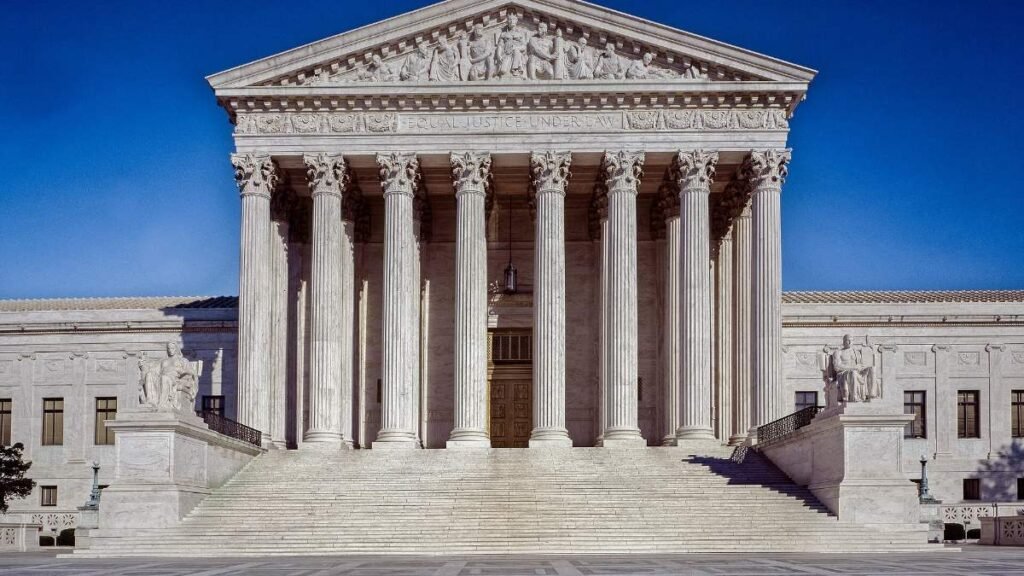
The Supreme Court on Oct. 19 declined to hear a challenge to Chicago’s practice of seizing and selling cars over as few as two unpaid parking tickets, but two justices from opposite ends of the court voiced “serious concerns” about a lower court’s ruling that the program isn’t a taking of private property.
Justice Sonia Sotomayor wrote a statement, joined by Justice Neil Gorsuch, agreeing with the decision not to take the case, O’Donnell v. City of Chicago, while questioning the lower court’s reasoning, according to the court’s order list. The same order list turned away two cases in which police SWAT teams damaged the property of people who had done nothing wrong.
“In Chicago, a driver who fails to pay as few as two parking tickets risks forfeiting his vehicle to the city,” Sotomayor wrote.
How Chicago’s program works
Under the city’s municipal code, a car can be booted once its owner has three or more unpaid parking or traffic tickets that have become final, or two that are more than a year old, according to Chicago’s brief to the court. After booting, the city can tow the car and charge storage fees. If the owner doesn’t pay and reclaim it within 21 days, the city can sell it at auction or for scrap.
The fees add up quickly. The petitioners told the court that owners face a $100 fee for the boot, $250 for the tow and $50 a day in storage, according to their petition. When the city sells the car, it keeps the money, does not credit it against the debt and does not refund anything above what was owed.
The drivers who sued
Ryan O’Donnell had three tickets: two for expired meters and one for parking in a time-restricted zone. The judgments totaled about $524. The city sold his car for its $273 scrap value and paid him nothing, according to Sotomayor’s statement.
Michael Goree didn’t owe any tickets himself. A co-signer on his car owed about $560 on a different vehicle. The city gave Goree’s car to the lienholder, without compensating him.
The petition said the practice affects “tens of thousands of motorists” and called the result “devastating and counterproductive.”
What the lower court said
The 7th U.S. Circuit Court of Appeals ruled in December 2025 that Chicago’s scheme “is an exercise of the City’s police power to enforce its traffic code, and thus isn’t a taking.” The Fifth Amendment’s Takings Clause requires the government to pay “just compensation” when it takes private property for public use, but courts have long held that property seized under a government’s police powers, such as forfeiture of property used in a crime, is not a taking.
The appeals court relied on Bennis v. Michigan, a 1996 Supreme Court decision that allowed the state to forfeit a car used in a crime even though one of its owners didn’t know about the crime.
Chicago told the justices its program is a lawful forfeiture under its police power and “provides for notice at every stage of the process and repeated opportunities to contest,” according to the city’s brief in opposition. The city said owners get 21 days’ notice before booting, can request a hearing after impound and can sign up for payment plans starting at $25 a month, with a hardship plan for low-income households.
Why Sotomayor and Gorsuch objected
“I have serious concerns about that conclusion,” Sotomayor wrote of the appeals court’s ruling.
She argued that the better comparison is Tyler v. Hennepin County, a 2023 decision in which the Supreme Court unanimously ruled that a Minnesota county violated the Takings Clause when it seized a woman’s home over a tax debt and kept the profit from the sale. Unlike in Bennis, she wrote, Chicago’s scheme is not limited to vehicles involved in violations; forfeiture follows from nonpayment, “not the antecedent legal infraction.” If the purpose is to collect a debt, she wrote, Tyler “would seem to control.”
She warned against “the talismanic invocation of the State’s ‘law enforcement authority'” as a way to avoid the Constitution’s compensation requirement, and said federal appeals courts have split on how far a “police power” exception to the Takings Clause reaches.
She agreed to deny review because the split “would continue to benefit from further percolation” and because the petitioners had brought a facial challenge, making the case “not the best vehicle,” according to the order list. She urged lower courts to “carefully and narrowly define” any exception so that “due deference to state police powers does not eclipse constitutional rights.”
Gorsuch, a conservative, has crossed lines on this issue before. In Tyler, he wrote separately, joined by liberal Justice Ketanji Brown Jackson, that the county’s scheme may also violate the Excessive Fines Clause, the ABA Journal reported.
The SWAT cases the court also turned away
The court also denied two cases in which police damaged innocent people’s property while chasing suspects.
Hadley v. South Bend: In 2022, a SWAT team searching for a fugitive with no connection to Amy Hadley’s family fired tear gas through her windows, threw flash-bang grenades and ransacked her house in South Bend, Indiana, according to the Institute for Justice. The fugitive was arrested elsewhere four days later. The damage was about $16,000, SCOTUSblog reported. The Institute for Justice, which represents her, plans to take the case to Indiana state court under the state constitution, WVPE reported.
Pena v. Los Angeles: In August 2022, an armed suspect barricaded himself inside Carlos Pena’s print shop in North Hollywood. After a 13-hour standoff, Los Angeles police fired 25 rounds of tear gas into the building, but the suspect had already escaped. Pena says he lost more than $60,000, which his insurance didn’t cover, according to the Institute for Justice. The 9th U.S. Circuit Court of Appeals ruled against him under a “necessity” exception. Los Angeles argued in its brief that “the Fourth Amendment and due process, not the Takings Clause, holds government actors accountable.”
Neither denial came with a written statement.
What happens next
The denials end the federal cases for O’Donnell, Hadley and Pena. Chicago’s program continues.
Sotomayor’s statement left the door open. By calling this case a poor vehicle because it was a broad, facial challenge, she suggested that a narrower case, brought by a single driver over a single car, could be treated differently.
Documents
- U.S. Supreme Court: Order list, Oct. 19, 2026
- U.S. Supreme Court: Docket, O’Donnell v. City of Chicago, No. 25-1098
- Petition for certiorari
- City of Chicago brief in opposition
- SCOTUSblog: The first relists of the 2026-27 term
Photo: Carol M. Highsmith/Library of Congress.