Updated Nov. 3, 2026: Adds Akhlaghi’s latest warning after U.S. strikes on Qeshm Island, plus Akhlaghi’s Oct. 21 air defense pledge, U.S. warnings to Gulf allies about possible strikes after the Nov. 3 elections, new Qatari mediation, the Pentagon’s latest war cost estimate and a corrected vote count.
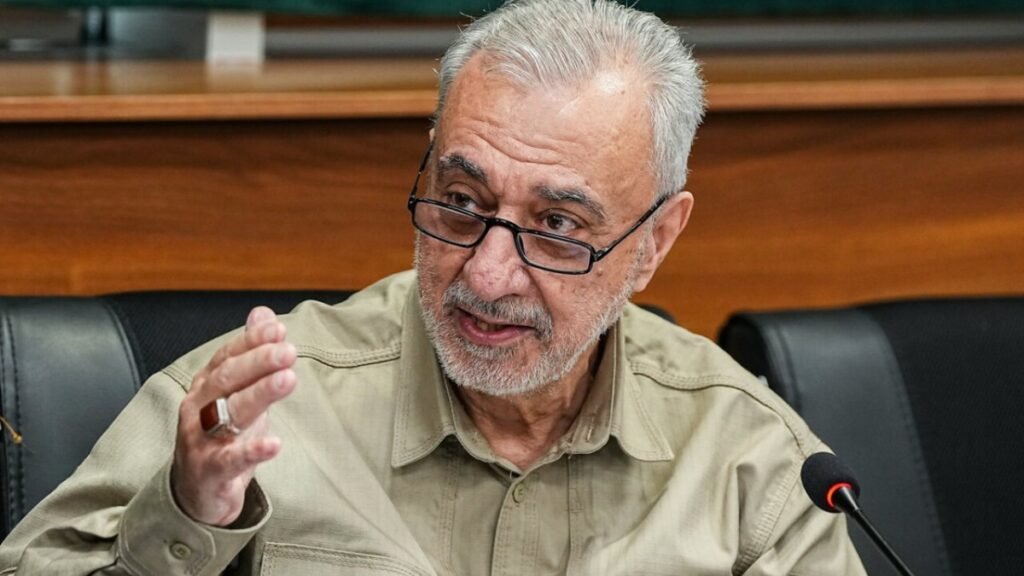
Iran’s parliament on Oct. 18 confirmed Mehrdad Akhlaghi, a longtime head of the country’s arms industry, as defense minister, filling a post left empty since his predecessor was killed in the opening strikes of the war with the United States and Israel nearly eight months ago.
Lawmakers approved Akhlaghi 237 to 15 in a virtual session attended by 277 members, Iran International reported. A member of parliament’s presiding board said 25 of those present could not cast votes because they had no internet access. Within hours, he issued a warning to Washington.
“Members of the Islamic Consultative Assembly today gave a vote of confidence to Mehrdad Akhlaghi,” Iranian state television announced, according to AFP. Xinhua, citing IRNA, said the vote was held in an open session.
“People can rest assured that they will most likely not dare to attack us,” Akhlaghi said after the vote. “If they (the US) do, they themselves and the region will suffer enormous damage.”
Who Akhlaghi is
Akhlaghi has no military rank, so the ministry now passes to an industrial manager rather than a uniformed commander. He has spent 42 years in Iran’s defense ministry and has led the Defense Industries Organization, the state weapons maker, since 2013, AFP reported. China’s state news agency Xinhua, citing Iran’s official IRNA agency, described him as a former managing director of Iran’s Aerospace Industries Organization, which oversees missile development.
The United Nations sanctioned him in 2007 over alleged involvement in Iran’s nuclear or ballistic missile activities, according to AFP.
His formal title is minister of defense and armed forces logistics. The ministry runs Iran’s weapons production, including the missiles and drones it has fired at Israel and at U.S. bases in the region since the war began.
Before the vote, Akhlaghi said the ministry’s responsibility would “fall to me at a sensitive juncture” and that “defending the country requires an accurate understanding of the environment,” according to the Iranian Students’ News Agency, as quoted by AFP.
Why the post was empty
Akhlaghi replaces Aziz Nasirzadeh, who was killed on Feb. 28, 2026, in the U.S.-Israeli strikes on a leadership compound that opened the war, according to AFP. Those strikes also killed then-Supreme Leader Ayatollah Ali Khamenei. His son Mojtaba Khamenei was chosen as supreme leader by the Assembly of Experts in March, Al Jazeera reported.
President Masoud Pezeshkian had named Majid Ebn al-Reza as acting defense minister in the meantime, Xinhua reported.
Iran responded to the strikes with missile and drone attacks on Israel and on U.S. bases, and by tightening its grip on the Strait of Hormuz, the narrow waterway that carries a large share of the world’s oil.
The fight over Hormuz
Akhlaghi takes over as the war at sea escalates. At least 12 ships were attacked in the week to Oct. 16, according to the British military’s UK Maritime Trade Operations center, which said the real number is likely higher, Al Jazeera reported. October has seen more attacks than any month since the war began. Of the 12 ships, one sank and two were disabled. In a separate attack, a tanker was hit by a rocket-propelled grenade fired from a small boat about 144 kilometers northeast of Jubail, Saudi Arabia, Al Jazeera reported.
Both sides claim to control the strait. “The Strait of Hormuz is controlled by the United States and our regional partners, not Iran,” said Adm. Brad Cooper, commander of U.S. Central Command, according to Al Jazeera. He said 400 ships and 100 million barrels of oil had moved through the strait in a week.
On Oct. 17, Iran’s Revolutionary Guards navy said two oil tankers had caught fire after hitting naval mines in the strait, each carrying about 2 million barrels of crude, Al Jazeera reported. Iranian state media said the ships had switched off their positioning and radar systems and used a route “not authorised by Iran,” and one was left immobilized. There was no independent confirmation.
Central Command says it has cleared the strait of mines and that ships are being hit by Iranian projectiles instead. It said an Iranian projectile, not a mine, struck the container ship GFS Pride, which later sank under tow, according to Al Jazeera.
The United States calls its blockade of Iran’s southern ports “ironclad” and says it has cost Iran $25 billion in oil income. U.S. officials also say they have seized $350 million in Iranian cryptocurrency financing, Al Jazeera reported.
Iran’s acting defense minister had warned Washington before Akhlaghi’s confirmation. “Your bombs will explode elsewhere; in your global reputation, the US economy, and even your electoral calculations,” he said, according to Al Jazeera.
What it means for oil
The strait, which runs between Iran and Oman, is the only sea route out of the Persian Gulf for oil from Saudi Arabia, Iraq, Kuwait, the United Arab Emirates, Qatar and Iran itself. Before the war, about 17.1 million barrels a day passed through it, according to Kpler.
Ships are still moving, but far fewer than before the war. About 11.6 million barrels a day passed through Hormuz in the week to Oct. 13, about 68% of the prewar level of 17.1 million, according to the ship-tracking firm Kpler, as cited by Al Jazeera. Brent crude hit $110 a barrel on Oct. 16 for the first time since May.
Akhlaghi puts air defense first as US weighs new strikes
Akhlaghi said in his first days on the job that he would focus on air defense, pledging to meet the needs of the Revolutionary Guards Aerospace Force and the regular military’s air defense branch, The Times of Israel reported Oct. 21, citing the Iranian news agency ISNA.
“Responding to repeated threats is not a contest of rhetoric,” he said, describing his aim as turning threats into greater readiness and stronger defensive capability.
“We are focusing on our objectives with new technologies,” Akhlaghi said. He did not say what those technologies were.
He ended the statement with a vow of resistance: “We will eat dirt, but we will not give up our land.”
His comments came as Washington weighed new strikes. U.S. officials have told several Middle East countries to prepare for possible renewed military action against Iran after the Nov. 3 midterm elections, and for Iranian retaliation, two diplomats briefed on the matter told The Associated Press. President Donald Trump has not made a final decision, they said.
The diplomats said the U.S. described a round of strikes that could last several days and urged allies to protect energy facilities and other critical infrastructure. The United States has not struck Iran since early September, the AP reported.
Iranian Foreign Minister Abbas Araghchi said Oct. 28 that Tehran “continues to give diplomacy a chance to succeed” and is working with mediators on the proposal it floated last month. Iran has said it will reopen the Strait of Hormuz only if the U.S. lifts its naval blockade of Iranian ports.
Talks are still alive. Qatari mediators returned to Tehran on Oct. 30 with a revised draft deal, and Trump said the same day that the war is “going to end soon,” without saying how, CBS News reported.
The bill for the war keeps growing. The Pentagon now puts U.S. costs at more than $47 billion, over 25% above Defense Secretary Pete Hegseth’s July estimate of $37.5 billion, Reuters reported Oct. 28.
Akhlaghi warns of response after strikes on Qeshm Island
Akhlaghi has escalated his rhetoric as the war edges back toward open combat. In a statement carried by the semi-official Mehr News Agency, the defense minister promised an immediate, effective and proportionate response to any threat, anywhere, without geographic limits, ABC News reported. His words echo the order Supreme Leader Mojtaba Khamenei gave the armed forces on Oct. 31.
The warning came as the United States carried out what officials called limited, defensive strikes on Iran’s Qeshm Island in the Strait of Hormuz late on Nov. 2, the eve of the U.S. midterm elections. One U.S. official told CNN the strikes answered Iranian surface-to-air missile fire at American aircraft, and officials said they did not mark a return to major combat. Iran’s deputy foreign minister, Kazem Gharibabadi, said Tehran reserved the right to defend itself.
For Akhlaghi, whose ministry is responsible for rebuilding Iran’s air defenses and missile production, the strikes are an early test of the pledge he made when he took office.
What comes next
Pakistan and Qatar have been passing messages between the two sides, but no breakthrough is expected soon, Al Jazeera reported.
For now, the new minister’s first test is at sea, where Iran’s navy and the Revolutionary Guards are contesting a waterway the United States says it controls.
Sources
- ABC News: Iran live updates, Nov. 3
- CNN: US military conducts strikes on Iran’s Qeshm Island
- AFP via The Times of Israel: Iran’s new defense chief warns US of ‘enormous damage’
- The Times of Israel: Iran parliament approves new defense minister
- Xinhua: Iran’s parliament approves new defense minister
- Al Jazeera: US and Iran both claim control of Strait of Hormuz
- Al Jazeera: Iran says two tankers catch fire after hitting mines in Strait of Hormuz
- The Associated Press: US warns allies to prepare for possible Iran strikes after elections
- Reuters via Military Times: US costs of Iran war rise to over $47 billion
- Iran International: Architect of Guards’ missiles becomes Iran’s defense minister
- CBS News: Iran war updates, Oct. 30
Photo: Hamed Malekpour via Wikimedia Commons (CC BY 4.0).