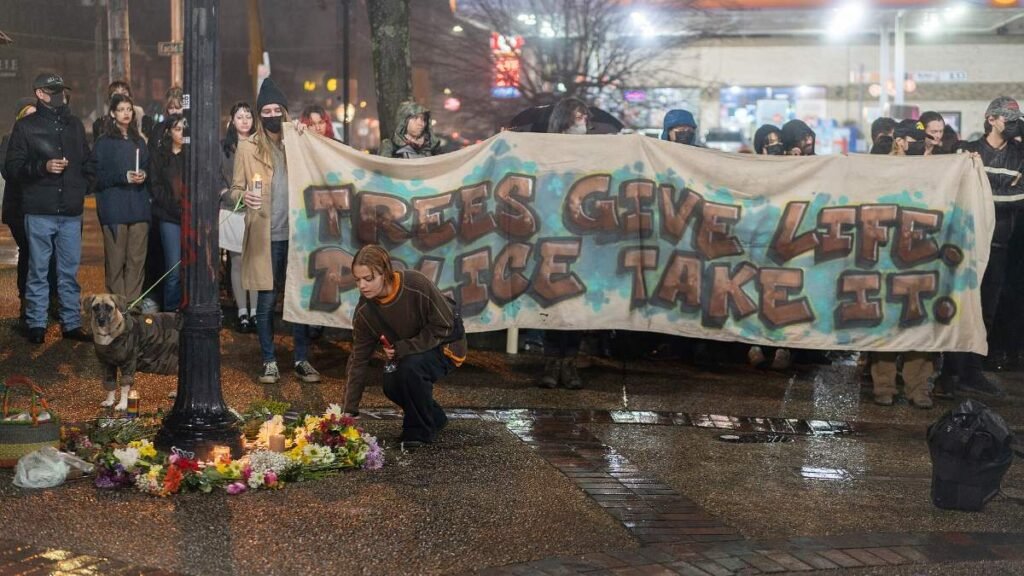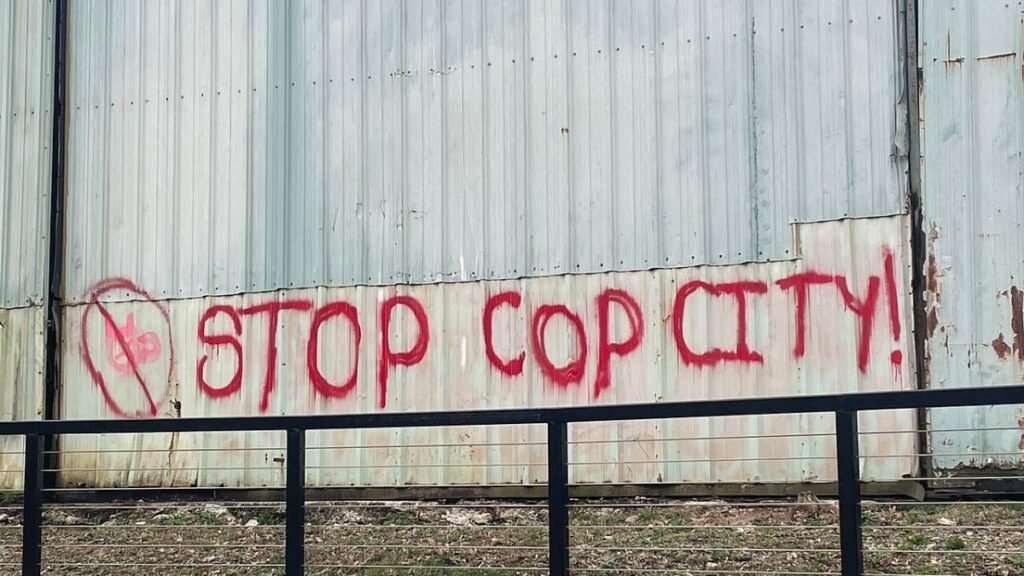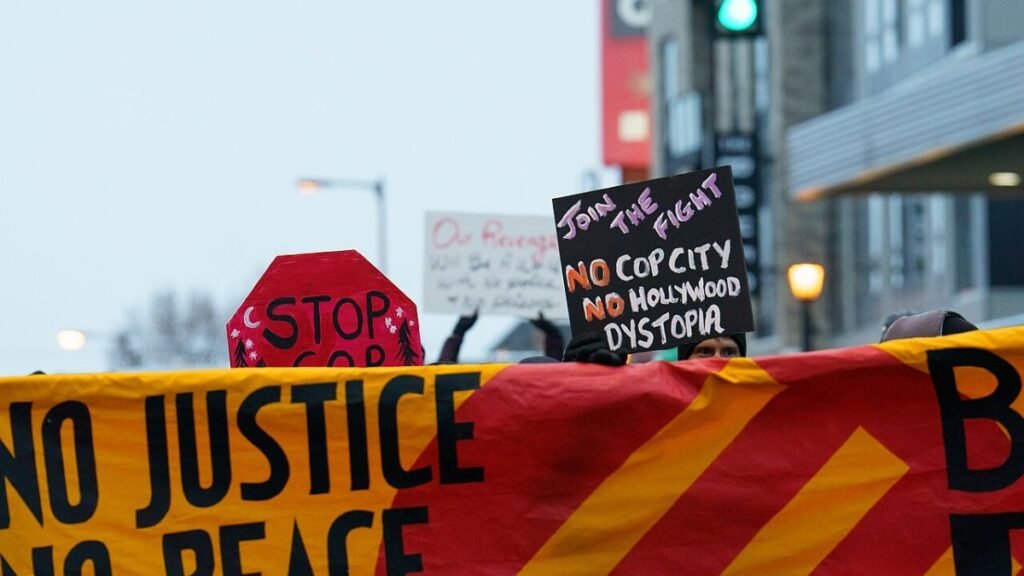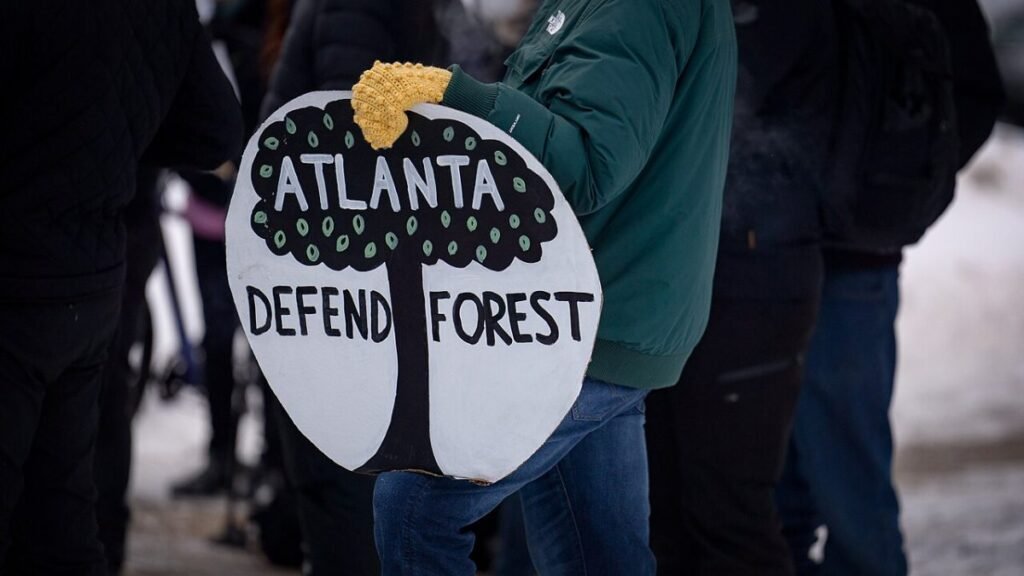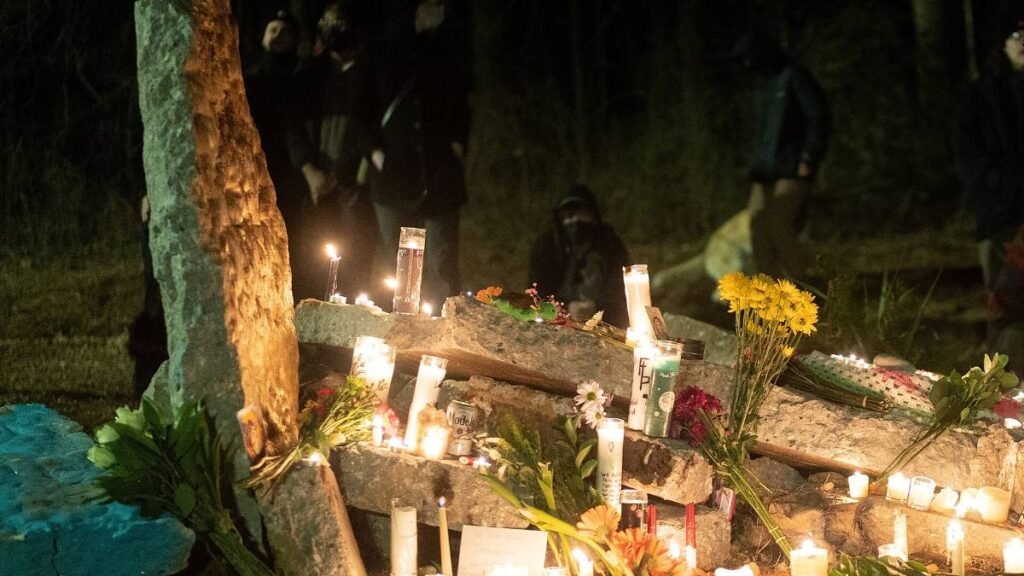
For three years, almost everything Americans heard about Atlanta’s public safety training center came from the fight over it: the tree-sits in the South River Forest, the arrests, the death of an activist, the racketeering indictment. Far less attention has gone to a simpler question. Now that the center is built and running, what actually happens there every day?
Local reporters were given a look inside in May 2026, about a year after the facility opened. Their accounts, along with figures from city and police officials, offer the clearest picture yet of how the $117 million campus is being used, who trains there, and why the debate around it has not really moved.
Key facts at a glance
- Opened: April 2025, after about three years of construction
- Location: 85 developed acres in southern DeKalb County, outside Atlanta city limits
- Reported cost: about $117 million
- Main users: Atlanta Police Department and Atlanta Fire Rescue, plus officers from outside agencies
- Trained so far: about 650 police and fire recruits by May 2026
- Still unresolved: the state’s appeal in the racketeering case against protesters
A campus built to replace parking lots and borrowed ranges
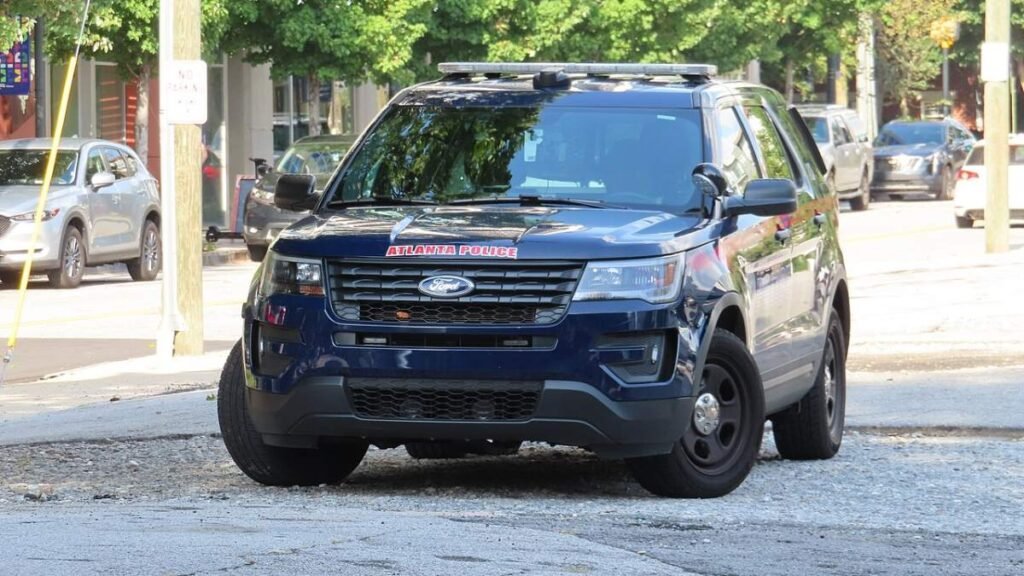
The Atlanta Public Safety Training Center opened in April 2025 on 85 acres in southern DeKalb County, just outside the city limits, after roughly three years of construction. It is used by both the Atlanta Police Department and Atlanta Fire Rescue, and police leaders say outside law enforcement agencies send officers there as well.
Before it existed, training was scattered. According to The Atlanta Journal-Constitution, fire crews practiced driving engines and ladder trucks in grocery store parking lots and outside abandoned strip malls. Police and fire trainees learned emergency driving on city streets or at borrowed sites in Forsyth County and Douglasville. Departments had to block off hours or days to train in other counties, and some older facilities were in such poor shape that crews had to evacuate them.
Fire Chief Rod Smith described the new center as a “monumental” improvement over what came before. Fire Rescue Section Chief Chris Grimaldi put it more simply: crews can now train whenever they need to, day or night, seven days a week.
What is on the 85 acres
The list of facilities explains a lot about both the supporters’ enthusiasm and the critics’ alarm. The campus includes:
- A seven-story burn tower for firefighting and rescue drills, including rappelling.
- A 28-lane indoor shooting range for firearms qualification and training.
- A mock gas station and convenience store used for police scenario training.
- A rail line with several rail cars, donated by Norfolk Southern, for hazardous materials drills.
- A wetted skid pad and closed driving course for emergency vehicle training.
- A firehouse, classrooms and horse stables, plus buildings designed for active-shooter training.
To supporters, this is what modern training looks like: realistic environments where mistakes are made safely, before they happen on a real call. To opponents, the mock storefronts and tactical buildings are part of what earned the project its “Cop City” nickname and fueled fears that it would encourage a more militarized style of policing.
A typical week, from hazmat drills to skid pads
The accounts from reporters who toured the site in May give a sense of the day-to-day routine.
Firefighters run what staff call “Hazmat Mondays,” climbing onto the donated rail cars to respond to a simulated chlorine leak. Fire Capt. George Daykin told reporters that this is far more hands-on than the classroom videos crews relied on before. According to Atlanta News First, some of these scenarios were previously practiced only every few years.
On the driving course, recruits practice hydroplaning, sudden stops and 180-degree spins on the wet skid pad, the kind of situations that are dangerous to rehearse on public roads but common in real emergency responses.
Outside the mock convenience store, officers walked through a simulated arrest of a would-be robber, using replica handguns. At the burn tower, officers demonstrated face-first rappelling down seven stories, a technique used for elevator shaft rescues and for reaching people threatening to jump from bridges or windows.
Police Chief Darin Schierbaum has framed the purpose in practical terms: lives are often saved by first responders who know how to apply a tourniquet, perform CPR or stop an active shooter, and those are the skills the center is built to drill.
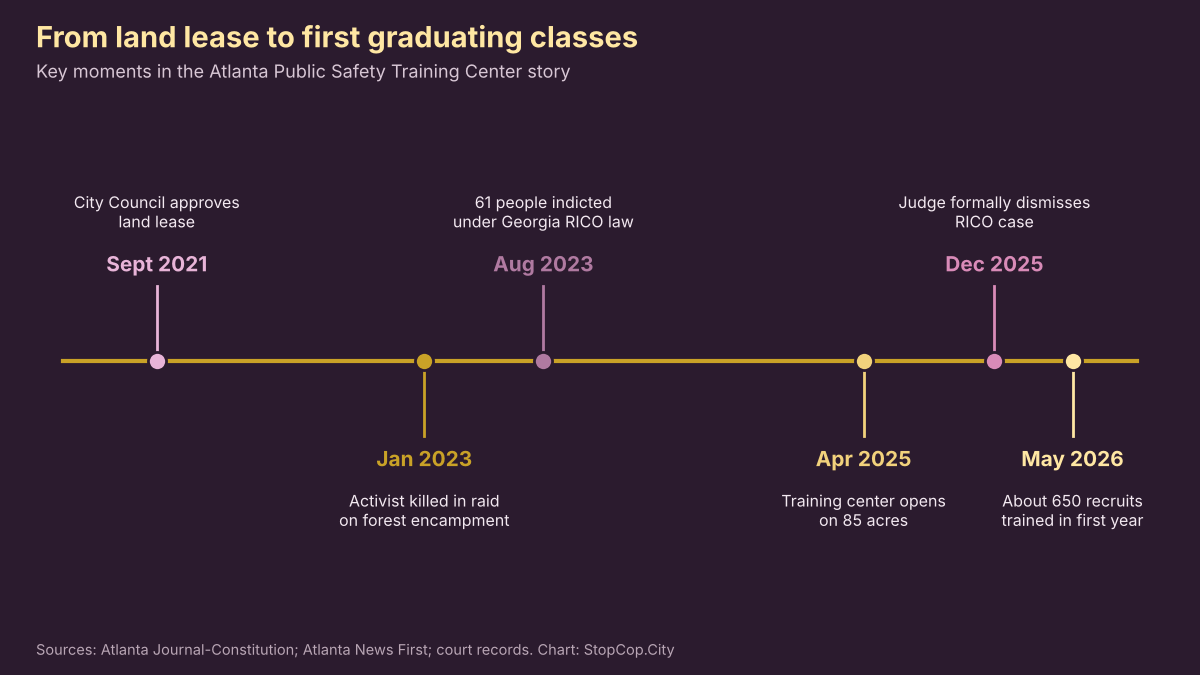
The numbers officials point to
City and police leaders have leaned heavily on recruiting and staffing figures to argue that the center is working.
- About 650 police and fire recruits had trained at the facility by May 2026.
- The police department had graduated eight academy classes in the center’s first year, putting 157 new officers on the street, according to Schierbaum. The AJC later counted nine police graduations and three for the fire department.
- Schierbaum said the department was about 90% staffed, a level he described as the best in years.
- A spokesperson for the mayor said recruitment was at an all-time high and attrition was down 16% year to date.
It is worth reading these numbers with some care. Police departments across the country have seen hiring recover from the low point of 2020 and 2021, and many factors affect recruiting, including pay, signing bonuses and local politics. The training center is clearly part of Atlanta’s pitch to recruits, but it is difficult to separate its effect from everything else the city has done to fill its ranks.
What the price tag covered, and what it did not
The facility’s cost is now commonly cited at $117 million. That figure was a sore point throughout the project, because early public discussion suggested a much smaller contribution from taxpayers, with the Atlanta Police Foundation raising private money for much of the rest. Critics argued that the public share grew as the project went on and that the city’s commitment was never put to a public vote.
There have been other costs as well. The AJC has reported that Atlanta spent more than $2.8 million on litigation and consultant fees connected to the training center. And state prosecutors have cited about $50 million in property damage linked to protests and attacks on equipment and contractors during construction.
The forest and the land around it
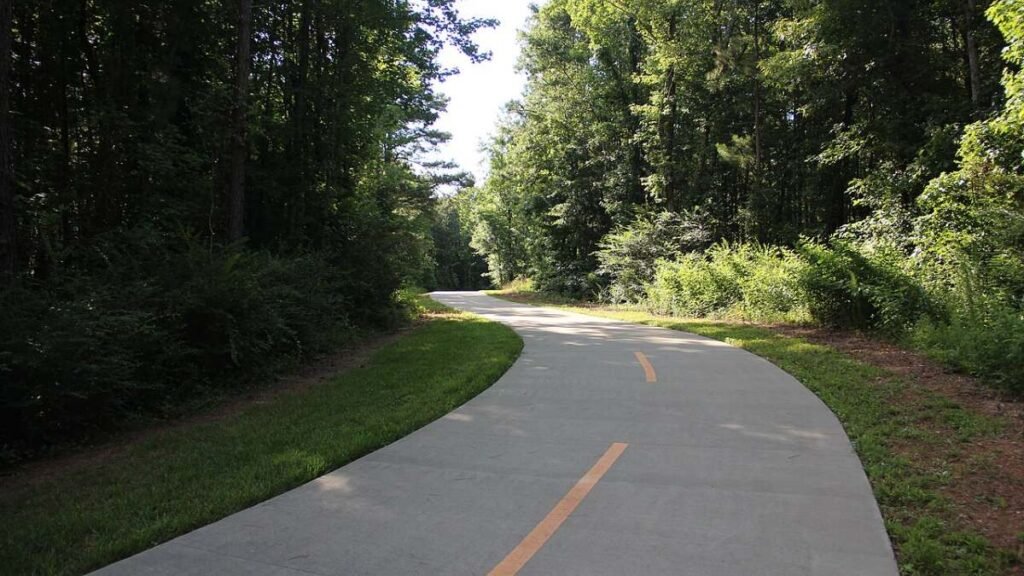
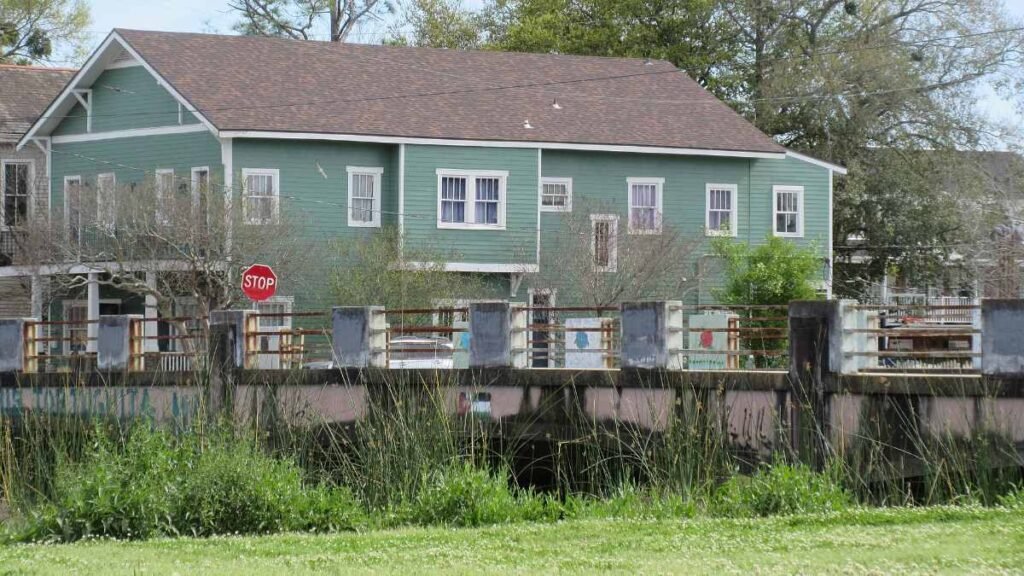
Much of the original opposition was not about policing at all, but about land. The training center sits on part of a roughly 380-acre tract once used as the Atlanta Prison Farm, a property that had been left largely to grow back into woods over the decades. Together with nearby parkland and creek corridors, it forms part of what conservationists call the South River Forest, and what many activists refer to by the Muscogee name Weelaunee.
City officials have said the developed campus covers about 85 acres and that the remaining land on the tract would be kept as green space. Environmental groups have long argued that clearing even part of the forest made little sense in a region that has steadily lost tree cover, and that the site’s wetlands and streams feed into the South River watershed.
Those concerns did not disappear when the buildings went up. For many neighbors in southeast Atlanta and southern DeKalb County, the question is now less about whether the center should exist and more about whether the surrounding land will be protected as promised, and whether anyone will be held accountable if it is not.
What it means for the people who live nearby
The communities closest to the site are majority Black, and many residents have pointed out that decisions about the property were made by a city government most of them cannot vote for. That frustration came up again and again during public comment periods before construction, and it explains why some neighbors remain skeptical of official statements about the center’s benefits.
There are practical issues too. Residents raised questions during construction about noise from firearms training, traffic on local roads and runoff into nearby creeks. The fact that the shooting range was built indoors has been cited as one way to reduce noise. Clear, independently checked information on noise and water quality would go a long way toward answering the doubts that remain.
At the same time, supporters argue that nearby residents are among those who benefit most from better-trained first responders, since faster, more skilled emergency response matters most in neighborhoods that have historically been underserved.
Why opinions have barely moved
A year of operations has not settled the argument, and in many ways it has hardened it. In early May, the AJC reported that views on both sides look much as they did during construction.
Supporters, including Atlanta City Council President Marci Collier Overstreet, describe it as a top-tier training facility, even as some acknowledge the city made mistakes in how it engaged the public. Overstreet has said the city took many wrong turns and should have pursued more community discussion.
Opponents point to process as much as to the building itself. The site sits in unincorporated DeKalb County, and community organizer Cat Leatherwood has noted that the people living closest to it could not vote for Atlanta’s mayor or council. Council member Kelsea Bond, an early opponent, has argued that residents were never given a real opportunity to shape the project.
Some of the most pointed criticism has come from criminal justice experts. Georgia State University criminology professor Thaddeus Johnson, a former Memphis police captain, has questioned the spending when the city faces other pressing needs, including homelessness. Volkan Topalli, who chairs GSU’s criminal justice department and served on a planning advisory committee under former Mayor Keisha Lance Bottoms, said recommendations for a broad overhaul of training and more investment in community crime prevention were not taken seriously, and he eventually left the group.
The referendum that never reached the ballot
One reason the anger lingers is the referendum effort. Activists gathered more than 100,000 signatures in a push to put the project to a public vote. The signatures were never counted, and opponents say the city fought their right to collect petitions in the first place. For many critics, that episode became a symbol of a decision they believe was made over the heads of the people most affected.
The legal aftermath is still unfolding
The courtroom side of the story has not ended either. In 2023, Georgia Attorney General Chris Carr brought a racketeering indictment against 61 people connected to the protest movement. A Fulton County judge signaled in September 2025 that the charges would be thrown out and formally dismissed the case at the end of 2025, ruling that the attorney general needed the governor’s permission to bring it. Carr’s office appealed, and the appeal was heard in February 2026.
Carr has since obtained a separate indictment against three out-of-state protesters accused of vandalizing the Cobb County office of construction contractor Brasfield and Gorrie, this time with Gov. Brian Kemp’s written support, and has suggested more charges could follow.
What a second year will reveal
The first year showed that the facility is busy and that the police and fire departments value it. The next year is likely to answer harder questions:
- Whether staffing gains hold up once the novelty of a new facility fades and other departments compete for the same recruits.
- Whether the city publishes clearer data on how training has changed, for example in de-escalation, crisis response and use-of-force outcomes.
- How the appeal in the RICO case is resolved, and whether new prosecutions follow.
- Whether the city takes any steps toward the community input that critics say was missing from the start.
For now, the center is both things its supporters and opponents said it would be: a modern place to train first responders, and a lasting reminder of one of the most bitter local policy fights in recent American history.
Sources and further reading
- Atlanta Journal-Constitution: From skid pad to train car, how the public safety training center is used
- Atlanta Journal-Constitution: After years of protests, training center opinions haven’t changed
- Atlanta News First: Inside Atlanta’s Public Safety Training Center one year later
- WABE: Georgia judge tosses landmark racketeering charges against protesters
Featured image: Jason Lawrence / Wikimedia Commons, CC BY 2.0 (cropped)