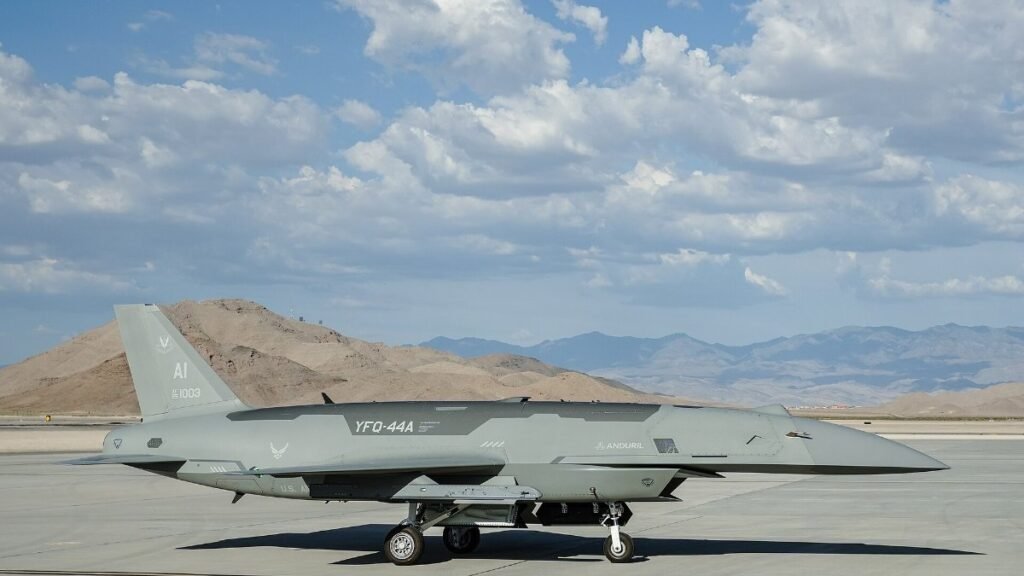
An F-22 Raptor pilot has taken control of a real drone wingman in flight for the first time, sending an Anduril YFQ-44A Fury new orders over a data link while both aircraft flew over California, the Air Force said Oct. 16.
The test is the clearest sign yet that the service’s plan to pair its fighter pilots with robotic “loyal wingmen” is moving from slides to the sky. Earlier F-22 trials used a stand-in drone. This one used a pre-production Collaborative Combat Aircraft, the type the Air Force plans to buy by the hundreds.
“During the demonstration, an F-22 pilot served as an airborne ‘quarterback,'” the Air Force said in its announcement, as quoted by The War Zone.
What happened over Edwards
The Raptor and the Fury both took off from Edwards Air Force Base and joined up in the air. Anduril said the flight took place the week of Oct. 5, according to Air & Space Forces Magazine. The Air Force described it as an “airborne tactical-control demonstration” that lasted multiple hours.
“While in flight, the Raptor pilot sent an updated mission plan to Fury using a tactical data link,” Anduril said. The pilot then steered the drone through maneuvers meant to mirror real missions. Fury’s onboard autonomy software took those high-level instructions and carried out what the Air Force called “dynamic flight maneuvers and simulated combat tasks” on its own.
The pilot sets the task; Fury’s autonomy flies it.
Neither the Air Force nor Anduril said what the pilot used in the cockpit to send the commands. Past Air Force budget documents mention buying “tablets, cables, and associated materials” for the F-22, The War Zone reported. How much extra work a pilot alone in a single-seat fighter can take on while also flying and fighting has been one of the biggest open questions about the concept.
Several units took part, according to the Air Force: the 412th Test Wing at Edwards, the 422nd Test and Evaluation Squadron at Nellis Air Force Base, the 309th Software Engineering Group at Hill Air Force Base in Utah, the Collaborative Combat Aircraft Experimental Operations Unit in Nevada, the F-22 program office and the service’s CCA autonomy and teaming branch. Lockheed Martin, which builds the F-22, is working on the control setup and interfaces, The War Zone reported.
What the brass said
Gen. Kenneth Wilsbach, the Air Force chief of staff, said the demonstration “shows the power of crewed-uncrewed teaming and the advantage it provides our warfighters.”
“We must test often, learn fast, and give commanders what they need, when they need it,” he said.
Air Force Secretary Troy Meink said it shows “what is possible when we are aligned with industry on a shared imperative,” and that the service is “driving urgency into every part of acquisition,” according to Air & Space Forces Magazine.
“The U.S. Air Force’s CCA program is the fastest moving, most mature CCA program anywhere in the world,” said Mark Shushnar, the company’s vice president of autonomous airpower. He said it “will be the first to field operational aircraft.”
How the F-22 got here
This is not the Raptor’s first drone test, but it is the first with the real thing.
In October 2025, an F-22 pilot used a cockpit tablet to control a General Atomics MQ-20 Avenger standing in for a CCA over the Nevada Test and Training Range, Breaking Defense reported. Lockheed’s Skunk Works led that company-funded test, with L3Harris providing radios and data links.
The aim, Skunk Works’ OJ Sanchez said then, was letting “single-seat aircraft command and control drones with simple and intuitive interfaces in the cockpit.” Further surrogate tests followed this year, including one in which an F-35 on the ground controlled an airborne MQ-20, Air & Space Forces Magazine reported.
The Fury and the program behind it
The Air Force picked Anduril and General Atomics in June to build the first operational Collaborative Combat Aircraft, four months ahead of schedule, DefenseScoop reported. Both won development and production contracts covering the first three production lots. The service did not disclose contract values or how many aircraft are in each lot.
Anduril’s drone is designated the FQ-44A Fury. General Atomics’ is the FQ-42A, based on its earlier XQ-67A design. The fiscal 2027 budget request includes $996.5 million to begin buying the first increment, according to DefenseScoop.
The Fury has moved quickly. It first flew in October 2025. In July, the Air Force announced that a Fury had fired an AIM-120 air-to-air missile at a simulated target over the Mojave Desert, DefenseScoop reported.
“We’re one step closer to delivering capabilities to the warfighter,” Wilsbach said after that shot. Gen. Dale White said the tests gave “operational validation that Collaborative Combat Aircraft can execute the weapon employment sequence autonomously.” In September, the Fury was shown flying in formation with F-35s, The War Zone reported.
General Atomics has had a rougher year. Its prototype crashed in April after an autopilot miscalculation. Col. Timothy Helfrich, an Air Force acquisition official, said the crash did not affect the contract award. “We see CCA as representing the next evolution of air power,” he said, according to DefenseScoop.
How many drones the Air Force wants
The Air Force wants at least 150 CCAs by the end of the decade and about 500 by 2032, with talk of 1,000 or more over time, according to DefenseScoop and Air & Space Forces Magazine.
The drones are modular and could later be refitted for strike and intelligence, surveillance and reconnaissance missions, DefenseScoop reported.
The drones are also meant to be cheap compared with crewed fighters. Air & Space Forces Magazine reported a goal of no more than $20 million per air vehicle, not counting sensors and weapons. DefenseScoop has reported an earlier target of about $30 million, roughly a third of the price of an F-35, and said the program was beating it.
The software that flies the drones is a separate competition. Anduril, Shield AI and Collins Aerospace are vying to provide the mission autonomy, with a primary provider to be picked in summer 2027, DefenseScoop reported. Requirements for a second increment are still being written, and other companies can compete.
Other companies are not waiting. Northrop Grumman’s company-funded YFQ-48A Talon Blue recently completed its first fully autonomous flight in the Mojave, even though it has no Air Force airframe contract, Air Force Times reported.
What comes next
The next big test is Emerald Flag in December 2026. The Fury and General Atomics’ drone are set to take part in what will be the first large-force exercise to put CCAs alongside crewed fighters, Lt. Col. Lyndon Bartlett, operations director of the experimental unit, said at the Air & Space Forces Association conference in September, according to The War Zone.
Plenty is still unsettled: where the drones will be based, how they will take off and land away from long runways, who will maintain them and how much pilots will trust them in a fight. It is also unclear whether an F-22 will be tested controlling General Atomics’ FQ-42A, The War Zone reported.
“We must test often, learn fast,” Wilsbach said. The Air Force has a little over two months before Emerald Flag to do both.
Sources
- The War Zone: F-22 pilot controls FQ-44 fighter drone from the cockpit for the first time
- Air & Space Forces Magazine: F-22 pilot directs CCA in flight as airborne QB
- DefenseScoop: Air Force picks Anduril, General Atomics to build first operational CCA drones
- DefenseScoop: Air Force live-fire test of missile from Anduril CCA drone
- Breaking Defense: In a first, F-22 pilot controls wingman drone from cockpit
- U.S. Air Force: F-22 directs Collaborative Combat Aircraft in airborne tactical-control demonstration
Photo: Senior Airman Renee Blundon/U.S. Air Force. The image shows a YFQ-44A Fury at Creech Air Force Base, Nevada.