The United States has spent months blockading Iran by sea. Now it says it is going after the roads, rail lines and Caspian Sea routes too.
U.S. Central Command announced Task Force Iron Gate on Nov. 7, and President Donald Trump said over the weekend that the land blockade is now in effect, Al Jazeera reported. In the same breath, he said renewed strikes on Iran are highly unlikely if there is progress in talks on Tehran’s nuclear program and on reopening the Strait of Hormuz.
Here is what the new unit is, what it can realistically do and how it fits into a week of intense diplomacy.
What is Task Force Iron Gate?
It is a coordination unit, not a new fleet or army. Based at CENTCOM headquarters in Tampa, Florida, it will work with other U.S. agencies to stop the movement of advanced weapons systems, dual-use technology, sanctioned materials and illegal revenue across Iran’s land borders and the Caspian Sea, CENTCOM said, according to Al Jazeera. It will reportedly be staffed by about 20 civilian and military personnel.
CENTCOM commander Adm. Brad Cooper said the effort would reinforce what he called the success of the U.S. naval blockade of Iran at sea.
How does it build on the naval blockade?
The sea blockade came first. The U.S. Navy reimposed it in July after a June memorandum with Iran broke down, and by its 100th day in late October it had kept about $25 billion in Iranian crude off the market, according to U.S. Central Command figures cited by CBS News. With most maritime routes already covered, the land and Caspian routes are what remain. Mulroy described the new unit as a way to extend that economic pressure to ground routes.
Which borders does it cover?
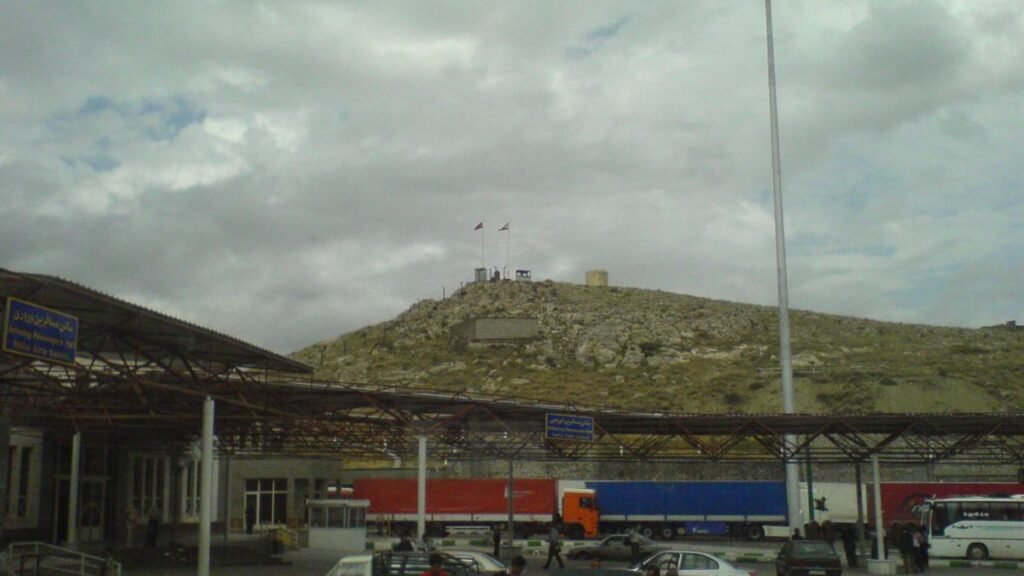
Iran shares land borders with seven countries:
- Afghanistan
- Armenia
- Azerbaijan
- Iraq
- Pakistan
- Turkey
- Turkmenistan
Its northern coast also faces the Caspian Sea, which it shares with Russia, Kazakhstan, Turkmenistan and Azerbaijan. U.S. media have reported that Russia has shipped drone components and explosives to Iran across the Caspian, Al Jazeera noted.
Can the US actually block land routes?
Not directly, analysts say. The United States has no military presence on the Caspian Sea and would need cooperation from Iran’s neighbors, which are reluctant to anger Russia, Mahjoob Zweiri, a professor at Qatar University, told Al Jazeera. Fully enforcing it would require troops on the ground, he said, which is unlikely.
Rami Khouri of the American University of Beirut pointed to Iran’s long history as a trading nation, with contacts across Asia, and said it was virtually impossible to seal every route.
The more realistic aim, according to Michael Mulroy, a former deputy assistant secretary of defense for the Middle East, is mapping how weapons and energy move so they can be cut off later. If the war resumes, he said, those routes and the infrastructure behind them could become a new set of targets, with the focus on economic rather than purely military sites.
How has Iran responded?
Dismissively. A Revolutionary Guards spokesman told the Fars news agency that the plan was just a play on words and that Washington could not collapse Iran’s economy this way, Dawn reported. He noted that U.S. officials had earlier predicted an economic collapse that did not come.
Tehran has also warned, as ABC News reported, of dire consequences if the United States resumes attacks, and the Guards said the same weekend they were building underground complexes to keep producing missiles and drones under bombardment.
Is the military pushing harder than the White House?
That is the criticism from one former official. Joe Kent, a former senior counterterrorism official who resigned in March over the war, accused CENTCOM of inviting escalation while Vice President JD Vance was trying to negotiate, Al Jazeera reported. The Wall Street Journal has reported that Cooper is among officials, along with Defense Secretary Pete Hegseth, urging Trump to renew strikes.
Trump’s own message over the weekend leaned toward diplomacy, with the blockade as leverage. He said he expects to discuss Iran with Chinese President Xi Jinping and Russian President Vladimir Putin at next week’s APEC summit.
Where the talks stand
Qatar’s prime minister, Sheikh Mohammed bin Abdulrahman Al Thani, was in Washington for talks with Trump and Vance on Monday. He said the United States was willing to seek a solution, Al Jazeera reported.
The gap remains wide. Iran says peace is impossible unless the United States lifts its naval blockade, releases seized assets and lifts sanctions. Secretary of State Marco Rubio described Iran’s latest proposal as unrealistic, while Iran’s Foreign Ministry defended it as the most reasonable offer on the table, Just Security’s news roundup noted.
There are hints of movement in Tehran. President Masoud Pezeshkian said Supreme Leader Mojtaba Khamenei had told the leadership to end the state of “no war, no peace” with the United States, The Times of Israel reported. It was not clear whether that meant pushing for a deal or preparing for a final confrontation.
The split inside Washington
Vance wrote after the midterms that Republicans lost because of the war. Trump pushed back on Nov. 8, saying Vance was right except for one thing, Just Security noted. With Democrats taking Congress in January and a House vote on impeaching Hegseth possible this week, the pressure to show progress is growing.
What to watch
- Any public readout from the Qatar talks at the White House.
- Whether Turkey, Iraq, Azerbaijan or Pakistan agree to cooperate with Iron Gate.
- Iranian retaliation at sea or through allied groups.
- What Trump discusses with Xi and Putin at APEC.
Sources
- ABC News: Iran live updates, Nov. 9
- CBS News: Iran war live updates, Oct. 23
- Al Jazeera: US task force to cut off Iran’s transport of advanced weapons
- Al Jazeera: Iran war live, Nov. 9
- Just Security: Early Edition, Nov. 9, 2026
- The Times of Israel: Live updates, Nov. 9
- Dawn: Live updates on the Iran war
- U.S. Central Command: Press releases
Photo: M karzarj, CC BY-SA 3.0, file photo.