
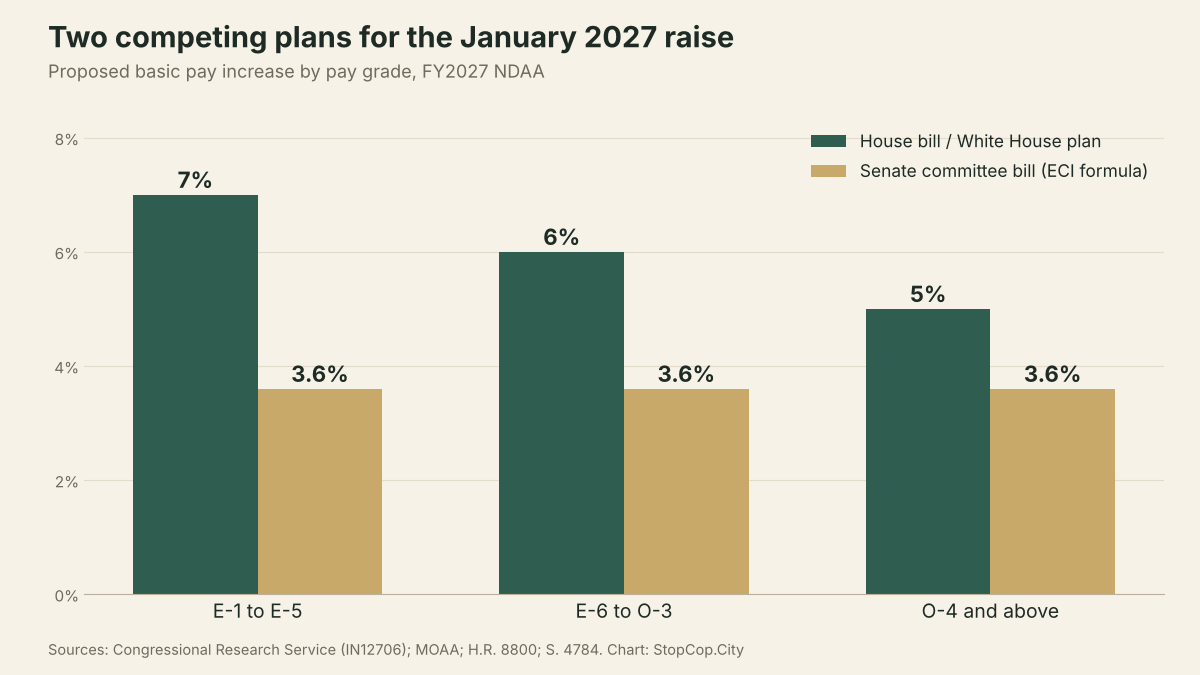
If you wear the uniform, the size of your January paycheck bump is still undecided, and the gap between the two options on the table is not small. One plan in Congress would give junior enlisted troops a 7% raise. The other would give everyone 3.6%.
That difference may look like a few percentage points on paper. For a young family living on an E-4’s salary, it can mean a car payment, a month of daycare or the difference between saving something and saving nothing. Here is where the fight stands, what each version would mean for you, and when you will actually know.
The short version
- The White House asked for a tiered raise: 7% for E-1 through E-5, 6% for E-6 through O-3, and 5% for O-4 and above, effective Jan. 1, 2027.
- The House backed that plan in its version of the defense bill, which passed 216-212 on July 22.
- The Senate Armed Services Committee wrote a flat 3.6% raise for all ranks into its version, matching the formula in federal law. That bill has not had a vote on the Senate floor.
- Serious negotiations between the two chambers are expected to start after the November election, and in recent years the final bill has often slipped into December.
Why there are two numbers in the first place
Your annual raise is not a number Congress picks out of thin air. Under federal law, it is tied to the Employment Cost Index, a government measure of how fast private-sector wages are growing. The raise for 2027 is based on the change in that index from the third quarter of 2025 to the third quarter of 2026, which works out to 3.6%, according to the Congressional Research Service.
The same law gives the president a way to propose something different. If the administration believes the standard formula is not right for the moment, it can send Congress an alternative plan, along with an explanation of how that plan affects recruiting and retention. That is what happened this year. The White House budget asked for $5.8 billion to fund a “7-6-5” targeted raise, which the Pentagon says averages out to about 6.2% across the force.
Congress then has the final word. Whatever ends up in the National Defense Authorization Act, the annual defense policy bill, sets the raise and overrides the formula.
What the House and Senate actually wrote
| Pay grade | White House request | House bill (H.R. 8800) | Senate committee bill (S. 4784) |
|---|---|---|---|
| E-1 to E-5 | 7% | 7% | 3.6% |
| E-6 to O-3 | 6% | 6% | 3.6% |
| O-4 and above | 5% | 5% | 3.6% |
The House plan leans heavily toward the youngest and lowest-paid troops. The Senate committee chose to stick with the formula, which treats a private first class and a colonel the same in percentage terms.
What it could mean for your paycheck
Every service member’s pay depends on rank and years of service, so the easiest way to see the difference is with round numbers. Take your current monthly basic pay from your Leave and Earnings Statement and plug it into the same math.
| If your monthly basic pay is | A 3.6% raise adds | A 5% raise adds | A 6% raise adds | A 7% raise adds |
|---|---|---|---|---|
| $2,500 | $90 a month ($1,080 a year) | $125 ($1,500) | $150 ($1,800) | $175 ($2,100) |
| $3,000 | $108 ($1,296) | $150 ($1,800) | $180 ($2,160) | $210 ($2,520) |
| $4,000 | $144 ($1,728) | $200 ($2,400) | $240 ($2,880) | $280 ($3,360) |
| $6,000 | $216 ($2,592) | $300 ($3,600) | $360 ($4,320) | $420 ($5,040) |
| $9,000 | $324 ($3,888) | $450 ($5,400) | $540 ($6,480) | $630 ($7,560) |
A few things to keep in mind as you read that table:
- This is basic pay only. Your housing allowance (BAH) and food allowance (BAS) are set separately, and BAH depends on where you are stationed. A bigger basic pay raise does not automatically change those.
- Taxes still apply. Basic pay is taxable; BAH and BAS are not. Your take-home difference will be a bit smaller than the numbers above.
- Retirement math is affected. Under both the legacy system and the Blended Retirement System, your pension is based on basic pay. A bigger raise now nudges your future retirement up, too.
Three households, three very different outcomes
Percentages hide how the choice lands in real homes. Consider three rough examples, using approximate basic pay figures rather than exact pay-chart values.
A young specialist with a spouse and a toddler. Say an E-4 takes home around $3,000 a month in basic pay. Under the House plan, that grows by about $210 a month. Under the Senate committee plan, it grows by about $108. The roughly $100 monthly gap is close to what many families near large installations spend on a week of groceries, or a meaningful share of a part-time child care bill.
A staff sergeant with 10 years in. At around $4,500 a month, an E-6 would see about $270 more under the 6% tier and about $162 more under 3.6%. Over a year, that is a difference of roughly $1,300 before taxes, and it compounds, because every future raise is calculated on top of the new base.
A major with a dozen years of service. At around $9,000 a month, an O-4 gains about $450 under the 5% tier and about $324 under the flat raise. The dollar gap is larger than for the junior troops, but as a share of household income it matters less, which is exactly the logic behind tiering.
Guard and Reserve members should note that drill pay is calculated from the same basic pay table, so whichever raise Congress chooses flows through to weekend drills and annual training as well.
How 2027 compares with recent raises
For context, here is what troops received in the last few years. The 2023 raise was 4.6%, the largest in two decades at the time. In 2024 it rose to 5.2%, then 4.5% across the board in 2025, followed by the extra boost for junior enlisted members that spring. The 2026 raise was 3.8%.
Seen that way, a flat 3.6% for 2027 would be the smallest raise in several years, though still in line with private-sector wage growth. A 7% raise for E-1 through E-5 would be the largest headline raise for those grades since the early 2000s, outside of the special 2025 adjustment. Both camps use the same history to argue their case: one side says recent raises have done their job and the formula should resume, while the other says living costs around many bases still outpace what junior troops earn.
Military retirees, meanwhile, are on a separate track. Retired pay is adjusted each year by a cost-of-living formula tied to consumer prices, not by the active-duty raise, so the NDAA debate does not directly change retiree checks.
The case for the bigger, tiered raise
Supporters of the House approach make a simple argument: the troops who need help most are the ones at the bottom of the pay chart. Junior enlisted members are more likely to be young parents, to live paycheck to paycheck and to feel the pinch of high rents and grocery prices, especially if they live off base.
There is also recent history behind the push. Congress already gave junior enlisted members a special boost in 2025. On top of a 4.5% raise for everyone in January 2025, E-1 through E-4 received an extra 10% in April, and E-5s received an average additional 7% for those with under 10 years of service. Backers of the tiered plan see 2027 as a chance to keep closing the gap for those ranks rather than letting it slip back.
The case for sticking with 3.6%
The Senate committee’s choice is not simply about saving money, although a smaller raise does cost less. The formula exists to keep military pay moving in step with civilian wages, so that service members do not fall behind and the government does not overspend in boom years.
There is also an argument from the Pentagon’s own research. The 2025 Fourteenth Quadrennial Review of Military Compensation found military pay “more than adequate” compared with civilian pay and concluded that across-the-board basic pay raises are an expensive tool. It suggested that targeted bonuses and other incentives may be a better way to fix specific recruiting or retention problems. Lawmakers who favor 3.6% often point to that finding.
The Military Officers Association of America, one of the largest advocacy groups for service members, has long made keeping pace with the wage index its top pay priority, while also supporting raises above the formula when readiness and retention call for it. In its October update, the group noted that a final number somewhere between the two versions is likely.
More than pay is riding on the bill
The pay raise gets the headlines, but the House bill also carries a long list of quality-of-life changes that could matter just as much to your household. According to a FedWeek summary, the House version includes:
- Permanent authority for temporary BAH increases, with a lower threshold for triggering them.
- A higher Family Separation Allowance for deployed members.
- More than $1.5 billion for barracks and family housing, plus an independent look at privatized housing conditions.
- More than $491 million for child development centers and a new child care assistance pilot for high-cost areas.
- A lower travel threshold for specialty care, from 100 miles to 75 miles.
- New bereavement leave for pregnancy loss or stillbirth.
The Senate version has its own list, including higher caps on some special pays and bonuses, higher tuition assistance limits and expanded hearing aid eligibility. Many of these items will be traded back and forth in the final negotiations, so the bill you end up living with may look different from either version today. Defense bills also drive programs that never touch a paycheck, such as the counter-drone laser and microwave pilot now heading to five US bases.
When you will actually know
Here is the realistic timeline:
- Now through early November: Little movement. The House bill reached the Senate on Sept. 14, but the Senate has not voted on its own version, and campaign season slows everything down.
- After the Nov. 3 election: House and Senate negotiators begin working out a single compromise bill.
- December: In most recent years, the final defense bill has passed in December and been signed shortly after.
- Jan. 1, 2027: The raise takes effect. Your first paycheck reflecting it typically arrives in mid-January.
If Congress were somehow unable to finish the bill on time, the raise does not simply vanish. Federal law ties the default adjustment to the wage index, which is why the 3.6% figure is often described as the floor. Any final law setting a different number would take precedence.
What you can do in the meantime
- Budget for the lower number. Plan around 3.6% and treat anything above it as a bonus. That way the final outcome can only surprise you in a good way.
- Check your LES in January. Make sure the new rate shows up on your first January statement and talk to your finance office if it does not.
- Revisit your TSP contribution. A raise is the least painful moment to bump your Thrift Savings Plan percentage, especially under the Blended Retirement System, where the government matches part of your contribution.
- Talk to your representatives. If you have a view on which version is better, now is when lawmakers are listening.
Frequently asked questions
Is the 2027 military pay raise final?
No. The House approved a tiered raise of 7%, 6% and 5%, while the Senate Armed Services Committee approved a flat 3.6%. The final figure will be set when Congress passes the compromise defense bill, which is expected in December.
When does the 2027 raise take effect?
The raise is scheduled to take effect on Jan. 1, 2027. Most service members see it on their first paycheck in mid-January.
Does the raise change my BAH or BAS?
Not directly. The basic pay raise applies only to basic pay. Housing and food allowances are calculated separately and announced on their own schedule.
Why is the formula raise 3.6%?
Federal law ties the annual raise to the Employment Cost Index, which measures private-sector wage growth. The index rose 3.6% between the third quarter of 2025 and the third quarter of 2026.
Sources
- Congressional Research Service: FY2027 NDAA, Military Basic Pay Raise Proposal
- MOAA: House and Senate versions differ on your 2027 raise
- FedWeek: Quality of life provisions in the House 2027 NDAA
Featured image: U.S. Army photo by Spc. Thomas Dixon / Wikimedia Commons, public domain (cropped)
