For years, the drones that buzzed over American military bases were treated as a nuisance that commanders could report but rarely stop. That is starting to change. On Oct. 6, the Pentagon named four directed-energy weapons, three lasers and one high-powered microwave, that will be set up and operated at five US installations as part of a year-long homeland counter-drone pilot ordered by Congress.
It is the first time the military has committed to fielding these kinds of weapons inside the United States for base defense, rather than testing them on a remote range or deploying them overseas. The pilot is small, the price tag has not been disclosed, and nobody has said which weapon goes where. But the choices tell us a lot about how the Defense Department is thinking about the drone problem at home, and about the trade-offs it still has not settled.
Here is what was announced, how each system works, and the questions the test is meant to answer.
What the Pentagon actually announced
The pilot is being run by Joint Interagency Task Force 401, known as JIATF-401, an Army-led organization created in 2025 to pull together counter-drone work that had been spread across the services and other federal agencies. Army Brig. Gen. Matt Ross directs the task force.
According to the announcement, reported by Defense News, service members, not contractors, will operate and maintain the weapons for one year. The work is being coordinated with the individual services, US Northern Command and the Federal Aviation Administration. Throughout the year, the task force will collect real-world data on how the systems perform, what they cost to run and what it takes to keep them working.
That last point matters more than it sounds. Directed-energy weapons have looked impressive in demonstrations for well over a decade. The harder question has always been whether a regular unit can keep one running day after day, in heat, rain and dust, without a team of company engineers standing by.
The five bases in the test
JIATF-401 picked the pilot locations back in May. They are a deliberately mixed group:
- Fort Huachuca, Arizona – an Army post that is home to military intelligence training and is tied to the southern border mission.
- Fort Bliss, Texas – one of the Army’s largest installations, also linked to border operations, and the site of an airspace scare earlier this year (more on that below).
- Naval Base Kitsap, Washington – a major Navy base in the Puget Sound region that supports the Pacific submarine force.
- Grand Forks Air Force Base, North Dakota – a northern Plains base with a large unmanned aircraft and surveillance mission.
- Whiteman Air Force Base, Missouri – home of the B-2 Spirit stealth bomber fleet.
Spread across desert, coastal, northern and Midwestern climates, the sites give the Pentagon a realistic spread of weather and terrain. That is important for lasers in particular, which lose effectiveness in fog, heavy rain and dust. Commanders at each installation have 180 days to work out deployment plans with the task force, with operations expected to begin later this year.
Four weapons, four different bets
The four systems are not variations on a single design. Each one represents a slightly different idea about what base defense should look like.
AeroVironment’s palletized laser
AeroVironment’s entry is a palletized, roll-on, roll-off version of its LOCUST high-energy laser. “Palletized” is the key word: the weapon is packaged so it can be loaded onto a truck or a ship and moved without being permanently built into a vehicle.
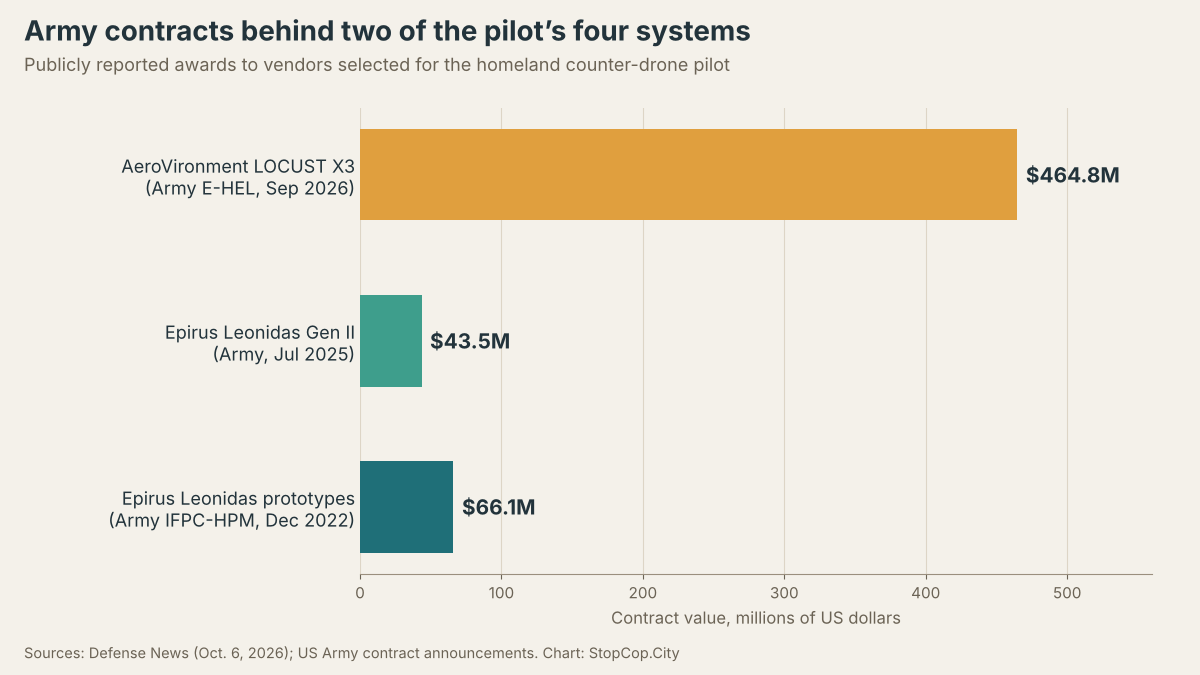
The company has a recent track record to point to. In October 2025, a palletized LOCUST tracked and defeated target drones aboard the aircraft carrier USS George H.W. Bush during a live-fire event with the Navy and the Army’s rapid weapons development office. In September 2026, the Army awarded AeroVironment $464.8 million to produce its 30-kilowatt LOCUST X3 under the Enduring High Energy Laser program. It is not yet clear whether the pilot systems will come from that production buy.
Kord’s Firefly
Kord, a subsidiary of KBR, is supplying its Firefly high-energy laser. Like the AeroVironment system, Firefly is palletized, but its main selling point is scalability: it can be configured anywhere from 5 to 40 kilowatts. In general, more power means a laser can burn through a target faster and at longer range, but it also means more heat to manage and a bigger power supply.
At a demonstration near Guntersville Dam in Alabama in August, company officials said a truck-mounted Firefly typically needs only a few seconds on target to bring down a small drone.
Boeing’s Compact Laser Weapon System
Boeing’s Compact Laser Weapon System, or CLWS, sits at the other end of the scale. It is a lower-power laser designed to be smaller and easier to move. Boeing says the system has defeated nearly 500 drones in testing and demonstrations at ranges from roughly 200 meters to 2.5 kilometers.
In 2024, a 5-kilowatt version brought down Group 3 drones, aircraft weighing up to about 1,320 pounds, at the Red Sands exercise in Saudi Arabia, using targeting data from the Army’s Forward Area Air Defense network. CLWS units have also returned from a multiyear Marine Corps deployment overseas, although Boeing has not said whether they engaged hostile drones.
Epirus Leonidas
The only non-laser weapon in the group is Epirus’s Leonidas, a high-powered microwave. Instead of focusing a beam on a single point, it sends out a burst of energy that disrupts the electronics of anything in its path.
Leonidas is already the basis for the Army’s high-power microwave prototype under its Indirect Fire Protection Capability program. The Army awarded Epirus $66.1 million in December 2022 for four prototypes and $43.5 million in July 2025 for a second-generation version. In September 2025, at Camp Atterbury in Indiana, Leonidas disabled all 61 target drones across five scenarios, including a 49-drone swarm knocked out in a single burst.
The four systems at a glance
| System | Maker | Type | Notable detail |
|---|---|---|---|
| Palletized High-Energy Laser (LOCUST family) | AeroVironment | Laser | Moved by truck or ship; Army bought 30 kW LOCUST X3 in Sept. 2026 |
| Firefly | Kord (KBR) | Laser | Scalable from 5 to 40 kW |
| Compact Laser Weapon System | Boeing | Laser | Lower power, smaller footprint; nearly 500 drones defeated in testing |
| Leonidas | Epirus | High-powered microwave | Disabled a 49-drone swarm in one burst in 2025 testing |
Lasers versus microwaves: the core trade-off
The pilot’s mix of three lasers and one microwave is not an accident. The two technologies solve different parts of the problem.
A high-energy laser works a bit like a magnifying glass on a sunny day, only far more powerful and precise. It holds a tightly focused beam on one spot of a drone, often a motor, battery or camera, until the material fails. That precision is useful near runways, fuel farms and housing areas, because the beam affects only what it is pointed at. The downside is that it engages one target at a time and must “dwell” on each one. Against a handful of drones, that is manageable. Against a swarm, it becomes a race against the clock.
A high-powered microwave flips that equation. Its wider cone of energy can disable many small drones at once, which is exactly what Leonidas did at Camp Atterbury. But that same wide footprint is why commanders worry about it at home. A burst strong enough to fry a drone’s circuits can, in principle, affect other electronics nearby. On a base surrounded by civilian neighborhoods, highways and airports, that concern is not theoretical.
Running both kinds of systems side by side, at real installations, is the clearest way to see where each one fits.
The cost argument, and why the task force is careful with it
Supporters of directed energy often point to the cost of a single shot. A laser or microwave burst costs a tiny fraction of an interceptor missile or even a gun round, and it leaves behind no unexploded ammunition, which matters a great deal when the “battlefield” is a base next to a town.
Ross has been notably cautious about leaning too hard on that math. As he put it in an earlier discussion reported by Defense News, a system that costs millions of dollars and fires once a year cannot be justified simply because each shot costs pennies. The real measure is the total cost of buying, staffing, maintaining and powering the system against how often it is actually needed, and how well it works when it is.
That is precisely the kind of number the pilot is designed to produce. Until it does, per-shot comparisons should be read as a best-case talking point rather than a budget figure.
The airspace problem nobody can ignore
Firing a weapon into the sky over the United States is not like firing one over a test range in the desert. Commercial aircraft, medevac helicopters, crop dusters and hobby drones all share that airspace, and the FAA, not the Pentagon, is responsible for keeping it safe.
That tension surfaced in February 2026, when the FAA briefly closed airspace over El Paso, Texas, after a counter-drone laser was used near Fort Bliss without coordination with the agency, according to an Associated Press report. The incident was short-lived, but it showed how quickly a base defense issue can turn into a civil aviation issue.
Officials moved to address it. In March, defense and FAA officials held a live-fire demonstration at White Sands Missile Range in New Mexico, and on April 10 the FAA said a safety review found that the tested laser systems, with proper safety controls in place, “do not pose undue risk to passenger aircraft.” The pilot’s formal coordination with the FAA is a direct result of that groundwork.
Why bases need better drone defenses now
The pressure behind the pilot has been building for years. Unidentified drones have been reported over US military installations repeatedly, including widely reported incursions over Langley Air Force Base in Virginia in late 2023 and a wave of sightings in New Jersey in late 2024 that included military sites. Overseas, small drones have become one of the defining weapons of the war in Ukraine and a constant threat to US forces in the Middle East.
The common thread is cost and scale. Commercial drones are cheap, easy to modify and hard to detect at low altitude. Using a missile that costs hundreds of thousands of dollars to shoot down a drone that costs a few thousand is not sustainable, and on US soil, shooting at all raises legal and safety questions that do not exist on a foreign battlefield.
Congress responded by ordering a homeland pilot, and JIATF-401 was set up to run it. The directed-energy systems are one piece of a larger effort.
Domestic Shield and the bigger counter-drone push
Just a week before the directed-energy announcement, on Sept. 29, the Army said JIATF-401 had awarded 10 contracts worth up to $4.15 billion combined for sensors, optical sights and gun-based systems. Those awards support Domestic Shield, the effort to protect priority Defense Department sites inside the United States.
Put together, the two announcements show a layered approach. Sensors and radars detect and track drones. Guns and other kinetic tools handle threats that need to be stopped right away. Lasers and microwaves offer a cheaper, deeper magazine for the many small drones that are likely to show up over time. No single tool covers every case, which is why the Pentagon is testing several at once. Missiles still have a place against faster, longer-range threats, a point underlined by the Air Force program we covered in our look at the AIM-260 JATM.
What happens next
The pilot is only the first step. JIATF-401 is planning a shoot-off for additional laser and microwave systems at Dugway Proving Ground in Utah in December. Ross said in August that systems that perform well there could move quickly to a purchase order so that production can begin.
That is a notable shift for a field that has often been stuck in what defense officials call the “valley of death,” the gap between a promising prototype and a funded production program. If the pilot and the Dugway event go well, directed-energy systems could move from demonstrations to regular use at US bases faster than many observers expected.
What to watch over the next year
- Which weapon goes where. The Pentagon has not said how the four systems will be matched to the five bases. The pairings will hint at which threats each site worries about most.
- Reliability in bad weather. Kitsap’s rain and Grand Forks’ winters will test lasers in conditions that are much harder than a sunny range day.
- Total cost of ownership. Watch for figures on staffing, maintenance and power, not just cost per shot.
- Airspace incidents. Any repeat of the El Paso closure would raise hard questions about how these systems operate near civilian traffic.
- Production orders. A quick move from the Dugway shoot-off to purchase orders would show the Pentagon is serious about fielding, not just testing.
Frequently asked questions
Will these lasers be used against drones flown by ordinary hobbyists?
The pilot is focused on protecting military installations from drones that pose a threat. Strict rules govern when and how US forces can act against drones at home, and the FAA is part of the coordination. A hobbyist who flies near a base is far more likely to deal with security forces and law enforcement than with a laser.
Are directed-energy weapons safe for nearby residents?
Lasers affect only what they are aimed at, and the FAA concluded in April that the tested laser systems, with proper safety controls, do not pose undue risk to passenger aircraft. High-powered microwaves have a wider footprint, which is one reason the pilot includes only one and will study its effects closely.
How much does the pilot cost?
The Pentagon has not released a cost for the one-year pilot or said how many units of each system will be fielded.
When will the systems be operating?
Installation commanders have 180 days to complete deployment plans, and operations are expected to begin later this year.
Sources and further reading
- Defense News: Pentagon names 4 directed-energy weapons for counter-drone program at US bases
- Federal Aviation Administration
Featured image: AeroVironment / Wikimedia Commons, CC BY 4.0 (cropped)