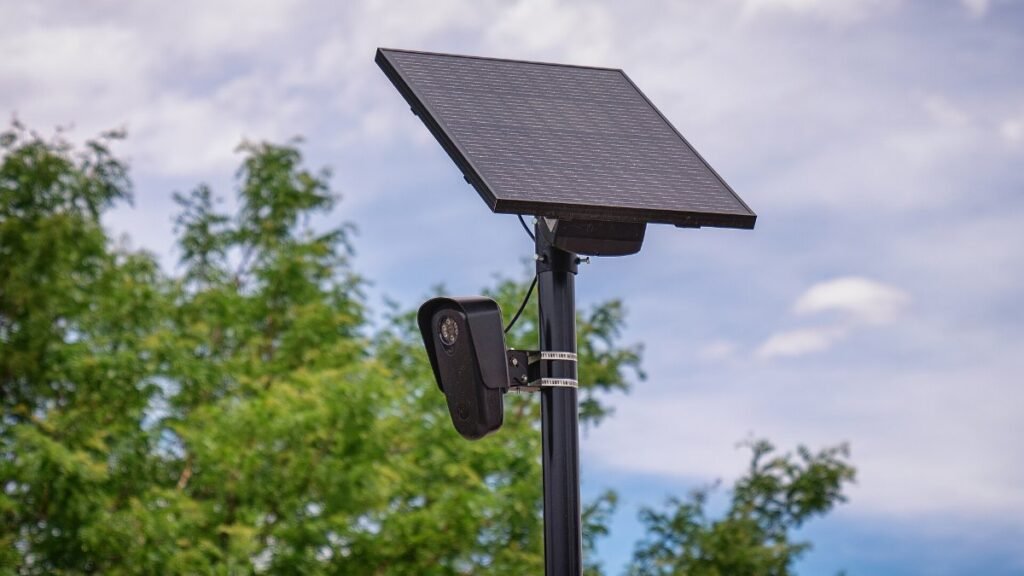
Police officers around the country have been charged with or accused of using license plate cameras to track former partners and other people they knew, and Atlanta-based Flock Safety, whose cameras sit on poles in thousands of American communities, changed its rules this summer in response.
Critics say the changes don’t go far enough.
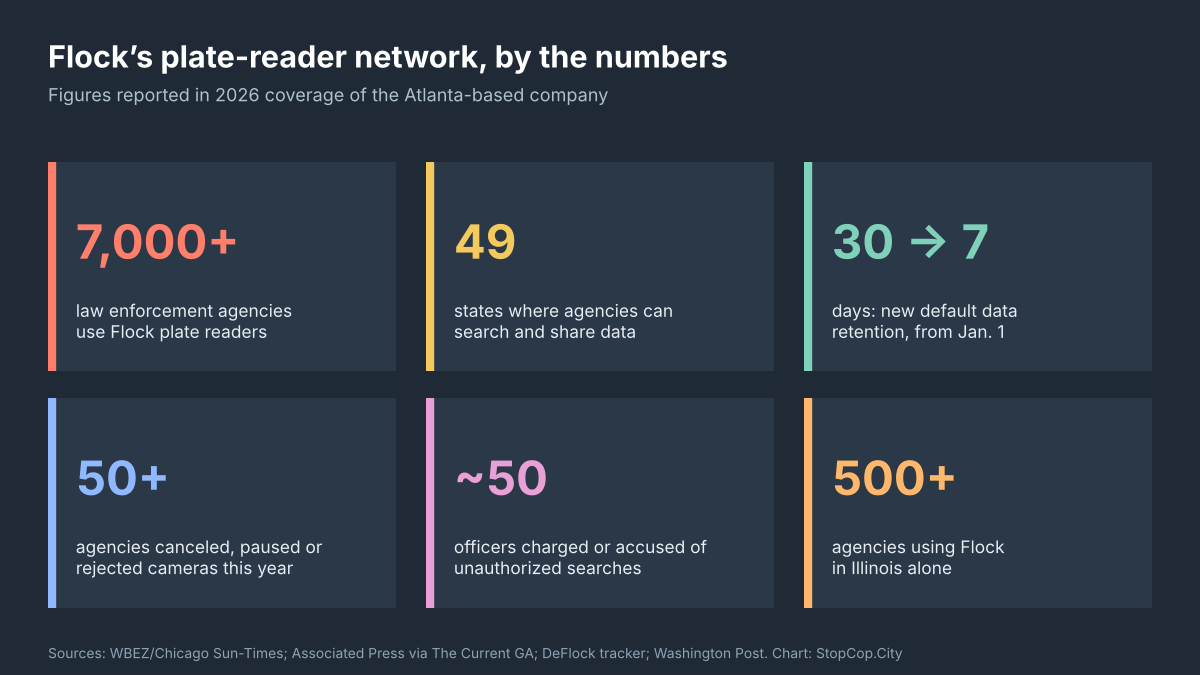
A Washington Post review identified roughly 50 officers nationwide who had been charged with or accused of misusing license plate reader data. In Georgia, the Savannah Police Department fired six employees, four of them officers, after an internal review of how the system had been used. In Illinois, a former police chief in the village of Holiday Hills was found to have run about 300 unauthorized searches.
On Aug. 14, Flock put new safeguards in place. Agencies now have to use an audit tool to review their officers’ searches and can be locked out if they don’t. Data is kept for seven days by default instead of 30, unless it is tied to a case number. Officers must enter a case number for every search. And agencies can block other departments from searching their data for certain kinds of offenses, such as immigration violations.
“Window dressing,” said Robert Frommer of the Institute for Justice, a libertarian public interest law firm that has challenged plate reader surveillance in court. His argument, which the American Civil Liberties Union shares, is that a protection a company grants is one the company can take back. A seven-day retention period in a vendor’s settings carries no penalty if it is changed later.
Flock chief executive Garrett Langley has presented the changes as a response to legitimate concerns and evidence that the technology can be used responsibly. The company says its cameras help solve homicides, kidnappings and car thefts, and that the vast majority of searches are legitimate.
The network is large. Flock says more than 7,000 law enforcement agencies in 49 states use its cameras, including more than 500 in Illinois. Each camera logs the plate, time, location and an image of passing vehicles, along with details such as make and color. Agencies can choose to share their data, so an officer in one town can search reads collected hundreds of miles away.
That sharing is what turned the issue from a local one into a national one.
Illinois limits cooperation with federal immigration enforcement and protects access to abortion. An audit by the Illinois Secretary of State’s office found that out-of-state agencies had searched Illinois plate data for purposes tied to immigration enforcement and to an abortion-related investigation, NPR Illinois reported. Evanston and Oak Park moved to end their Flock contracts.
Other cities followed for their own reasons. DeFlock, a project that maps plate reader cameras and tracks local decisions, counts more than 50 agencies that have canceled or suspended contracts. In Lisle, Illinois, cameras were stolen outright.
The legal ground is shifting, too. The Supreme Court held in Carpenter v. United States in 2018 that long-term, comprehensive location tracking can require a warrant, even when each individual data point was collected in public. A federal judge in Oklahoma has since ruled that a warrantless search of license plate reader data in a criminal case violated the Fourth Amendment. The ruling does not bind other courts, but it is the kind of decision police lawyers watch closely.
Andrew Guthrie Ferguson, a law professor who studies policing technology, has said the deeper problem is the absence of a clear legal framework for networked surveillance, not any one company’s settings. Ian Adams, a criminologist who studies police technology, has noted that both the usefulness of these networks and the risks grow with their size.
Even within policing, there is pressure for clearer rules. Chuck Wexler, executive director of the Police Executive Research Forum, has urged departments to adopt written policies and be open with the public about how they use the cameras.
Lawmakers are moving at several levels. Legislators in Oregon, Texas and Missouri have weighed new limits on plate readers. Republican members of Congress introduced bills over the summer addressing parts of the issue, and Sen. Bernie Sanders and Rep. Alexandria Ocasio-Cortez said in October that they planned to introduce legislation of their own.
Proposals tend to circle the same handful of protections:
| Protection | Flock’s August rules | What advocates want in law |
|---|---|---|
| Data retention | 7 days unless tied to a case | A statutory limit with penalties |
| Reason for each search | Case number required | Case number plus outside audit |
| Audits | Mandatory audit tool, lockout for noncompliance | Independent audits, public results |
| Out-of-state sharing | Agencies can block some offense types | State-level limits on sharing |
| Misuse | Vendor can cut off access | Criminal penalties in serious cases |
Georgia has no comprehensive plate reader statute. Contracts and department policies set the terms, many of them signed before the misuse cases became public. The Atlanta Journal-Constitution reported in August that Atlanta police were moving to root out Flock misuse amid growing scrutiny.
Documents and reporting cited
- Associated Press via FOX 10: Flock Safety to tighten surveillance rules, audit checks following backlash
- ACLU: Despite new updates, Flock cameras remain a civil liberties threat
- NPR Illinois: Hundreds of police departments use camera company accused of breaking state law
- Wednesday Journal of Oak Park: State says Flock Safety broke the law
- Atlanta Journal-Constitution: Amid growing scrutiny, Atlanta police look to root out Flock camera misuse
Featured image: Tony Webster / Wikimedia Commons, CC BY 2.0 (cropped)