France will put about 70,000 police officers and gendarmes on the streets Saturday, Oct. 24, for a second straight Saturday of nationwide protests and the first since President Emmanuel Macron said only union-organized marches would be allowed. Interior Minister Laurent Nuñez announced the figure Friday. Paris police have approved just one union march in the capital and rejected rally requests from the UNEF student union and the Yellow Vest movement, Reuters reported. UNEF says its rallies will go ahead anyway.
Macron was scheduled to chair a defence council on Friday, and his office said he would announce “additional decisions” afterward, Al Jazeera and AFP reported. As of Friday evening in Paris, none of the reporting we reviewed from Reuters, AP, AFP, Al Jazeera or France 24 described what the council decided. Macron also met high school student representatives on Friday afternoon, his first talks with those groups; no outcome had been reported.
Police deployment for Saturday’s protests
The force is about 10,000 larger than the one deployed a week ago, Nuñez said, according to Reuters. On Oct. 17, nearly 60,000 personnel did not prevent widespread looting and vandalism on the edges of the marches. Junior Interior Minister Jean-Didier Berger told BFMTV the Saturday deployment would be 20% larger than on Oct. 17, Euronews reported. Soldiers from Operation Sentinelle, the army’s domestic patrol mission, will support police.
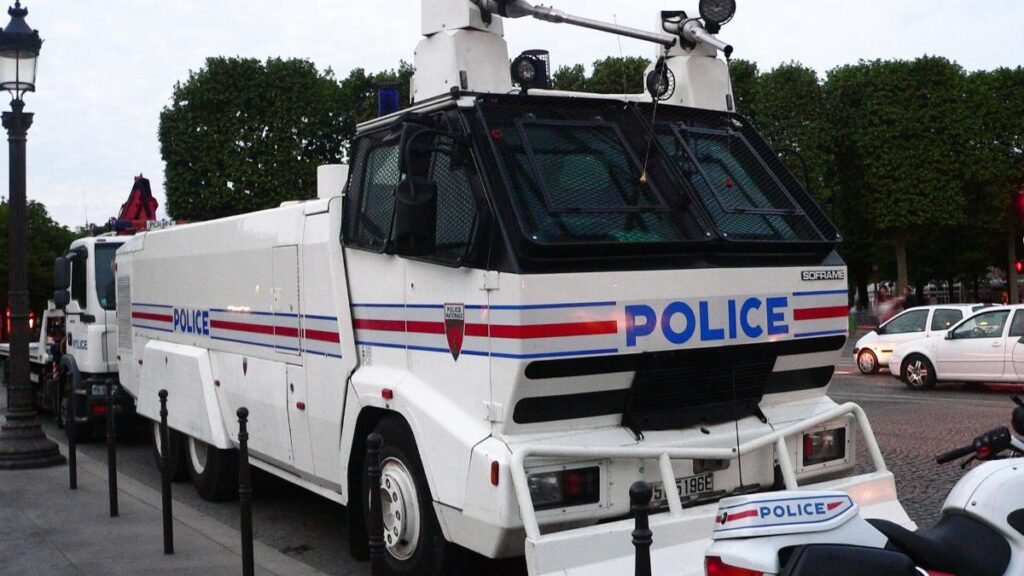
Reuters reported the operation includes the RAID and GIGN tactical units, mounted police, helicopters, drones, anti-drone systems, armored vehicles and water cannon.
“We will be uncompromising with rioters, looters and all those who commit acts of violence,” Nuñez said Friday, according to Reuters. He added: “We are ready for tomorrow. We will be extremely vigilant, extremely firm, and we will let absolutely nothing pass.”
The Justice Ministry said Thursday that about 2,700 people had been taken into custody over last weekend’s riots and looting, and 217 had been jailed after fast-track hearings, RFI reported. Justice Minister Gérald Darmanin said about half of those detained had no criminal record, the BBC reported.
City-by-city restrictions for Oct. 24
More than 600 protests were planned across France for Saturday, Connexion France reported. Prefects have issued full or partial bans in Rouen, Montpellier, Limoges and Le Mans as well as the cities below, RFI reported.
Paris
The approved march runs from Place de la Bastille to Place de la Nation under an agreement with the police prefecture first reported by France Inter, and is due to start at 2 p.m. The CGT union proposed the route, and student, high school and workers’ unions backed it, The Local reported. The prefecture banned a second route, from Bastille to Opéra, which the Yellow Vest coordination group and the student union Interfac IDF had filed. RFI reported that the Yellow Vest coordination then decided to join the union march.
The overnight curfew around Place de la République and the Les Halles shopping district has been extended until Monday. Movement in those areas is barred from 11 p.m. to 6 a.m., the BBC reported. Paris and Lyon reported no major incidents under their curfews Monday night, CBS News reported.
The capital will be partly closed. France’s Culture Ministry said the Louvre, the Orsay, the Picasso Museum and the Grand Palais would close Saturday, and it told institutions to act for “visitor safety, staff protection and the preservation of artworks,” the AP reported. The Fondation Louis Vuitton will also close, according to Reuters.
Marseille
Jacques Witkowski, the prefect of Bouches-du-Rhône, banned all demonstrations across the department on Saturday, “declared or otherwise,” according to his order as reported by Le Bonbon Marseille. Reuters and RFI’s English service also reported that all Saturday protests in Marseille were banned. RFI’s French service, however, reported Friday afternoon that in Bouches-du-Rhône “only the union demonstration in Marseille” had been given the green light. Which account holds will not be clear until Saturday.
The department’s curfew now covers adults as well as minors, from 11 p.m. to 5 a.m. on Saturday and Sunday nights, according to the same order. Transit reports have conflicted, with the BBC saying service would be suspended Saturday and Al Jazeera saying it would be restricted. The most recent account, from local outlet Maritima on Friday morning, said the prefect’s proposal to shut down the RTM bus, tram and metro network for 24 hours had not won “the necessary consensus” and that the network would keep running, with service regulated through the day as conditions require. The Marseille Chamber of Commerce urged businesses to close Saturday, Reuters reported. More than 500 businesses were damaged in the city last weekend, according to the BBC.
Lyon
Rhône prefect Etienne Guyot banned protest marches and gatherings from 10 a.m. to 11 p.m. Saturday across the Presqu’île peninsula, parts of Vieux Lyon, Confluence, the 6th arrondissement and Part-Dieu, Lyon Capitale reported. He also renewed an 11 p.m. to 6 a.m. curfew Friday night for part of the Presqu’île, including Place Bellecour. Protesters set fire to the city’s tourism office during last weekend’s protests, the BBC reported.
Nice
The Alpes-Maritimes prefecture banned demonstrations from 8 a.m. to midnight in central Nice, covering Place Masséna, Old Nice, the port and the train station area. About 450 officers will be in the city. A curfew for minors runs from 9 p.m. to 6 a.m. until Monday morning, local outlet Monte Carlo Living reported.
Toulon
The Var prefecture banned protests in part of the city center from 11 a.m. to midnight. Prefect Simon Babre also confirmed a 6 p.m. to 6 a.m. curfew on unaccompanied minors in central Toulon. Mayor Josée Massi said the Réseau Mistral bus and ferry shuttle network would stop at 10 a.m. Saturday and restart at 6 a.m. Sunday, Riviera Radio reported.
Orléans
Marine Le Pen’s National Rally is holding its party congress in the city, and about 50 organizations plan a counter-protest. Prefect Hugues Moutouh expects 20,000 to 30,000 demonstrators, the AP reported. Le Pen said she had “no concerns” about security.
What protesters say
Students started this movement in mid-September with protests over overcrowded classrooms, teacher shortages and run-down buildings. Student groups sharply criticized the union-only rule, Al Jazeera reported. In an emailed statement, UNEF said: “Macron is trampling upon the freedom to protest in our country,” Reuters reported.
“For years, we’ve been given promises that were never kept.” – Soumaya Sarre, 18, of the Federation of High School Students from Working-Class Neighbourhoods, to Al Jazeera
Nathanael Combary, 18, who chairs the student group Renouveau Lycéen, told Al Jazeera: “Let’s be clear: Our demands are not all impossible to meet.”
The unions Macron is relying on to lead Saturday’s marches have criticized his decision too. “It’s not for the president to decide who can legitimately request to protest,” Marylise Léon, general secretary of the CFDT, told TF1, according to Reuters. RFI reported that the CGT called the decision an attack on the foundations of democracy.
What’s legal: the right to protest in France
The French Constitution protects the right to demonstrate, the AP noted.
The bans have already been tested in court. On Thursday, an emergency judge at the Paris administrative court suspended a police order banning a student demonstration, and the march went ahead peacefully, the AP and France 24 reported.
Macron’s statement on Thursday is now being challenged at the highest level. Adelico, an association that defends constitutional liberties, and the Syndicat de la magistrature, a judges’ union, said Thursday they had filed an emergency petition with the Council of State, France’s top administrative court. They asked it to suspend “the decision of the President of the Republic” and any instructions issued to carry it out, according to Le Club des Juristes. Late Friday, the Council of State’s emergency judge rejected the petitions, which had been joined by the Ligue des droits de l’Homme and seven left-wing parties, L’Express reported. The judge found that Macron’s remarks did not amount to a decision to ban all protests or an instruction to prefects, so there was nothing to suspend. Prefects must still weigh the public-order risk of each gathering, and they cannot ban a protest only because of the risks that any demonstration carries. Their lawyer, Jean-Baptiste Soufron, argues that sorting protest organizers into unions and everyone else is discriminatory.
“The executive can limit this freedom to demonstrate, but it cannot under any circumstances add criteria,” Manon Lefebvre, national secretary of the Syndicat de la magistrature, told RFI, in a translation from French. Marion Ogier, a civil liberties lawyer and member of the Human Rights League (LDH), told RFI the rule has been turned upside down: demonstrations “are presumed to be freely permitted,” she said, but “today, we are on a presumption of a ban on demonstrating.” The LDH said it would go to court in some cities that have bans.
Saturday’s demonstrations come as France’s borrowing costs climb. After markets closed Friday, Moody’s left France’s Aa3 rating unchanged with a negative outlook, warning that the sharp rise in French government bond yields heightens the risk to debt affordability, CNBC reported. Our earlier report covers the bond market and Macron’s dispute with President Donald Trump.
The State Department keeps France at Level 2, “Exercise Increased Caution,” citing terrorism and civil unrest. It tells travelers to avoid demonstrations and areas with heavy police activity.
FAQ
Are all protests banned in France on Oct. 24?
No. Union-organized marches may go ahead, though some have been rerouted. In Paris, the CGT-backed march from Bastille to Nation was approved. Bouches-du-Rhône, which includes Marseille, has a department-wide ban, and Lyon, Nice and Toulon have banned protests in their city centers.
What did Macron’s defence council decide?
Macron’s office said he would announce additional decisions after Friday’s meeting. As of Friday evening in Paris, no decisions had been publicly reported.
How long does the Paris curfew last?
Until Monday morning. It covers the areas around Place de la République and Les Halles from 11 p.m. to 6 a.m. and applies to everyone.
Official links
Photo: David Monniaux/Wikimedia Commons, CC BY-SA 3.0.