Angela Lipps was babysitting at a neighbor’s house in Elizabethton, Tennessee, in July 2025 when a U.S. Marshals fugitive task force arrived with guns drawn, according to a federal lawsuit she filed last month. There was a nationwide warrant out for her arrest. North Dakota prosecutors had charged her with eight felonies in a string of bank frauds in the Fargo area, the most serious carrying up to 10 years in prison.
Lipps says she had never been to North Dakota.
She was extradited anyway and held in the Cass County Jail on a $100,000 bond. She was still there at Thanksgiving, and on her 50th birthday, the complaint says. Prosecutors dismissed every charge on Dec. 24, 2025, after her lawyer produced bank records showing she had been in Tennessee when the thefts happened.
What led police to her was a facial recognition match.
Lipps is now suing the City of Fargo and a Fargo police detective, Lucas Heck, for $10 million in U.S. District Court in North Dakota. Her case, filed Sept. 15, is the latest in a short but growing list of Americans who were arrested after a computer said their face looked like a suspect’s, and police didn’t do enough to check. The allegations in her complaint have not been tested in court, and Fargo declined to comment to MPR News on the lawsuit.
The match came from a fake ID photo, the lawsuit says
The thefts happened in April and May 2025. A woman used stolen identities and a fake ID to take money from several Fargo-area banks. According to the complaint, facial recognition software used by the West Fargo Police Department and a North Dakota intelligence center flagged Lipps as a possible match, and the results were passed to Heck.
The lawsuit says Heck pushed ahead even though Lipps lived more than 1,000 miles away, had no known connection to North Dakota, did not match the suspect’s physical description and had no unexplained money tied to the thefts. It also says he did not disclose that the match was run on the photo from the suspect’s fake ID card, not on bank surveillance video. West Fargo police reportedly said the results were not strong enough on their own to bring charges.
The complaint describes her time in custody in detail, including periods when jail staff allegedly kept her dentures and medication from her. When she was released, it says, she walked out with four cents, no winter coat and temperatures near 10 degrees, and got home with help from a nonprofit and a neighbor.
Fargo’s police chief at the time, Dave Zibolski, acknowledged “investigative errors” at a news conference in March and said the department had since adopted a facial recognition policy and training. He resigned later that month. Lipps’ lawsuit says that when she was arrested, the department had no policy, training or supervision for the technology at all. Neighboring West Fargo, by contrast, limits it to specially trained officers and bars arrests based solely on a match.
She is suing for unlawful seizure, false arrest and imprisonment, malicious prosecution, due process violations, and a civil rights claim against the city over its lack of policy and training.
Lipps is not the first, and the pattern looks familiar
The best-known cases share the same shape. Software produces a lead. Investigators treat it as an answer. Basic checks, like where the person actually was that day, come later, often after a lawyer does them.
| Person | Where | What happened | Outcome |
|---|---|---|---|
| Robert Williams | Detroit | Driver’s license photo flagged as a match to a man on video at a Shinola watch store; arrested in front of his family | Detroit paid $300,000 in 2024 and changed its rules |
| Randal Reid | Arrested in DeKalb County, Ga., on Louisiana warrants | Clearview AI match by a Jefferson Parish detective; affidavit cited only “a credible source”; jailed six days | $200,000 settlement in 2025, no admission of fault |
| Porcha Woodruff | Detroit | Arrested while eight months pregnant after a facial recognition lead and a photo lineup; held about 10 hours | Charges dropped; her lawsuit was dismissed in 2025, appeal planned |
| Angela Lipps | Arrested in Tennessee on North Dakota charges | Match allegedly run on a fake ID photo; held for months | Charges dismissed Dec. 2025; $10 million lawsuit filed Sept. 2026 |
Reid’s case hits close to home for readers here. He was pulled over outside Atlanta the day after Thanksgiving 2022 and told he was wanted in Louisiana, a state he said he had never visited, in connection with thefts of designer handbags. A Jefferson Parish Sheriff’s Office detective had matched his photo using Clearview AI, which the office had paid $25,000 for in 2019, according to Biometric Update. A Baton Rouge detective used the same identification to get a second warrant. Nobody checked where Reid’s phone had been. He spent six days in the DeKalb County jail before the warrants were withdrawn.
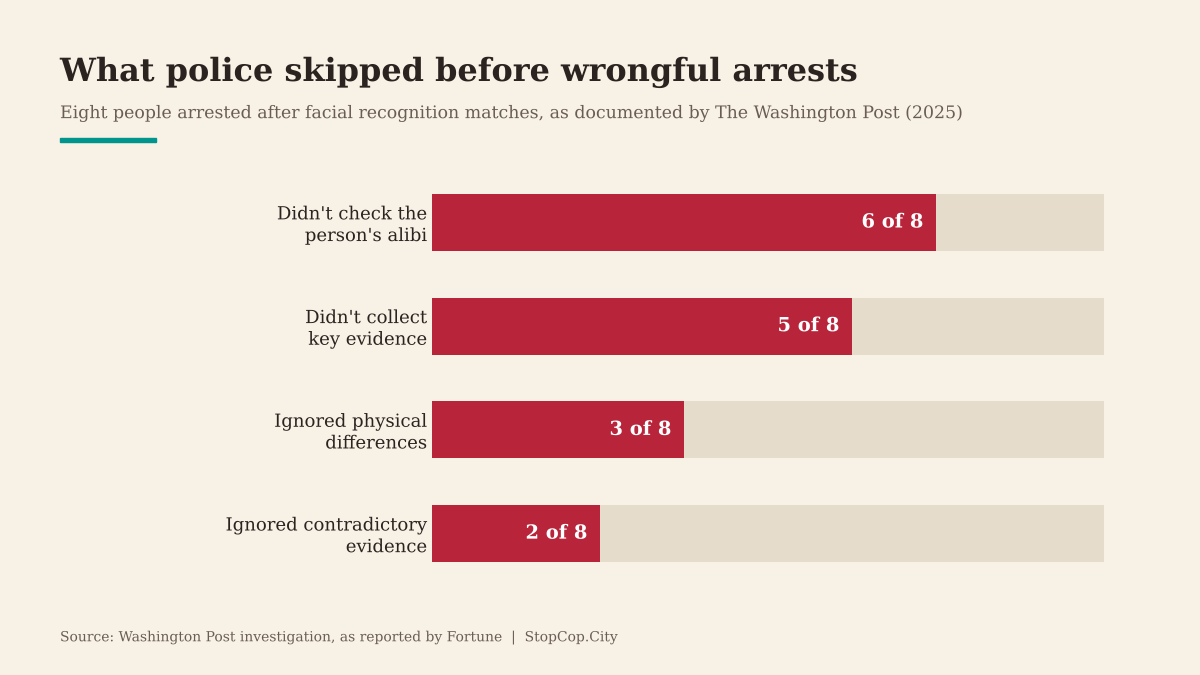
A 2025 Washington Post investigation found 15 police departments in 12 states that had arrested people identified by facial recognition without other evidence, often in violation of their own standards. In the eight wrongful arrests the Post documented, police failed to check alibis in six. Seven of the eight people were Black.
That disparity has a long paper trail. A 2019 study by the National Institute of Standards and Technology tested 189 algorithms and found many were far more likely to falsely match Black and Asian faces than white men’s. The algorithms have improved since, but the photos still matter. A blurry frame from a store camera, or a photo from someone else’s fake ID, gives software less to work with.
The fix most departments land on is a simple rule
When Detroit settled with Williams in June 2024, it agreed that police could no longer arrest anyone based only on a facial recognition result, or on a photo lineup built from a facial recognition search. It also agreed to review cases from 2017 through 2023 in which the technology was used. Phil Mayor, an ACLU of Michigan lawyer on the case, said the point was that police could use a facial recognition lead to “go out and do old-fashioned police work.”
Jefferson Parish put a similar line in writing after Reid’s arrest. A January 2023 memo said facial recognition was only a lead-generating tool and that arrests required additional evidence.
Rules like those depend on departments following them, and most are not required to report when they use the technology at all. Georgia has no statewide law governing how police use facial recognition. Neither does North Dakota or Tennessee.
Woodruff’s case shows the limits of suing after the fact. A federal judge dismissed her lawsuit against the Detroit detective in August 2025, finding her lawyer hadn’t shown the officer lacked probable cause, even as the judge called her arrest and jail time “troubling for many reasons.” Her attorney, Ivan Land, said he planned to appeal.
Lipps has asked for a jury trial.
Frequently asked questions
Can police arrest someone based only on a facial recognition match?
There is no federal rule against it, and most states have no law on the question. Some departments, including Detroit’s under a 2024 settlement, now ban arrests based solely on a facial recognition result and require other evidence.
How many people have been wrongly arrested because of facial recognition?
No one knows the full number because most departments don’t have to report when they use the technology. A 2025 Washington Post investigation documented eight wrongful arrests, and other cases, including Angela Lipps’ in North Dakota, have surfaced since.
Does Georgia regulate police facial recognition?
Georgia has no statewide law governing how police use facial recognition. Rules, where they exist, are set by individual departments.
Sources and further reading
- Atlanta News First (Gray News): Woman sues city, detective for $10 million over wrongful arrest tied to facial recognition error
- Biometric Update: Wrongful arrest linked to facial recognition error leads to $200K settlement
- Associated Press: Detroit paying $300,000 to man wrongly accused of theft
- Associated Press via Michigan Public: Woman wrongly accused of carjacking loses lawsuit against Detroit police
- Fortune: Police continue to use facial recognition software despite evidence of false arrests (on the Washington Post investigation)
- NIST: Study evaluates effects of race, age, sex on face recognition software
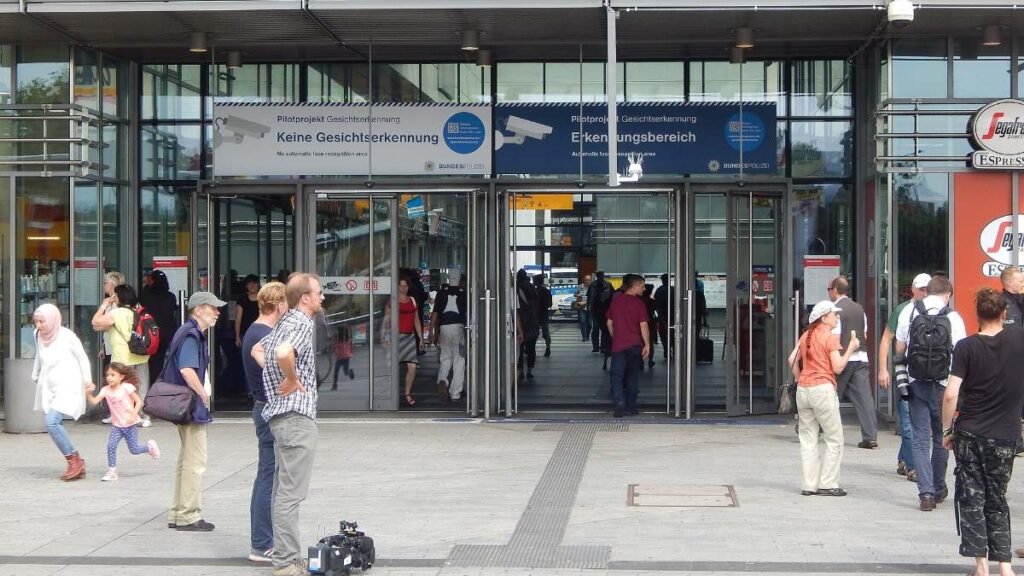
Featured image: C.Suthorn / Wikimedia Commons, CC BY-SA 4.0 (cropped)