Updated Oct. 20: Adds what acting Army Secretary Adam Telle and acting Chief of Staff Gen. Christopher LaNeve said at AUSA, the new FASCOM command and the status of nominations.
The Army is about to throw its biggest party of the year, and the two people at the top of the guest list are both temps.
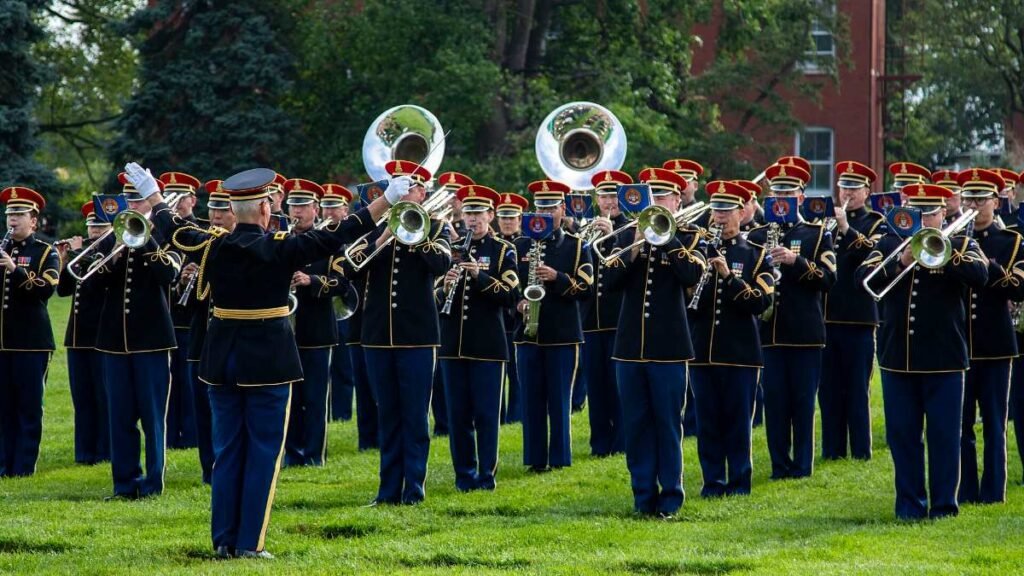
The Association of the U.S. Army‘s annual meeting kicks off Monday, Oct. 12, at the Walter E. Washington Convention Center in Washington. It’s three days of generals, defense contractors, foreign delegations, members of Congress and a lot of very expensive booths. Normally, the Army secretary and the chief of staff use it to tell everybody where the service is headed.
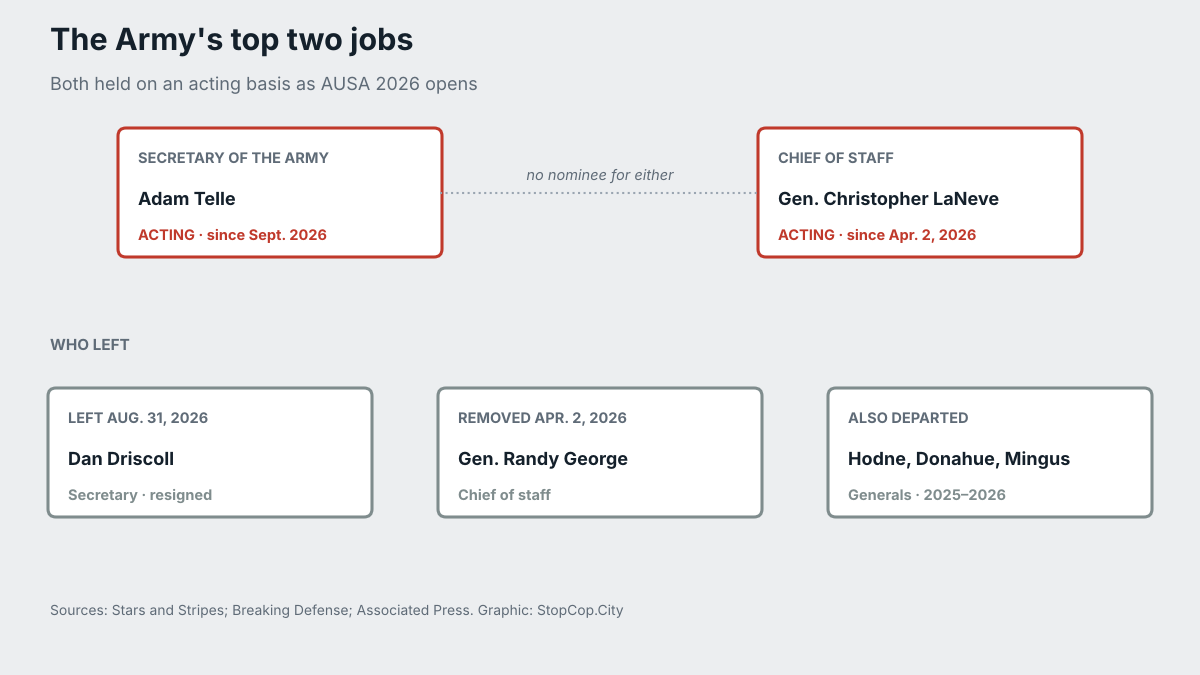
This year the secretary is Adam Telle, who’s filling in. The chief is Gen. Christopher LaNeve, who’s also filling in. Nobody has been nominated for either job.
How the Army ran out of bosses
It didn’t happen all at once.
Gen. James Mingus retired as vice chief in October 2025, about a year earlier than expected. In April, Defense Secretary Pete Hegseth removed Gen. Randy George as chief of staff with no public explanation. The Pentagon said only that George would “be retiring.” The New York Times tied it to a fight over Hegseth’s decision to pull four officers off a promotion list of 29. Gen. David Hodne, who ran the command built to overhaul the Army, and the Army’s chief of chaplains were reportedly pushed out the same day.
Gen. Christopher Donahue, the Europe commander and the Army’s loudest voice on drone warfare, stepped down in July.
Then on Aug. 31, Army Secretary Dan Driscoll quit after 18 months. He didn’t say why. But according to The Atlantic, he’d gone to President Donald Trump the week before and argued that the Army couldn’t transform while so many of its leaders were being fired, forced out or passed over.
Meet the stand-ins
Telle is the Army’s assistant secretary for civil works, the job that oversees the Army Corps of Engineers. He’s a Capitol Hill guy, not a soldier: former chief of staff to Sen. Bill Hagerty, R-Tenn., and Trump’s former point man in the Senate. Trump skipped over Under Secretary Michael Obidal, who’d normally get the acting job, to name Telle in September. Trump called him “a Great Patriot, who is respected by all.”
LaNeve is a combat veteran who commanded the 82nd Airborne and then the Eighth Army in Korea before spending a year as Hegseth’s senior military assistant. The Senate confirmed him as vice chief in January. He got his fourth star in February. Less than two months later, he was running the Army.
The Pentagon wants to keep him there. Chief spokesman Sean Parnell says LaNeve “has the complete and total trust” of Hegseth. But the White House hasn’t sent his nomination to the Senate, and The Wall Street Journal reported in August that some Republicans on the Armed Services Committee, including Iowa Sen. Joni Ernst, aren’t sold on a general with so little time wearing four stars.
The overhaul nobody’s driving
All of this lands on top of the biggest Army shake-up in years.
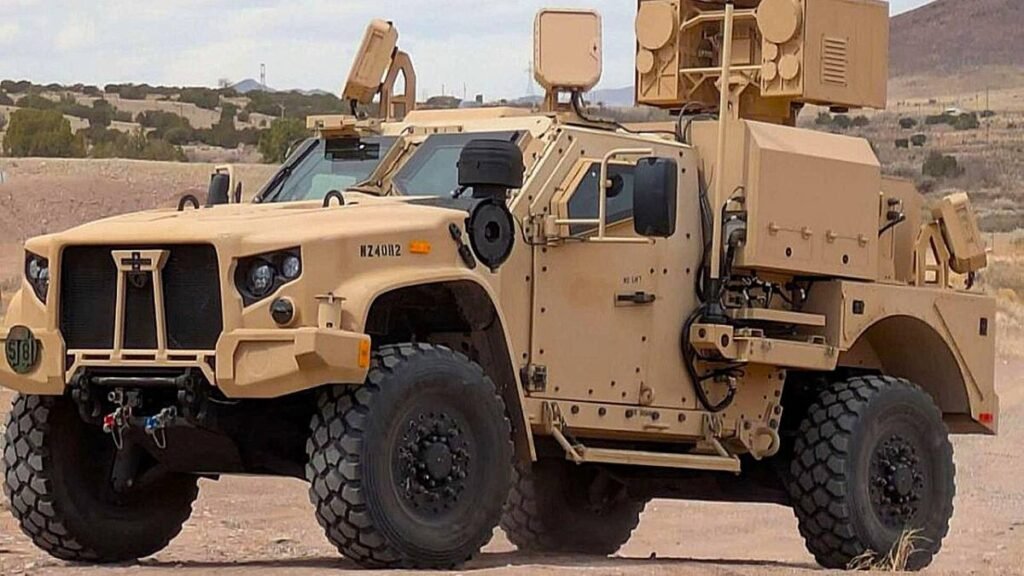
In 2025, Driscoll and George rolled out the Army Transformation Initiative. They stopped buying the M10 Booker, killed a request for more Humvees, pulled Apache battalions out of the active force and cut about 1,000 jobs from the Army staff. The idea was to free up money for drones, counter-drone gear and commercial tech, fast. “Buy capabilities, not specific programs,” George said.
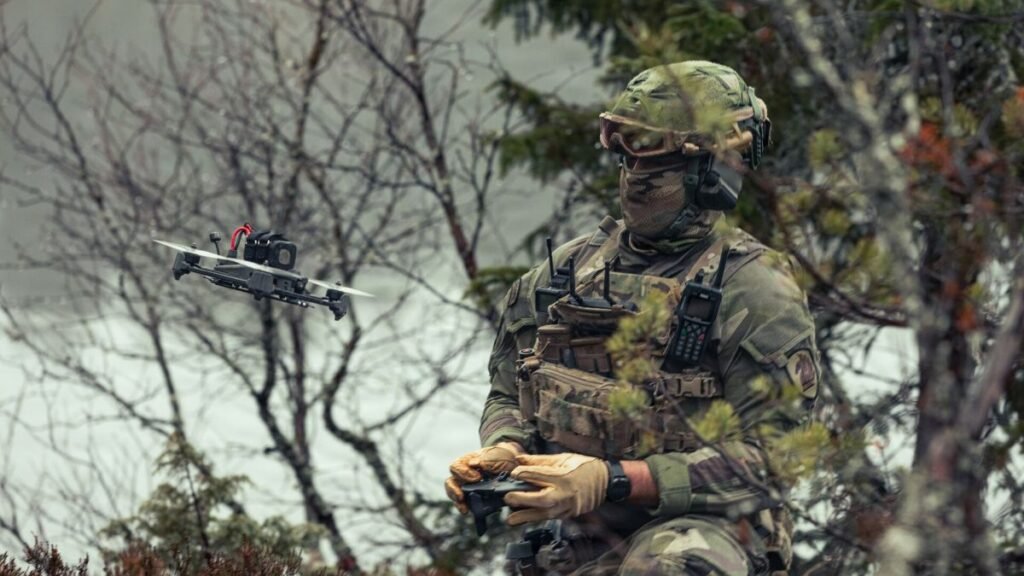
The plan hasn’t been officially scrapped. But almost everyone who built it is gone, and the vibe has shifted. LaNeve has been talking up a return to the “fundamentals of Soldiering.” The Journal reported that the Army is ending the special mission of an airborne battalion in Europe that was supposed to learn from Ukraine and speed up drone use. It’s going back to being a regular airborne unit.
That stings a little after this spring’s Combined Resolve exercise in Germany, where about 3,500 soldiers, mostly from the 1st Cavalry Division’s 3rd Armored Brigade Combat Team, went up against a force backed by Ukrainian drone operators. The Ukrainians came out ahead, according to the Journal.
Michael Horowitz, a former senior Pentagon official now at the Council on Foreign Relations, cautioned in a September analysis that the battalion decision might say more about LaNeve’s priorities than about the Army giving up on drones. A lot of the Pentagon’s drone push now runs above the Army anyway. The 2027 budget request includes about $55 billion for the Defense Autonomous Warfare Group.
Not just the Army
Hegseth has cleared out senior officers across the force since early 2025: the chairman of the Joint Chiefs, Air Force Gen. CQ Brown; the chief of naval operations, Adm. Lisa Franchetti; and the top uniformed lawyers of the Army, Navy and Air Force. Navy Secretary John Phelan left in April, and Hung Cao is the acting Navy secretary.
Sen. Jack Reed of Rhode Island, the top Democrat on Armed Services, said he “does not welcome” Driscoll’s exit and accused Hegseth of building a culture where “dissent is punished.” The White House praised Driscoll’s work on his way out.
What the acting leaders said at AUSA
The Army’s two stand-ins used the Association of the U.S. Army’s annual meeting in Washington, held Oct. 12-14, to lay out their plans, even as the service still has no confirmed secretary or chief of staff.
Acting Army Secretary Adam Telle gave his first public speech in the job on Oct. 12. “Our ability to control and secure that piece of dirt is the ultimate deterrent,” he said, according to the Army. “The pace of change is accelerating faster than humans can comprehend.”
Telle, who had led the Army’s civil works program since August 2025, promised to put the defense industry under pressure. “We’re going to stress test the supply chain, the manufacturing processes, and see where it breaks,” he said. The Army plans its first “Manufacturing Rodeo” in early 2027.
Gen. Christopher LaNeve, the vice chief of staff who is serving as acting chief, told industry leaders on Oct. 13 that the Army is not retreating from new weapons. “We are not walking away from modernization,” he said, according to Defense News. “We are sprinting towards it… and we are doing so responsibly with a recognition that resources are not endless.”
LaNeve announced that Army Futures and Concepts Command will be renamed U.S. Army Futures and Autonomous Systems Command, or FASCOM, a three-star command, Defense News reported. “FASCOM will pioneer operational concepts that harness autonomous capabilities across all warfighting functions,” he said, according to Stars and Stripes. The Army is also sorting its equipment into legacy, enduring and modern categories. “We’re going to divest legacy equipment with the intention to unburden our units as fast as we can,” LaNeve said.
The Army also published new guidance written by LaNeve, “How the Army Fights,” on Oct. 7. It is built around four ideas: convergence, strike, close battle and endurance, according to the Army.
On Oct. 14, Defense Secretary Pete Hegseth and the service secretaries appeared on an AUSA panel promoting the new Autonomous Warfare Command. Protesters interrupted several times, Stars and Stripes reported.
Still no nominees
No nomination for Army secretary or Army chief of staff had been announced as of Oct. 19, and the Senate had confirmed no one for either job. LaNeve is widely expected to be the pick for chief of staff but could face resistance in Congress, including from Republicans, Stars and Stripes reported.
For secretary, Hegseth favors Pentagon spokesman Sean Parnell, and White House Chief of Staff Susie Wiles is leading the search, CBS News reported in September. The Navy is also without a confirmed civilian leader; Hung Cao is serving as acting Navy secretary.
So what changes for soldiers?
“Dissent is punished.”
Sen. Jack Reed, describing the culture he says Hegseth has built
Day to day, not much. Pay is set by Congress and formulas, not by whoever’s in the corner office. Lawmakers are still fighting over whether junior enlisted troops get a 7% raise or 3.6% in January, a fight we broke down here.
But units that reorganized under the overhaul could see changes paused or reversed. Drone and counter-drone specialists don’t know exactly how their units will be used. And anyone watching the promotion boards has learned that things at the top can change overnight.
The clock is also ticking on the acting setup. Under the Federal Vacancies Reform Act, an acting official in a Senate-confirmed civilian job can generally serve 210 days, with the clock paused while a nomination is pending. The chief of staff job runs on different rules, but going this long without a confirmed one is rare.
Driscoll, for what it’s worth, came into the job as an outsider. He’d been a cavalry scout platoon leader in Iraq, went to Yale Law on the GI Bill, where he met JD Vance, and worked in venture capital. Last November, he took a group of Army leaders to Kyiv to meet President Volodymyr Zelenskyy and Ukrainian drone units. Nine months later, he was gone.
Sources
- Stars and Stripes: Driscoll resignation leaves a gap in Army leadership
- Breaking Defense: Trump taps Adam Telle as acting Army secretary
- Associated Press via Al Jazeera: Hegseth removes Army chief of staff
- Council on Foreign Relations: Is the U.S. Army backing off on drones?
- U.S. Army: Army leaders propose bolstering lethality through transformation
Featured image: U.S. Army photo, 3d U.S. Infantry Regiment (The Old Guard) / Wikimedia Commons, public domain (cropped)