The Army plans to execute Nidal Hasan by firing squad at Fort Hood, Texas, on Dec. 3, and the Pentagon says it will livestream the execution.
Death penalty experts consulted by Reuters said that, if it goes ahead as planned, it would be the first known broadcast or livestream of a lawful execution anywhere. It would also be the first time the U.S. military has carried out a death sentence since 1961.
The Pentagon has said details will follow. Here is what has been announced so far, and what hasn’t.
Who is Nidal Hasan?
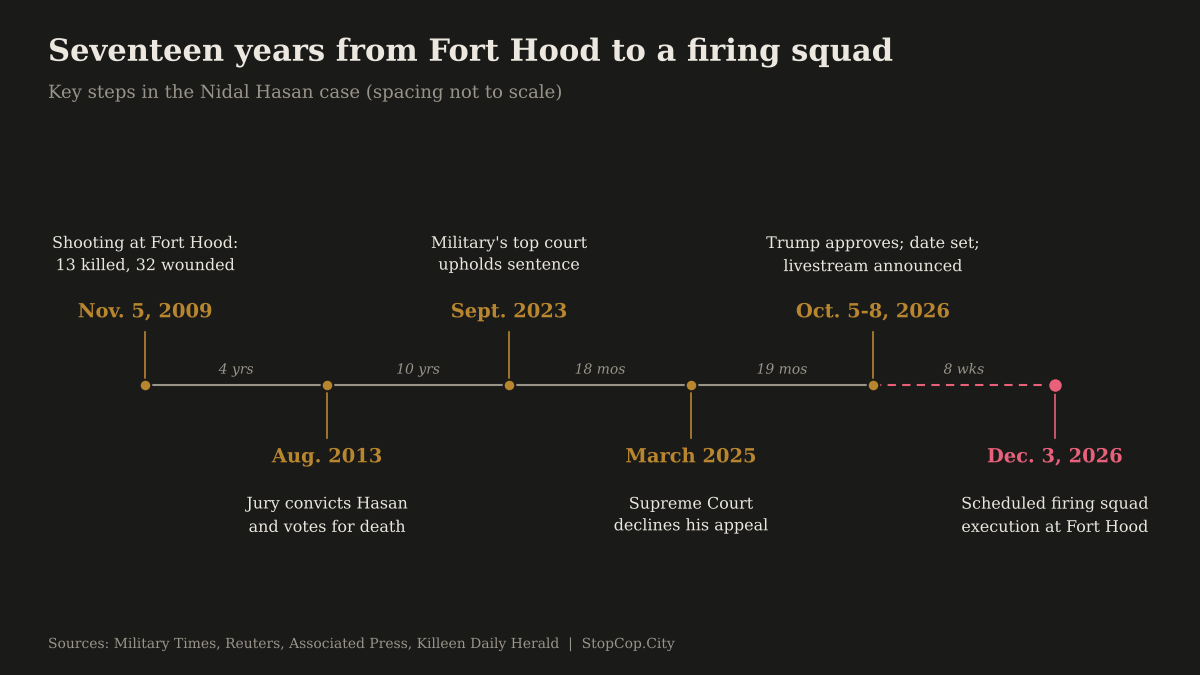
Hasan was an Army major and psychiatrist. On Nov. 5, 2009, he walked into a soldier readiness processing center at Fort Hood, where troops were waiting for immunizations and deployment paperwork, and opened fire with a laser-sighted handgun. He killed 13 people, including a pregnant soldier, and wounded 32.
Investigators recovered 146 shell casings inside the building, according to trial evidence reported by the Associated Press. Hasan said he acted to stop soldiers from deploying to Afghanistan. A military judge barred him from presenting that as a defense.
He represented himself at his court-martial, admitted to the shooting and, in August 2013, a military jury convicted him of 13 counts of premeditated murder and 32 counts of attempted premeditated murder and sentenced him to death. He is 56 and has been held on death row at the U.S. Disciplinary Barracks at Fort Leavenworth, Kansas.
How did the case get to an execution date?
Military death sentences go through several layers of review. The Army Court of Criminal Appeals affirmed Hasan’s conviction and sentence. The Court of Appeals for the Armed Forces, the military’s top court, upheld them in September 2023. The U.S. Supreme Court declined to hear his appeal in March 2025, the Killeen Daily Herald reported.
Under military law, an execution cannot happen until the president personally approves the sentence. Chief Pentagon spokesman Sean Parnell said on Oct. 5 that Defense Secretary Pete Hegseth had recommended death by firing squad and that President Donald Trump approved it. Two days later, acting Army Secretary Adam Telle set the date and place: Thursday, Dec. 3, at 1 p.m. Central time, at Fort Hood.
Hegseth said on a podcast that holding it on a Thursday at about 1 p.m. at Fort Hood, close to the day, time and place of the 2009 attack, was a “no-brainer.”
What exactly will be livestreamed?
That is the biggest open question. A Pentagon official told Reuters on Oct. 8 that the execution would be livestreamed and that more details would come later. Hegseth told Real America’s Voice that “people are able to watch it, that it’s public.”
No one has said where the stream will appear, whether it will show the shooting itself or only part of the proceedings, whether there will be a delay, or how the Army will handle the rules that normally govern who may witness an execution. The White House referred questions to the Pentagon.
Asked whether Hasan had made any final requests, Hegseth replied: “Don’t care. We’ll see him on December 3rd.”
Has anything like this happened before?
Not lawfully, according to the experts Reuters consulted. Executions in the United States take place behind prison walls before a small group of witnesses. The last legally sanctioned public execution in the country was in 1936.
The 2006 hanging of Saddam Hussein spread worldwide through official and leaked recordings, but it was not shown live. Amnesty International has said recent public executions have been concentrated in Iran and Taliban-run Afghanistan. Social media companies have spent years removing execution videos posted by extremist groups, and a livestream is hard to moderate because viewers can copy and repost it as it happens.
The military’s own record is thin. The Army last executed a soldier by firing squad on Jan. 31, 1945, when Pvt. Eddie Slovik was shot in France for desertion. The last military execution of any kind was the 1961 hanging of Army Pvt. John Bennett at Fort Leavenworth.
Could it still be delayed?
Yes. Military law experts told the AP that Hasan could file a habeas corpus petition in civilian federal court, which could slow things down considerably. Eugene Fidell, who teaches military law at Yale Law School, said the process “might outlast the current administration.”
Hasan represented himself at trial, but lawyers from the Army’s Defense Appellate Division have handled his appeals since, including the petition the Supreme Court turned down last year.
Why a firing squad?
The Pentagon has not explained the choice beyond Hegseth’s recommendation. A handful of states also authorize firing squads, and South Carolina used one in 2025.
The last time a president approved a military execution, in 2008, it never happened. President George W. Bush signed off on the death sentence of former Army Pvt. Ronald Gray, and a federal judge halted the execution before it could be carried out. Gray, convicted in 1988, remains one of four men on military death row along with Hasan, ABC News reported in June.
The Fort Hood plan is also a departure from the Army’s own playbook. An internal plan called Operation Resolute Justice, issued in February and described by ABC News, called for moving condemned prisoners from Fort Leavenworth to the federal execution facility in Terre Haute, Indiana, and preparing for an execution within 150 days of presidential approval.
The Army has not said how it will select the firing squad or who will witness the execution in person.
Sources
- Reuters via Military Times: US to livestream Army execution of Fort Hood shooter, Pentagon official says
- Reuters via Military Times: How the US military plan to livestream an execution compares with global practice
- Associated Press via PBS NewsHour: Pentagon says firing squad execution of Fort Hood shooter will be livestreamed
- Military Times: Death penalty upheld for soldier who killed 13 in base shooting (2023)
- Killeen Daily Herald: U.S. Supreme Court denies petition filed by Nidal Hasan
- ABC News: Army lays groundwork for death row executions if Trump gives approval
- The Army Lawyer: From Soldier to Condemned Prisoner
Featured image: U.S. Army / Wikimedia Commons, public domain (cropped)