WASHINGTON — The Army Black Hawk that collided with an American Airlines regional jet over the Potomac River in January 2025 had a location transmitter that hadn’t worked for some time, a crew that missed two key radio calls, and a published route that left as little as 75 feet between helicopters and landing airliners, the Army’s own investigation found.
The report, completed in May, was released Oct. 8 after months of pressure from families of the 67 people killed. Its author, a lieutenant general, described “breakdowns across all layers of conflict management,” according to the Associated Press, which obtained a copy hours before release. Reuters reported that it had also reviewed the previously undisclosed document.
The crash on the night of Jan. 29, 2025, near Ronald Reagan Washington National Airport was the deadliest U.S. aviation disaster in more than two decades. American Eagle Flight 5342, arriving from Wichita, Kansas, was on final approach when it struck the helicopter, which was on a training flight with three soldiers aboard. Everyone on both aircraft died.
The Army report spreads the blame. It says the controller at Reagan National could have prevented the crash by giving the helicopter crew more precise information about the jet and by warning the jet’s pilots about the helicopter. It criticizes air traffic control’s “non-standard terminology for directing air traffic and providing incomplete traffic advisories,” Reuters reported.
Much of it, though, is about the Army.
Two radio transmissions to the helicopter were partly blocked, so the crew never heard key details about where the jet was. The pilots were flying on night-vision goggles, which narrowed their field of view and made the airliner’s lights hard to pick out against the city behind it. The helicopter’s ADS-B Out system, which broadcasts an aircraft’s position to controllers and other planes, was not transmitting because of improper maintenance. And the Army had not fixed known problems that caused Black Hawks to display inaccurate altitude.
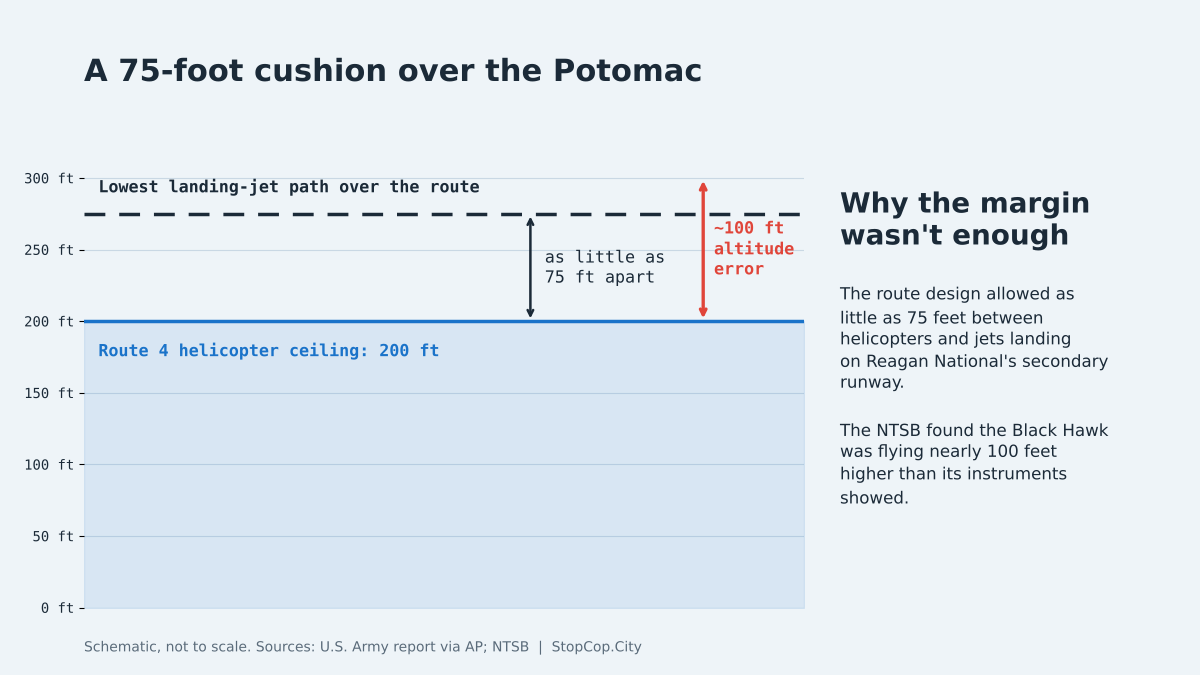
That last point mattered because of how thin the margin was. Helicopters on the route along the river, known as Route 4, were supposed to stay at or below 200 feet, which left as little as 75 feet of vertical separation from a jet landing on Reagan’s secondary runway. The design assumed helicopters would hug the riverbank, which the route did not actually require, and the 75-foot gap did not account for accepted altimeter error. The National Transportation Safety Board found the Black Hawk was flying nearly 100 feet higher than its instruments showed.
The report also found that many helicopters in the battalion, including the one that crashed, lacked a traffic collision avoidance system, that crews were often not meeting semiannual minimum flight hours, and that a working group meant to coordinate Army and FAA helicopter operations around Washington “did not discuss airspace violations, near-miss reports, or pilot deviations.”
Since the crash, the Army says it has inspected and reconfigured 3,585 helicopters, tightened crew training, added altitude-awareness testing and begun sharing close-call data with the Federal Aviation Administration. The report recommends reviewing Army helicopter flights near other big cities. An Army official told the AP that reviews of operations around Los Angeles and the Seattle-Tacoma area are underway, and Reuters reported that the recommendations also cover U.S. bases in South Korea, Japan and Germany.
The Army’s findings largely track the NTSB’s. The safety board’s final report in January blamed a long series of FAA failures, including years of missed warnings about crowded airspace at Reagan, along with weak safety culture in the military. In an Oct. 1 letter, NTSB Chair Jennifer Homendy told the Army it had made significant progress on seven of the board’s eight recommendations, but wrote that “the Army’s aviation safety system failed to consistently detect, interpret, and act on signals of latent hazards.”
The FAA, by contrast, has not acted on roughly a third of the NTSB’s recommendations aimed at it, the AP reported. After the crash it barred controllers from relying on pilots to keep visual separation in busy airspace and closed the stretch of the helicopter route that ran beneath Reagan’s approach.
Families are not satisfied. Parts of the Army report are redacted, and it assigns responsibility to the system rather than to individuals. Tim Lilley, a former Army Black Hawk pilot whose son Sam was the jet’s first officer, said the Army “owes the families and the American public a full accounting” of how the risks were allowed to persist. The Lilley family also said the report “acknowledges failures involving known altimeter issues.”
The Army said it remains “committed to transparency regarding the Army’s review.”
The House and Senate have each passed aviation safety bills that respond to the crash, but they have not agreed on a final version. The Families of Flight 5342 group said the Army’s findings strengthen the case for requiring aircraft to carry technology that lets pilots detect nearby traffic. “There is nothing left for Congress to wait for,” the group said.
Documents and reporting cited
- Associated Press: Army identifies systemic failures behind DC midair collision and calls for safety fixes
- Reuters via Military Times: US Army report cites systematic failures in 2025 helicopter and jet collision that killed 67
- NTSB: Investigation DCA25MA108, midair collision near Ronald Reagan Washington National Airport
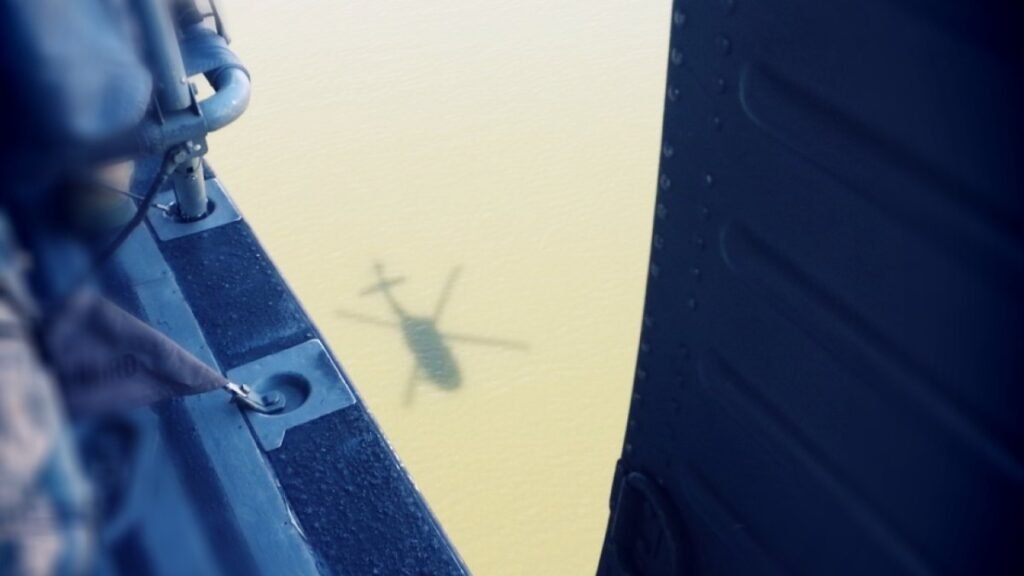
Featured image: Officer Candidate Jesse Searls / U.S. Army via Wikimedia Commons, public domain (cropped)