Three civil rights groups are asking a federal judge to force the Defense Department to explain, in its own documents, why it ordered a new study of women’s “effectiveness” in ground combat jobs, a decade after the Pentagon opened every one of those jobs to women.
The American Civil Liberties Union, the National Women’s Law Center and the Service Women’s Action Network sued the department on Oct. 8 in the U.S. District Court for the District of Columbia, according to the complaint. The case is a Freedom of Information Act lawsuit, not a challenge to the study itself. The groups filed a FOIA request on Aug. 19 and say most of the Pentagon offices likely to hold relevant records have neither made a decision on it nor released anything.
The Pentagon said it did not comment on pending litigation, Stars and Stripes reported Oct. 9. Military Times, which reported on the suit Oct. 19, did not include a department response.
What the groups want from the Pentagon
The August request asks for records on the review’s scope, purpose, methodology and anticipated use. It also seeks material on why the work was first given to the Institute for Defense Analyses and later moved to the Johns Hopkins University Applied Physics Laboratory, and on an earlier Pentagon review of occupational standards for combat jobs.
According to the complaint, the request covers records created from Jan. 21, 2025, onward. The Marine Corps confirmed receipt but denied expedited processing on Aug. 20. The office handling requests for the secretary and the Joint Staff sent an interim response on Aug. 25, denied expedited processing and cited “unusual circumstances.”
The groups say Sept. 17 was the 20-working-day deadline for the department to decide whether to comply, that the Air Force’s statutory period ran out Sept. 25, and that extended deadlines for the Defense Intelligence Agency and the secretary and Joint Staff office ran out Oct. 1.
Gillian Thomas, senior counsel at the ACLU Women’s Rights Project, framed the case around Defense Secretary Pete Hegseth. “The public has a right to know why, and what he plans to do with the results,” she said in the groups’ lawsuit announcement.
Lauren Khouri, senior director of workplace justice at the National Women’s Law Center, was blunter. “If Hegseth wants to push women out of the military, he cannot hide from the public,” she said, adding:
“We’re suing today to hold Hegseth accountable for his baseless, sexist, and offensive attacks on women servicemembers.”
Elisa Cardnell, the Service Women’s Action Network’s CEO, said the department “owes servicewomen and the public full transparency about why this study was ordered” and how the results will be used.
How the women in combat study changed hands
In December 2025, Anthony Tata, the undersecretary of defense for personnel and readiness, signed a memo directing Army and Marine Corps leaders to hand over data on readiness, training, performance, casualties and command climate in ground combat units, Military Times reported after NPR first disclosed the study on Jan. 6. The complaint dates the order to about Dec. 18. The work was assigned to the Institute for Defense Analyses, a federally funded nonprofit, with a six-month timeline.
In April, the Pentagon moved the job to Johns Hopkins APL, a university-affiliated research center, and gave it 12 months, Army Times reported. The study was renamed the “Performance, Readiness, and Integrated Mission Effectiveness Assessment.” A Pentagon official said the department “has since recognized the need to incorporate combat-relevant field tests,” and that APL can examine existing personnel and operational data as well as run those tests.
The lead researcher at APL is Jane Pinelis. Her LinkedIn profile lists her as the lab’s chief AI engineer and chief scientist for special operations, according to reporting by The War Horse published by Military Times in July. Pinelis did not respond to The War Horse’s request for comment, and APL did not respond either.
Critics questioned the switch. “Shopping around for researchers is not a good look,” Laura Junor Pulzone, a former principal deputy undersecretary for personnel and readiness, told The War Horse. Sue Fulton, executive director of the Women in the Service Coalition, said advocates worry the study “is going to be used as a pretext to remove women from combat arms.”
Not every critic opposes a review on principle. “We’re really not opposed to an evidence-based review, if it’s done legitimately,” Rita Graham, SWAN’s policy director, told The War Horse.
The 2015 Marine study and why it’s contested
Pinelis’ name matters because of her earlier work. In 2015, as a statistician, she led the design and analysis of the Marine Corps’ study of gender-integrated ground combat units, The War Horse reported. The study found that all-male units outperformed mixed-gender units on 69% of tasks.
Critics attacked it quickly. Ellen Haring, a retired Army colonel, told NPR in 2015, “It was a flawed design from the get-go.” The groups’ complaint calls it “widely-discredited” and says critics have described it as “biased in its selective reporting of results.” In a 2022 Forbes interview cited by The War Horse, Pinelis acknowledged the finding was “a very politically unpopular conclusion” and said, “There’s no room for compromise when it comes to scientific rigor.”
Hegseth leaned on the study in his 2024 book, “The War on Warriors,” which devotes a chapter to women in combat. He cited its finding that female Marines were injured at higher rates than male Marines, The War Horse reported. Marine Corps briefing materials said better physical screening would have eliminated that gap.
The Marine Corps had sought a partial exemption from integration. Then-Defense Secretary Ash Carter rejected it and on Dec. 3, 2015, announced that all military occupations would open to women who met the standards, with no exceptions. “They’ll be allowed to drive tanks, fire mortars and lead infantry soldiers into combat,” Carter said, according to the Army. Nearly 220,000 positions, about 10% of the force’s jobs, were still closed to women before that decision, the Marine Corps reported.
What the Pentagon has said about the review
The department has publicly framed the study as routine policy evaluation focused on standards, not on excluding anyone. A Pentagon official told Army Times in April that the review is “in line with standard [Department of War] practice for evaluating the effects of significant policy changes” and is “expected to further this tradition, increasing the lethality and readiness of the force.”
Pentagon press secretary Kingsley Wilson said in January that combat arms standards would be “sex neutral” and apply equally to all personnel, Military Times reported. In an emailed statement, she said the department “will not compromise standards to satisfy quotas or an ideological agenda — this is common sense,” according to Army Times.
That position grows out of a March 2025 memo in which Hegseth ordered a 60-day review of combat arms standards. “All entry-level and sustained physical fitness requirements within combat arms positions must be sex-neutral,” the memo said, according to Military Times. In a September 2025 speech to senior military leaders, Hegseth said combat jobs would return to “the highest male standard” and that “if that means no women qualify for some combat jobs, so be it,” Military Times reported.
Hegseth’s own words have shifted. On Shawn Ryan’s podcast in late 2024, before his nomination, he said, “I’m straight up just saying we should not have women in combat roles.” At his 2025 confirmation hearing, he said women would keep access to ground combat roles “given the standards remain high,” Army Times reported. Military Times wrote that he has since softened his rhetoric, though critics say he is pursuing the same goal under the banner of standards.
What’s next in the FOIA lawsuit
The case asks the court to order the department to process the request promptly, conduct an adequate search, release the records and grant a fee waiver. Under Justice Department FOIA litigation guidance, the government’s answer is generally due 30 days after it is served with the complaint, and production schedules are often set by agreement or court order.
The department could also withhold some records under FOIA’s exemptions, and the groups could contest those withholdings later.
Key dates in the women in combat review
- Dec. 3, 2015: Carter opens all combat jobs to women who meet the standards.
- March 2025: Hegseth orders a review of combat arms standards and calls for “sex-neutral” requirements.
- December 2025: Tata’s memo launches a six-month review at the Institute for Defense Analyses.
- Jan. 6, 2026: NPR first reports the review.
- April 2026: The study moves to Johns Hopkins APL and is extended to 12 months.
- Aug. 19, 2026: The ACLU, NWLC and SWAN file their FOIA request.
- Oct. 8, 2026: The groups sue the Defense Department in federal court in Washington.
Official links
- ACLU: Civil rights groups file lawsuit against DOD
- National Women’s Law Center: ACLU et al. v. Department of Defense case page
- Complaint, ACLU et al. v. DOD, No. 1:26-cv-03516 (D.D.C.)
- Defense Department: March 2025 combat arms standards memo
- U.S. Army: SecDef opens all military occupations to women (2015)
- Justice Department: FOIA litigation considerations
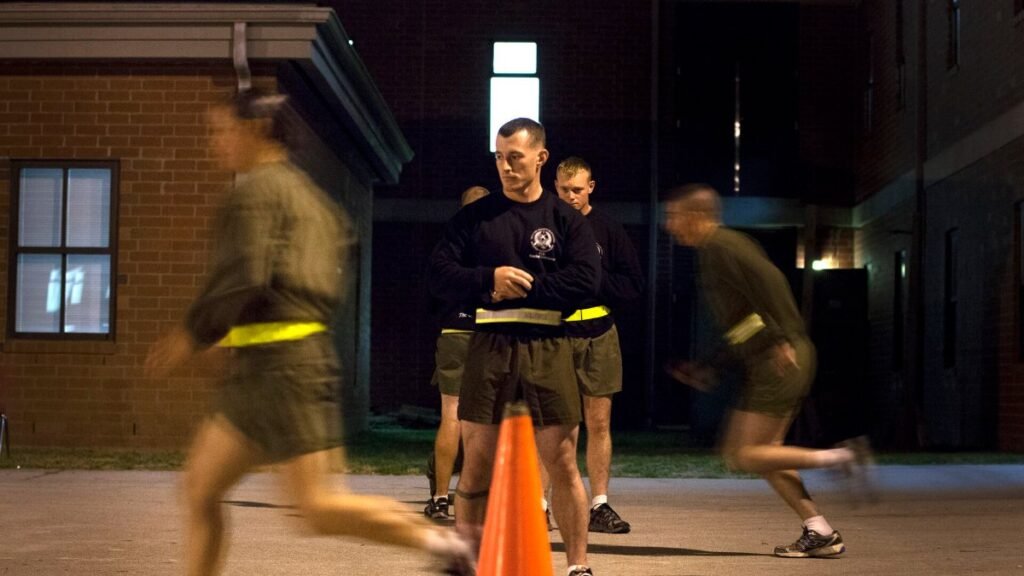
Photo: Cpl. Chelsea Anderson/U.S. Marine Corps.