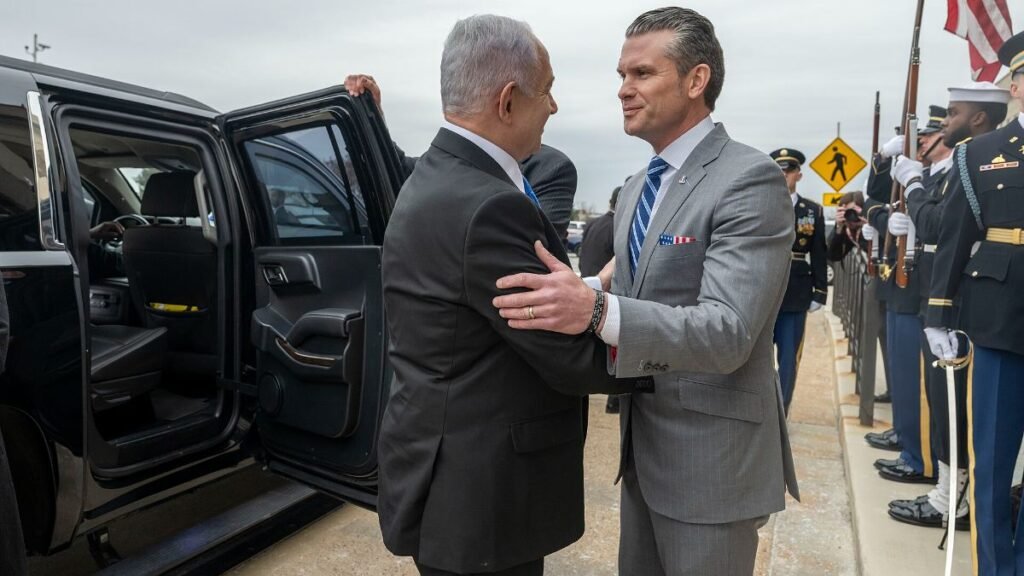
Defense Secretary Pete Hegseth flew into Israel without public notice on Monday and met Prime Minister Benjamin Netanyahu at Uvda Air Base in the Negev desert, where the two discussed Iran, according to Israeli officials. The visit, first reported by Axios and confirmed Tuesday by Netanyahu’s office, came eight days before Israelis vote in a national election and as the nearly eight-month U.S.-Iran war sits in an uneasy, increasingly violent pause.
The Pentagon has said almost nothing. A Defense Department spokesman declined to comment on reports of the trip, Al Jazeera reported. Hegseth’s own account was brief. He posted on X that he had visited U.S. troops in the Central Command region, without naming a country, and on Tuesday said he “was there visiting our troops” and “had a chance to talk to the prime minister,” CBS News reported. “The nature of our conversations is not something I would talk about,” he said, adding that the two have “been good partners.”
What happened at Uvda Air Base
Netanyahu’s spokesman, Doron Spielman, told Reuters the meeting took place at Uvda, an Israeli air force base in the southern Negev, and that the two men discussed “the threats in the region,” Defense News reported, carrying the Reuters story. Three Israeli officials said Iran was on the agenda.
According to Spielman, Hegseth thanked Israel for hosting U.S. forces, which the spokesman said number in the thousands, and passed along President Donald Trump’s support for Netanyahu. “There’s a deep personal relationship here that was at the core of this discussion,” Spielman said, according to Al Jazeera.
Hegseth’s post, from his @SecWar account, read: “As always, it was an honor to visit our warfighters in @CENTCOM today. The best of our country, on a historic mission,” The Times of Israel reported.
Why now: Hormuz, the Houthis and stalled talks
The war began Feb. 28, when U.S. and Israeli forces struck Iran. A Pakistan-brokered ceasefire took hold April 8, and in June the two sides agreed to a 14-point framework known as the Islamabad memorandum of understanding. It called for the U.S. to lift its naval blockade of Iranian ports within 30 days, for Iran to reopen the Strait of Hormuz, and for about $24 billion in frozen Iranian assets to be released in phases over 60 days of further talks, Al Jazeera reported. That window closed in mid-August without an extension. The blockade remains, and Iran has kept the strait shut, saying Washington must move first. Trump rejected an Iranian proposal to end the war on Sept. 26.
The strait is getting more dangerous, not less
Shipping attacks in and near Hormuz have climbed sharply this month. The U.K. Maritime Trade Operations center said October had become the worst month for attacks on shipping in the strait since March, CBS News reported Tuesday. Iran’s Revolutionary Guards said two “violating” tankers were “set ablaze and halted” at what they called an illegal crossing point in the southern strait, then said a third “exploded and caught fire after striking a naval mine south of the Strait of Hormuz.” Trump had declared in late August that U.S. forces had “totally cleared the strait of mines.”
Iran’s foreign minister, Abbas Araghchi, has kept a seven-day plan on the table. Under it, the U.S. would end its blockade and lift oil sanctions in exchange for a ceasefire on all fronts. If Washington complies, “the Strait of Hormuz will reopen on the sixth day, and negotiations will begin on the seventh day,” Araghchi told Iran’s Tasnim news agency, CBS News reported.
Houthi strikes on Saudi Arabia
The second pressure point is Yemen. Iran-aligned Houthi forces have fired missiles and drones deep into Saudi Arabia. An Oct. 10 strike on King Khalid International Airport in Riyadh killed at least 13 people and wounded more than 300, and the capital came under attack three days running, Al Jazeera reported. Asked about it, Trump said, “Well, the Houthis are misbehaving very badly. No good.” Iran’s foreign ministry has rejected Saudi claims that Tehran is involved in the attacks.
Diplomacy is moving, slowly
Pakistan’s army chief, Field Marshal Asim Munir, arrived in Tehran on Tuesday for his fifth visit since the ceasefire, a day after Russian Foreign Minister Sergey Lavrov made his first trip to the Iranian capital since the war began. Iranian President Masoud Pezeshkian told Munir that “Washington must lift its pressures, threats and sanctions before any negotiations,” according to a readout cited by CBS News. Qatar’s foreign ministry spokesman, Majed al-Ansari, struck a different note: “The negotiation is ongoing. We are seeing engagement from the parties.”
Iran is also rebuilding its military leadership. Lawmakers on Oct. 18 approved Mehrdad Akhlaghi as defense minister, replacing a predecessor killed on the war’s first day, The Times of Israel reported, citing AFP. Akhlaghi has threatened “enormous damage” if U.S. attacks resume.
On the U.S. side, Trump wrote on Truth Social on Oct. 8, “We will not be attacking Iran at any time prior to the Midterm Elections,” which fall on Nov. 3. Netanyahu has reportedly said he is not seeking to strike Iran before Israel’s own vote.
US forces in Israel: what is actually known
Spielman’s “thousands” is the most specific public figure, and it came from Netanyahu’s office, not the Pentagon. The Defense Department has not published a count of U.S. personnel in Israel. Reuters reported that Israel has hosted additional U.S. forces, including military aircraft, since at least February.
Missile defense is the best-documented part of that presence. The U.S. sent a Terminal High Altitude Area Defense battery to Israel in October 2024, with about 100 troops to operate it, after Pentagon spokesman Maj. Gen. Pat Ryder confirmed the deployment, The Times of Israel reported at the time. During this year’s fighting, the U.S. fired more than 200 THAAD interceptors at missiles headed for Israel, reportedly more than half its THAAD inventory, along with more than 100 SM-3 and SM-6 interceptors, according to a Washington Post analysis of Defense Department data summarized by The Times of Israel in May. Israel fired about 190 of its own interceptors over the same period.
Those numbers explain part of the interest in Hegseth’s trip. If fighting resumes, the U.S. would again be defending Israeli airspace with a stockpile it drew down heavily this year. The Pentagon told the Post that ballistic missile interceptors “are just one tool in a vast network of systems and capabilities.” The U.S. has also sent an additional aircraft carrier toward the region, expected to arrive by late November, Al Jazeera reported.
The Israeli election angle
Israelis go to the polls Oct. 27, the first national election in four years and the first since the Hamas-led attack of Oct. 7, 2023. Trump gave Netanyahu his “Complete and Total Endorsement” on Sunday, a day before Hegseth landed, and called him “a Great Warrior Prime Minister,” according to Al Jazeera and CBS News. Vice President JD Vance did not follow. “I endorse American candidates, and that’s where I’m focused is on the midterms,” Vance said Monday in an interview with the digital outlet 2WAY, according to Al Jazeera. “I’m not getting involved in Israeli elections.”
Polls project Netanyahu’s religious-nationalist coalition will lose its governing majority, though the opposition may struggle to form a government of its own, Al Jazeera reported.
In a statement released by his office Tuesday, Netanyahu said he had spoken with Trump on Sunday and added:
“We are committed to completing the elimination of the Iranian regime.” — Benjamin Netanyahu, as reported by Al Jazeera
A meeting with the U.S. defense secretary at an Israeli air base, a week before the vote, carried a message whatever was said inside. For Netanyahu, it showed Washington standing with him. For Tehran, it came alongside Trump’s remark Tuesday in the Oval Office that he is deciding whether to win “the nice way or the not nice way,” CBS News reported.
What to watch
- A Pentagon readout. Any official account of the Uvda meeting, or of where Hegseth went next, would be the first U.S. description of what was discussed.
- Munir’s talks in Tehran. Pakistan brokered the April ceasefire; a new proposal out of this trip, or a flat rejection, will shape the coming weeks.
- Shipping in Hormuz. More mine strikes or vessel attacks would add pressure on Washington to act on the blockade, one way or the other.
- Houthi fire on Saudi Arabia. Houthi leaders have warned of retaliation against U.S. interests if Washington joins the fighting in Yemen.
- Oct. 27 in Israel. A Netanyahu loss or a drawn-out coalition fight could change who in Jerusalem is making decisions on Iran.
- Nov. 3 in the U.S. Trump’s no-strike pledge runs through the midterms. Iran’s armed forces chief has said Tehran will not wait on those results before answering any new attack.
Official links
- U.S. Department of Defense
- U.S. Central Command
- Israel Prime Minister’s Office
- U.S. Embassy in Israel
- Israel Central Elections Committee
Photo: Senior Airman Madelyn Keech/U.S. Air Force (DoD).