Seven years into Chicago’s police consent decree, one of its core promises still has no answer: who should run the criminal investigation when a Chicago police officer kills someone.
At a status hearing Tuesday, Oct. 20, before U.S. District Judge Rebecca Pallmeyer, the Illinois Attorney General’s Office said the city and the Chicago Police Department have not met Paragraph 492 of the decree and called for a law enforcement task force built from several outside agencies to take over those investigations, the Chicago Tribune reported.
“An agency should not investigate a death that occurs at the hands of one of its own,” said Chris Wells, chief of the attorney general’s public interest division, according to the Tribune. He called the requirement “one of the most significant remaining projects” in the decree and said, “The city of Chicago and CPD can not achieve compliance with PCRIA on their own.”
Since 2019, Chicago has averaged about 14 police shootings a year, the Tribune reported.
What Paragraph 492 of the consent decree requires
Paragraph 492 says criminal investigations into the actions of any CPD member relating to an “officer-involved death” will comply with the Police and Community Relations Improvement Act, the Illinois law known as PCRIA. Under the decree, the city must use “best efforts” to make sure a “law enforcement agency,” as PCRIA defines that term, handles those investigations, and that the agency has “substantial experience and expertise in criminal homicide investigations.”
The state law sets the floor. Section 1-10 of PCRIA says each officer-involved death investigation “shall be conducted by at least 2 investigators, or an entity or agency comprised of at least 2 investigators, one of whom is the lead investigator.” The lead must be certified as a lead homicide investigator. And the investigators generally cannot work for the agency that employs the officer involved. The one carve-out is for Illinois State Police investigators who are not assigned to the same division or unit as the officer.
Pallmeyer pointed out at the hearing that the issue “involves not only the consent decree, but plain language of state law,” the Tribune reported.
Why the requirement is still unmet
Today, when a Chicago officer fires a gun, the case runs on two tracks inside the city. CPD detectives assigned to the department’s Investigative Response Team handle the investigation, according to the Tribune. The Civilian Office of Police Accountability, the city’s civilian oversight agency, conducts an administrative investigation into whether the force fell within CPD policy.
COPA does not bring criminal cases. Its own guidance says its investigators “have no arrest powers” and that it “refers all officer-involved shootings to the Cook County State’s Attorney” for independent review. If prosecutors open their own case, COPA keeps working the administrative side while the State’s Attorney’s Office runs a parallel criminal investigation.
That leaves CPD detectives investigating shootings by CPD officers. The attorney general’s office says that setup cannot satisfy PCRIA when someone dies.
The 14th Independent Monitoring Report, filed Oct. 13 and covering Jan. 1 through June 30, 2026, says the parties restarted work on the issue over the past year and the attorney general’s office worked with the city on possible paths to compliance. As of June 30, though, the parties were still working toward “a viable path forward,” and the monitor did not find compliance.
CPD did put its revised officer-involved shooting and death policy series, General Order G03-06 and related directives, into effect June 30, 2026. That earned preliminary compliance on Paragraphs 488 through 491, the monitor found. Paragraph 492, which deals with who investigates, was not part of that.
Wells told the court the most likely fix is “a combination of resources from multiple law enforcement agencies assembled into a task force.” He named the Illinois State Police and the Cook County Sheriff’s Police as possible sources, the Tribune reported.
Who supports a task force and who opposes it
The attorney general and CPD leadership
Wells framed the issue as one of public trust. “Public confidence depends in significant part on who is conducting these types of investigations,” he said, according to the Tribune.
Interim CPD Superintendent Fred Waller backed the idea. “To have a task force that allows us to have transparent, external investigations of police shootings,” he said, “that’s something that we’ve always looked for,” the Tribune reported.
The Fraternal Order of Police
John Catanzara, president of the Fraternal Order of Police, questioned where the money and manpower for any task force would come from, the Tribune reported. He also disputed that the city is out of compliance.
“I mean, the current (expletive) paragraph is being met by the current setup, there’s no violation of it,” Catanzara said. He also took aim at the monitoring team, which is led by Maggie Hickey: “I just don’t get where Maggie’s coming from.”
No cost estimate or staffing commitment for a task force was reported from the hearing. A unit that meets PCRIA would need certified lead homicide investigators from outside CPD, on call for a city averaging more than one police shooting a month.
How other states handle police-involved deaths
Several states have moved criminal investigations of police killings out of local departments, either into the attorney general’s office or into a standalone state agency.
| Jurisdiction | Who investigates | Legal basis | Cases covered | Who decides charges |
|---|---|---|---|---|
| Chicago (current) | CPD Investigative Response Team; COPA handles the administrative review | Consent decree Paragraph 492 and PCRIA require an outside agency; not yet met | Officer-involved shootings and deaths | Cook County State’s Attorney, on referral from COPA |
| New York | Attorney General’s Office of Special Investigation | Executive Law Section 70-b, effective April 1, 2021; earlier Executive Order 147 (2015) was narrower | Deaths caused by police or peace officers, including corrections officers, on or off duty; not federal officers | OSI itself; it must present to a grand jury or issue a public report explaining why not |
| New Jersey | Attorney General’s Office of Public Integrity and Accountability | N.J.S.A. 52:17B-107 (P.L. 2019, c. 1); AG Directive 2019-4 | Deaths from police use of force, during police encounters, or in custody | A grand jury; fatal use-of-force and police-encounter cases must be presented once the investigation is complete |
| Washington | Office of Independent Investigations, led by a civilian director | Created by the Legislature in 2021 (RCW 43.102) | Deadly force resulting in death, substantial bodily harm or great bodily harm | The local prosecutor; OII makes no charging recommendation |
New York’s prosecutor model
New York gives its attorney general the investigation and the prosecution. Under Section 70-b, OSI takes a case when an officer has caused a death or there is a question whether one did. In its 2026 annual report, OSI said it closed 41 investigations since its previous report, brought criminal charges in five new cases and won guilty verdicts in both cases it took to trial.
New Jersey’s grand jury rule
New Jersey’s attorney general handles fatal police encounters, and those cases must be presented to a grand jury once the investigation is done, under procedures set in 2021.
Washington’s standalone agency
Washington built a separate agency from scratch, and its rollout shows how long that can take. The Office of Independent Investigations grew out of a governor’s task force and was created in 2021. It did not start responding to cases until Dec. 1, 2024, and then only in 12 counties in Southwest Washington and on the Olympic Peninsula. It expanded into Pierce County on May 1, 2026. As of late April, it had responded to nine incidents, submitted four completed investigations to local prosecutors and had 32 investigators statewide.
Where Chicago’s consent decree stands now
The consent decree, which grew out of the attorney general’s 2017 lawsuit against the city, was approved by the federal court on Jan. 31, 2019. It stays in place until a federal judge finds CPD has put the required reforms into effect and kept them there.
The monitor scores progress at three levels: preliminary compliance usually means a compliant policy exists, secondary means personnel are trained on it, and full means the reform works in practice.
Of the 552 original monitorable paragraphs, the city reached preliminary compliance on at least 546, or about 99%, by June 30. It reached secondary compliance on 428, or about 78%, and full compliance on 188, or about 34%. Six paragraphs had not reached any level.
Counting all 609 monitorable paragraphs, including later additions, the figures are about 99%, 73% and 32%.
So the headline 99% figure mostly measures written policy. Only about a third of the decree has been carried all the way through to practice, and the monitor has yet to find any compliance with Paragraph 492.
“We hope to have more to report on PCRIA compliance in Independent Monitoring Report 15,” the monitoring team wrote.
Official links
- Illinois Attorney General: Chicago Police Consent Decree
- Chicago Police Independent Monitoring Team: reports
- Civilian Office of Police Accountability (COPA)
- Illinois General Assembly: 50 ILCS 727/1-10 (PCRIA)
- New York Attorney General: Office of Special Investigation
- New Jersey Attorney General: directives and guidance
- Washington Office of Independent Investigations
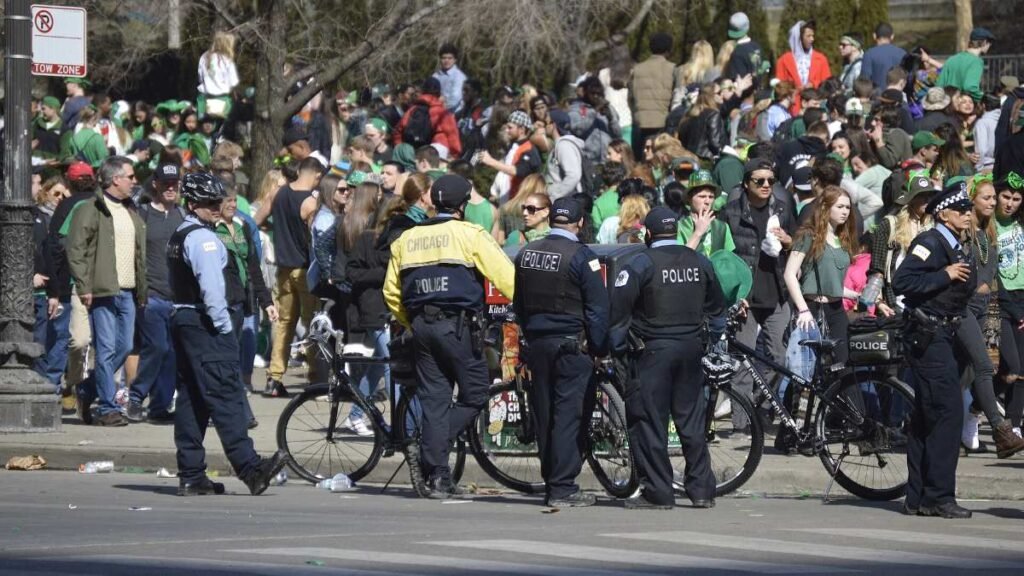
Photo: Arvell Dorsey Jr./Wikimedia Commons, CC BY 2.0.