Updated Oct. 21, 2026: Added where the Veterans’ Compensation Cost-of-Living Adjustment Act stands in Congress, what VA’s rate tables show now and what veterans told Stars and Stripes about the 3.6% figure.
Veterans getting VA disability checks are set to get a 3.6% raise in the payment that arrives Dec. 31, once Congress passes the annual VA cost-of-living bill. The Social Security Administration made it official on Wednesday, Oct. 14.
That’s the Social Security Administration‘s 2027 cost-of-living adjustment. VA compensation has moved in lockstep with Social Security for decades, so whatever retirees get, disabled vets get too.
It’s the biggest bump since 2023’s 8.7%. This year’s was 2.8%.
How much more you’d get
Here’s the math at 3.6% for a veteran with no dependents, using VA’s current rate table. VA’s official 2027 numbers may be off by a few cents because of rounding.
| Rating | Now | 2027 (est.) | More per month |
|---|---|---|---|
| 10% | $180.42 | $186.92 | +$6.50 |
| 20% | $356.66 | $369.50 | +$12.84 |
| 30% | $552.47 | $572.36 | +$19.89 |
| 40% | $795.84 | $824.49 | +$28.65 |
| 50% | $1,132.90 | $1,173.68 | +$40.78 |
| 60% | $1,435.02 | $1,486.68 | +$51.66 |
| 70% | $1,808.45 | $1,873.55 | +$65.10 |
| 80% | $2,102.15 | $2,177.83 | +$75.68 |
| 90% | $2,362.30 | $2,447.34 | +$85.04 |
| 100% | $3,938.58 | $4,080.37 | +$141.79 |
Rated 30% or higher with a spouse or kids on your award? Your raise is bigger in dollars, because the add-ons for dependents go up by the same percentage. Quick way to estimate it: take the total on your latest award letter and multiply by 1.036.
And since VA disability isn’t taxed, what you see is what you get.
Where 3.6% comes from
Nobody in Washington picks the number. It’s a formula.
The government averages a consumer price index called CPI-W for July, August and September, then compares it with the same three months last year. The change, rounded to one decimal, is the COLA. July and August are already in. September comes out from the Bureau of Labor Statistics at 8:30 a.m. Eastern on Oct. 14, and the announcement follows.
The final number matched what AARP and The Senior Citizens League forecast in late summer. Earlier in the year the guesses were all over the place, from 2.8% in a February model run by the Military Officers Association of America to 3.9% from The Senior Citizens League in May.
When it actually hits your account
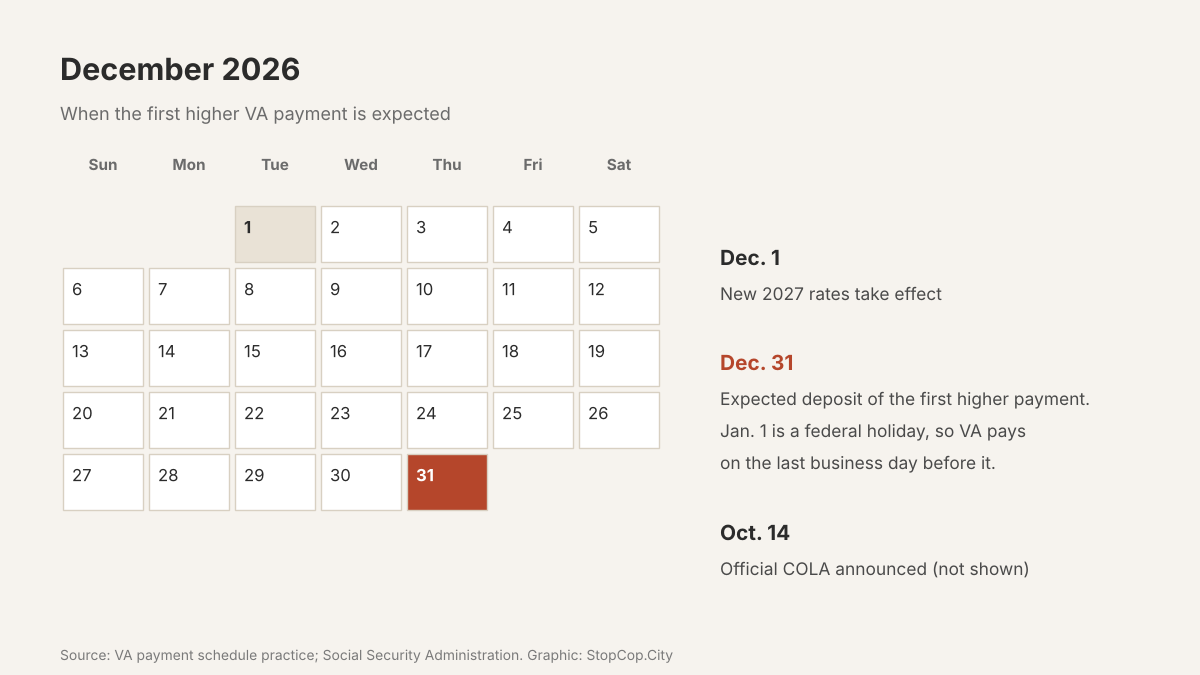
New rates kick in Dec. 1. But VA pays for the month that just ended, so the December raise shows up in the payment that normally lands Jan. 1.
Jan. 1 is a Friday and a federal holiday, which means VA pays on the last business day before it. Look for the bigger deposit on Thursday, Dec. 31.
You don’t have to file anything. Once Congress and the president approve the increase, VA applies it automatically.
Why Congress still has to approve the 3.6% VA increase
The Social Security announcement sets the number. It doesn’t raise VA rates by itself. Unlike military retired pay, which goes up automatically under permanent law, VA disability compensation needs its own act of Congress each year.
Stars and Stripes put it plainly in its Oct. 14 report: “Congress must pass a specific bill every year to direct the VA to increase compensation rates.” The current VA rate tables still show the rates that took effect Dec. 1, 2025, with $180.42 for a 10% rating and $3,938.58 for a veteran alone at 100%.
Where the 2026 bill stands
| Bill | Introduced | Latest action |
|---|---|---|
| S. 4487 (Sen. Jerry Moran, R-Kan.) | May 11, 2026 | Referred to Senate Veterans’ Affairs Committee, May 11 |
| H.R. 8552 (Rep. Morgan Luttrell, R-Texas) | April 28, 2026 | Forwarded to full House Veterans’ Affairs Committee by voice vote, June 30 |
Both bills carry the formal name Veterans’ Compensation Cost-of-Living Adjustment Act of 2026, and neither has passed its chamber, according to the official bill status records. With the Nov. 3 elections ahead, the session after Election Day is the realistic window to finish the job before the Dec. 1 effective date.
The bill has bipartisan backing. When the Senate version was announced in May, Sen. Richard Blumenthal, D-Conn., said, “As the cost of groceries, housing, and gas continues to skyrocket, veterans deserve to know their benefits will keep pace,” according to the Senate Veterans’ Affairs Committee. Moran said, “Congress has a responsibility to deliver meaningful benefits for veterans and their families.”
What veterans are saying about the number
Not everyone sees 3.6% as much of a win. Adam Jacob, a veteran with a 100% rating, told Stars and Stripes, “The COLA [cost of living adjustment] never really keeps up with inflation.” He added, “Don’t get me wrong. I am still grateful for it.”
Brett Martin, a retired Navy captain who heads the Oklahoma Veterans Commission, took the other view on social media: “Every additional dollar matters.”
What to watch between now and Dec. 31
- A floor vote on S. 4487 or H.R. 8552, or the language folded into a larger veterans bill
- The president’s signature, which makes the 3.6% official for VA
- New rate tables on VA.gov with a Dec. 1, 2026, effective date
- The larger deposit on Thursday, Dec. 31
Until VA posts its own tables, the dollar amounts above are estimates based on the 3.6% figure.
Who else gets it
- Survivors on DIC: same percentage.
- VA pension: the maximum rates and income limits go up by the same percentage, though your actual check depends on your other income.
- Military retirees: retired pay gets its own COLA using the same formula, so it’s normally the same number. Unlike VA comp, it’s taxable.
- CRDP and CRSC: both rise. Combat-Related Special Compensation is pegged to VA rates.
- Special monthly compensation and the clothing allowance: up by the COLA too.
Not included: GI Bill rates, which reset on their own schedule, usually in August.
Is 3.6% actually a raise?
Sort of. A COLA is meant to catch you up with prices that already went up, not put you ahead. If rent, insurance and groceries cost you about 3.6% more than a year ago, a 3.6% COLA keeps you even.
For context, here’s how recent years shook out:
- 2023: 8.7%, the biggest since 1981
- 2024: 3.2%
- 2025: 2.5%
- 2026: 2.8%
It can also be zero. There was no COLA at all for 2010, 2011 or 2016, because prices didn’t rise enough. That’s not on the table this year.
A few things to do now
Check your dependents. Got married, had a kid or have a kid who just started college? Make sure they’re actually on your award at VA.gov. If they’re not on it, they don’t get paid, raise or no raise.
Update your direct deposit if your bank changed this year, so the Dec. 31 payment doesn’t bounce.
Ignore anyone asking for money. Every COLA season brings calls and texts telling veterans to “verify” their account or pay a fee to get their increase. VA doesn’t do that. If something sounds off, hang up and call VA at 800-827-1000.
Got a claim pending? You’re not losing anything. If VA grants an increase with an effective date in the past, back pay is calculated at whatever rates applied each month.
VA has not yet posted its 2027 rate tables; its website still shows the rates that took effect Dec. 1, 2025.
Sources
- U.S. Department of Veterans Affairs: Veteran disability compensation rates
- Social Security Administration: Latest cost-of-living adjustment
- Bureau of Labor Statistics: Consumer Price Index
- Gray News: How much are Social Security benefits expected to increase in 2027?
- Newsweek: VA disability payments in 2027
Featured image: Tony Webster / Wikimedia Commons, CC BY-SA 2.0 (cropped)