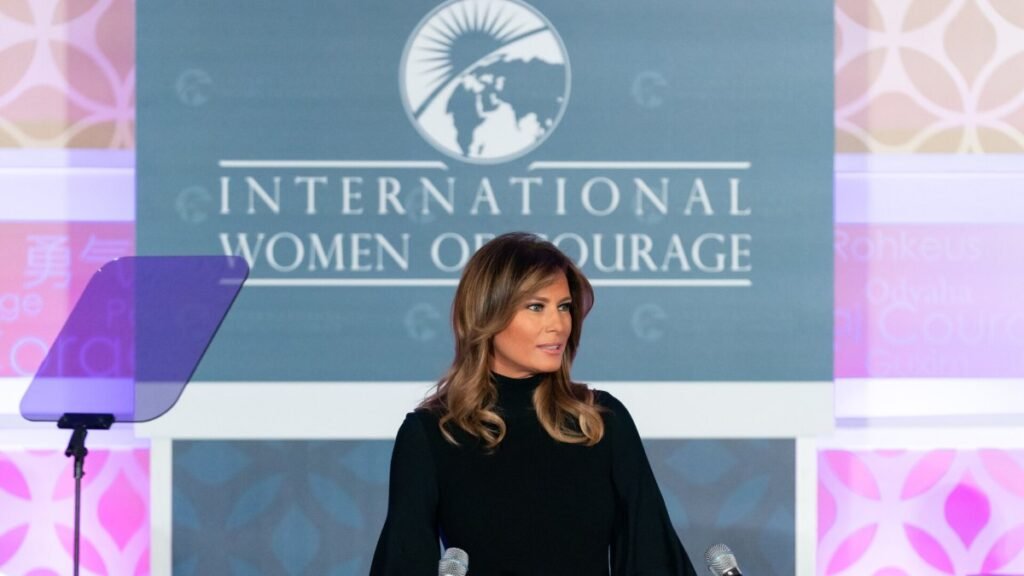
Russia and Ukraine have agreed to halt military action in the Russian-occupied town of Oleshky starting Thursday, Oct. 29, so aid can reach trapped residents and those who want to leave can get out, the White House said Friday, Oct. 23. The statement from the Office of the First Lady credited Melania Trump with brokering the deal, saying she started the talks herself and acted “in her formal role as Exclusive Intermediary.”
Both governments have since signed on. Gen. Valery Gerasimov, chief of Russia’s General Staff, said on the Defense Ministry’s Telegram channel that Russian troops would hold their fire from 4 a.m. local time on Tuesday, Oct. 27, so the humanitarian operation could begin, Reuters reported. David Arakhamia, whom Reuters described as Ukraine’s top negotiator, said on Telegram that the operation would start once the ceasefire was in place and credited a long process involving Melania Trump and Pope Leo XIV. The Kremlin welcomed the agreement, praised the first lady’s role and said President Donald Trump and Vladimir Putin had discussed the details.
The White House statement says “Both nations agreed to temporarily stop all military action in Oleshky,” but it gives no end date. When the announcement first came out, CBS News and the Associated Press reported no immediate comment from either government. The confirmations from Moscow and Kyiv came later on Friday.
Oleshky sits on the left bank of the Dnipro River, across from Ukrainian-held Kherson. For months, Ukrainian officials, U.N. monitors and European governments have warned that the people left there are going hungry.
What the ceasefire covers
The terms below come from the White House statement. Moscow and Kyiv have confirmed the pause but have not published full terms of their own.
- Start date: The White House says the pause begins Thursday, Oct. 29, 2026. Gerasimov said Russian forces would stop firing two days earlier, at 4 a.m. local time on Oct. 27, to let the operation get going. The White House calls the pause temporary and sets no end date.
- Area: Oleshky only. It is not a wider truce along the Kherson front.
- Needs assessment: Non-military civilian leaders from both countries will visit residents in their homes to work out what each household needs.
- Evacuation: Residents who want to leave will get coordinated transportation through a designated safe passage to the destination they choose.
- Logistics and demining: The White House says both countries have assigned teams to coordinate the mechanics of the operation, including demining.
- Media: An “impartial American media organization” will accompany and document the Russian and Ukrainian teams on the ground.
The White House didn’t name the outlet in its statement. Reuters reported that Newsmax said its cameras would have “exclusive access to document the effort.”
“Residents who wish to evacuate will receive coordinated support and transportation to their preferred destination,” Melania Trump said in the statement, as quoted by the Kyiv Independent. “I anticipate some will want to go to Russia, and some to Ukraine.”
That line matters to Kyiv. On Oct. 18, Ukraine’s human rights commissioner, Dmytro Lubinets, said the two sides were close to an evacuation deal. According to the Kyiv Independent, the plan under discussion would let people cross directly into Ukrainian-controlled territory. Without it, they would have to take the long route through occupied areas, Russia and Belarus. The White House statement doesn’t say which crossing points will be used.
“The situation in Oleshky is dire. … The people of Oleshky have limited electricity, live amid mined roads, and endure regular military attacks.”
— Melania Trump, in the White House statement of Oct. 23, 2026
Why Oleshky
Russian forces took Oleshky on the first day of the full-scale invasion in February 2022. The White House puts the prewar population at about 24,000. It estimates 1,700 to 2,000 people remain, most of them elderly, along with about 50 children.
Flood, then siege
The town was flooded in June 2023, when the Kakhovka Dam upriver collapsed. The White House says about 90% of Oleshky’s territory went under water. An Associated Press investigation found the explosion that broke the dam was likely caused by the Russian military, and that the flood killed hundreds of residents.
Since then, the Dnipro has served as the front line. In an Oct. 17 report, the AP said the town has no electricity, heat or running water, and that its roads are mined. It cited the U.N. human rights office as saying the last regular food delivery by road was on May 26. Russian-installed officials said they delivered 2 tons of aid in October and admitted it was hardly enough. A spokesman for Ukraine’s 34th Separate Marine Brigade said the unit’s drones had carried more than 7 tons of food aid into the town since September.
Tetiana Hasanenko, the exiled head of Ukraine’s military administration for the town, told the AP that another 100 bodies filled the basement of the town’s hospital, while bodies at the city morgue were decomposing without electricity. She said the route to Radensk, a six-to-eight-hour walk or bike ride, is known as “the road of death” because “corpses lie on this road and no one is taking them away.” Ksenia Arkhipova, who fled Oleshky in 2022 and now helps others leave, told the AP: “I’m terrified at the thought of the coming winter, when many people in Oleshky will be simply doomed.”
Competing accounts of the blockade
Kyiv and Moscow blame each other for the hunger. In late September, Oleksandr Prokudin, head of the Kherson regional military administration, said Russian troops shot down food-carrying drones, confiscated or resold supplies, and detained residents caught with aid parcels, Euronews reported. Foreign Minister Andrii Sybiha accused Russia of “deliberately provoking a humanitarian catastrophe.” Kremlin spokesman Dmitry Peskov acknowledged that the situation was “indeed critical” but blamed the “Kyiv regime.”
The European Union raised the alarm at the OSCE on Oct. 1. In a statement to the OSCE Permanent Council, it cited testimony that Russian forces had stopped some residents from leaving and called on Moscow to ensure “safe and unhindered humanitarian access” and to fully comply with international humanitarian law.
Before Friday, every evacuation effort had stalled. Lubinets’s office told the AP that “Russia has not provided clear, verifiable guarantees for conducting a humanitarian operation.” The International Committee of the Red Cross said it would help only if both countries agreed and security guarantees were in place.
The pope, the Kremlin and a crowded channel
The first lady wasn’t the only outsider working on Oleshky. On Oct. 16, Pope Leo XIV urged Vladimir Putin in a phone call to agree to a ceasefire so food and medicine could reach Oleshky and civilians could be evacuated. The Kremlin said Putin voiced support for the Vatican’s efforts and readiness to cooperate, the AP reported. The Kremlin’s readout also had Putin blaming Ukraine for the crisis, according to the Kyiv Independent. Three days later, President Volodymyr Zelensky said after his own call with the pope: “We are working to help our people there and are preparing solutions.” He added: “His Holiness informed me about his contacts with the Russian side regarding this issue.”
On Oct. 20, Peskov told reporters that Putin had discussed Oleshky with President Donald Trump and that Russia’s human rights commissioner was involved, Reuters reported. The White House statement doesn’t mention the pope’s call or the president’s.
Melania Trump’s back channel
The first lady’s office says the Oleshky deal grew out of a channel she opened with Moscow over Ukrainian children. Ukrainian authorities accuse Russia of removing thousands of children from occupied territory, and Moscow denies kidnapping them. The AP reported that she personally wrote to Putin about reuniting children displaced by the war with their families. The White House says that work has led to six reunifications involving 34 children. AP also noted that she hosted a U.N. Security Council meeting on children in conflict earlier this year.
CBS News pointed out how unusual this is: a first lady’s office announcing a battlefield arrangement in place of the president or a senior national security official.
How it fits into the wider talks
The announcement came two days after special envoy Steve Witkoff met Putin in St. Petersburg on Oct. 21. That followed his talks with Zelensky and European officials in Oslo. After the meeting, Kremlin aide Yuri Ushakov said Putin had agreed “in principle” to resume three-way talks with Washington and Kyiv after Nov. 10, the AP reported. CBS News reported that Ushakov also said the proposals Witkoff brought, which he attributed to Ukraine and the European Union, “contained little that was useful in the context of resolving the Ukrainian crisis.” Peskov said Moscow would study them and that the talks would take a long time.
Large gaps remain. The two sides “remain far apart” on the terms of any peace deal, Al Jazeera reported, and the AP said Moscow and Kyiv have “stuck to their longstanding basic demands.” Over the same stretch, Trump has voiced frustration with Zelensky. CBS reported that he said Russia “has been fine on Ukraine.” Witkoff was criticized for calling Putin “humanitarian” after Russia released Stephen Hubbard, an American who had been jailed there for more than four years.
What could go wrong
Most of what is public about the deal still comes from the White House. There is no announced end date, no named monitor beyond a news crew, and no published enforcement mechanism. The White House statement also doesn’t say who will deliver aid or how much. Earlier efforts collapsed over exactly these issues: Ukraine asking for guarantees, Russia withholding them, and aid groups refusing to move without both. The Kyiv Independent has reported that civilians trying to flee on the only roads out are frequently targeted by drones, and the AP described mined routes with winter approaching.
The first test comes when the civilian teams start going door to door, which the White House expects from Oct. 29. Both Moscow and Kyiv have now endorsed the pause, but neither has published its own terms.
Official links
- The White House: First Lady Melania Trump secures ceasefire localized to Oleshky
- Official website of the President of Ukraine
- Ukrainian Parliament Commissioner for Human Rights
- UN OCHA: Ukraine
- EU statement to the OSCE on the humanitarian situation in Oleshky
Photo: The White House (public domain).