Vladimir Putin said Thursday, Oct. 22, that the three-way talks Moscow has agreed to resume with Washington and Kyiv would focus on security arrangements for a final peace deal, not a “short” truce, AFP reported. He made the remarks in a televised interview that aired late Thursday, Moscow time. A day earlier he had hosted U.S. envoy Steve Witkoff in St. Petersburg. By then, Kyiv had spent a full day clearing debris from an overnight barrage of ballistic missiles and drones.
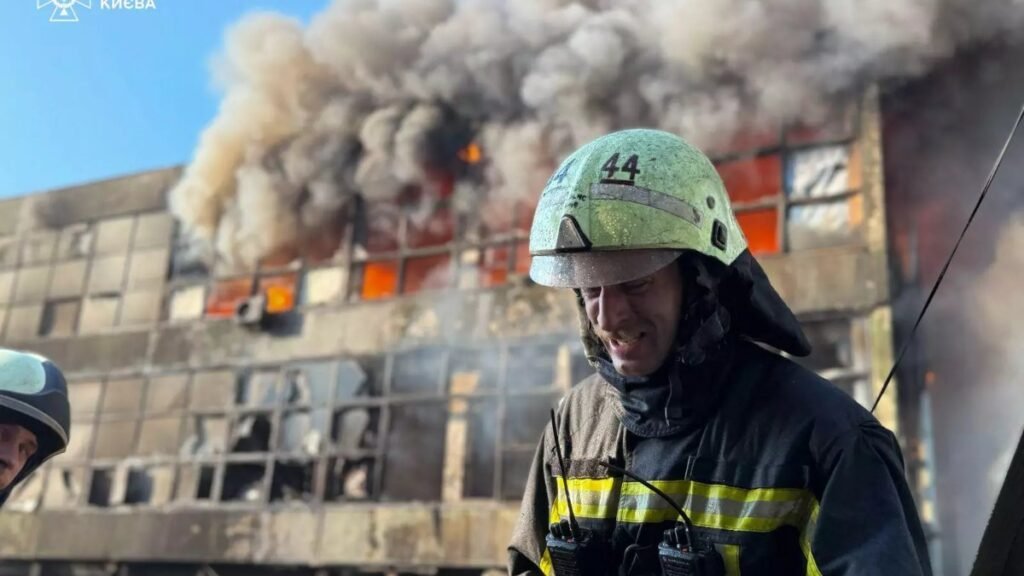
The attack began late Wednesday, Oct. 21, and continued overnight, only hours after the Kremlin announced that Putin had agreed “in principle” to new talks. President Volodymyr Zelenskyy said Russia fired 21 ballistic missiles at Kyiv in three waves, three of them with cluster warheads. Ukraine’s Air Force said Russia also launched 210 drones overnight.
“Russia has not changed the way it wages this war, and it is taking no steps that would signal a genuine desire to end it,” Zelenskyy said, the Associated Press reported.
Cluster warheads over Kyiv’s historic center
Zelenskyy said one of the cluster-armed missiles hit the Pechersk district between the Kyiv-Pechersk Lavra monastery complex and the Sviato-Vvedensky Monastery. Monastery buildings, apartment blocks, shops and cafes were damaged. “There was not even theoretically any military facility nearby,” he said, the Kyiv Independent reported.
Zelenskyy said the warheads burst in the air and scatter submunitions over an area roughly 400 meters across. Presidential adviser Serhii Beskrestnov said the Iskander missiles carried K5 cluster warheads, according to the Kyiv Independent. He said the strike was meant to “destroy part of the old city and injure as many people as possible.”
What was hit
Kyiv’s city military administration listed damage in six districts: Dniprovskyi, Darnytskyi, Sviatoshynskyi, Obolonskyi, Holosiivskyi and Pecherskyi. In Pechersk, a medical facility was hit. Mayor Vitali Klitschko said six ambulances were damaged at a paramedic station and no medical staff were hurt. Klitschko also reported damage to metro infrastructure at the Pivdennyi (South) Bridge over the Dnipro, Al Jazeera reported.
Zelenskyy’s broader list, as carried by AP, included apartment buildings, energy facilities, a railway station, the subway system, shopping malls and businesses. In the Dniprovskyi district on the city’s east bank, fires broke out and one person was killed, AP reported, citing Ukrainian officials.
Casualty figures shifted through the day
Tallies changed as rescuers worked. By mid-morning Thursday, the Kyiv City Military Administration put the toll in the capital at one dead and 24 injured, 16 of them hospitalized. Zelenskyy later said two people were confirmed killed and 34 were hurt “in Kyiv and across the regions,” including five children, Ukrinform reported. The latest figures from Kyiv city authorities, cited by AFP, were two dead and more than 30 wounded in the capital.
The strikes reached well beyond Kyiv. Oleh Syniehubov, who heads the Kharkiv regional military administration, said two women, ages 50 and 60, were killed when a strike hit a market in Lozova, according to AP. AP counted at least four people killed across Ukraine. Zelenskyy said 12 regions were hit overnight and that Russia has carried out about 170 strikes on Ukraine’s critical energy facilities since Oct. 11. In Donetsk, families with children were told to evacuate the front-line towns of Kramatorsk and neighboring Sloviansk after attacks that killed dozens of civilians, AFP reported.
The overnight attack by the numbers
| Category | Figure | Source |
|---|---|---|
| Drones launched | 210 (including 110 jet-powered) | Ukrainian Air Force, via Kyiv Independent |
| Drones shot down or suppressed | 181 (including 87 jet-powered) | Ukrainian Air Force, via Kyiv Independent |
| Missiles launched at Kyiv | 21 ballistic, in three waves | President Zelenskyy |
| Missile types | Iskander-M, S-400, Zircon, Oniks | Ukrainian Air Force |
| Missiles intercepted | Not reported in the Air Force figures cited by the Kyiv Independent | Ukrainian Air Force |
| Missiles with cluster warheads | 3 | President Zelenskyy |
| Impact sites | 32 locations hit; debris fell at 8 more | Ukrainian Air Force |
Russia’s Defense Ministry said its air defenses shot down 808 Ukrainian drones overnight. Moscow’s airports temporarily restricted air traffic, AP reported. The Russian ministry said its own strikes hit drone and cruise missile plants, transport infrastructure in Kyiv and port facilities in Odesa.
Inside the Witkoff-Putin meeting in St. Petersburg
Putin hosted Witkoff on Wednesday at the Constantine Palace outside St. Petersburg. Kremlin aide Yuri Ushakov and Kirill Dmitriev, Putin’s envoy for investment and economic cooperation, sat in for the Russian side, according to the Kremlin’s transcript. The meeting lasted about three hours, and Jared Kushner joined by video, AP reported.
In the published opening remarks, Witkoff said the talks in Oslo the day before had shown “some degree of momentum.” He said he hoped to discuss “resumption, potentially, of trilateral talks between Ukraine, Russia, and the United States.”
Afterward, Ushakov said Putin had agreed “in principle” to resume the three-way format after Nov. 10, about a week after the U.S. midterm elections. Ushakov also said the proposals from Oslo “contained little of real value,” though he later called them a step in the right direction, AP and Reuters reported.
On Thursday, Kremlin spokesman Dmitry Peskov said Abu Dhabi was being considered as the venue but that Moscow had not chosen its representative, the Financial Times reported.
What we know about the talks
- Format: Three-way negotiations among Russia, Ukraine and the United States, at the level of technical teams, not leaders.
- Timing: The Kremlin says after Nov. 10. Zelenskyy has said he hopes negotiators can meet in early November. No date has been set.
- Venue: Abu Dhabi is under consideration, according to Peskov. No decision has been announced.
- Agenda: Ushakov said the focus would be “building a security system for Russia and Ukraine after the conflict ends,” AP and Reuters reported. Putin says he wants a final settlement, not a temporary ceasefire.
- Main obstacle: Territory. Russia demands that Ukraine withdraw from the parts of Donetsk it still holds, a demand Kyiv calls tantamount to capitulation, AFP reported.
- History: The last U.S.-mediated round was in February, before the U.S.-Israeli war with Iran began.
‘Humanitarian’ remark and a freed Air Force veteran
The meeting came the same day Russia released Stephen Hubbard, a 74-year-old retired teacher from Michigan. Russian forces arrested Hubbard in eastern Ukraine in April 2022, and he was sentenced to nearly seven years as an alleged mercenary, charges his family and U.S. officials call false. The State Department had designated him wrongfully detained, ABC News reported. According to Military Times, he served on active duty in the Air Force from March 1974 to March 1978. His last posting was Mather Air Force Base in California.
Witkoff thanked Putin for the release. “You talk so much about my president, President Trump, being a humanitarian,” he told Putin. “You are a humanitarian also, sir,” ABC News reported. Asked about the comment, President Donald Trump said, “I guess you could say for that particular purpose,” and added that he “wouldn’t say anything one way or the other.”
Trump has tied the release to his decision, less than a week earlier, to block new sanctions that would have targeted the biggest buyers of Russian oil and gas. “If I would’ve done that, you would not have Mr. Hubbard coming back,” Trump said, Military Times reported. Witkoff said the release “was not part of an exchange.” Witkoff also thanked Putin for agreeing to send diesel to the United States, AP and Reuters reported, and told him Washington was “grateful” for the diesel deal, which drew outrage in Kyiv and across Europe, according to Al Jazeera.
Ukrainian Foreign Minister Andrii Sybiha said, “Appeasement, servility, and flattery will not stop this war. Only strength will,” according to AP.
Washington’s line: closer than ever, but Donbas still unresolved
Trump said Wednesday that a settlement was “maybe now the closest we’ve been.” At a press appearance in Mumbai on Oct. 21, Secretary of State Marco Rubio called the negotiation “very difficult.” He said the core dispute is “the differences over Donbas” and that “if this was an easy war to solve, it would’ve been solved a long time ago,” according to a State Department transcript.
Zelenskyy has pressed Washington for more Patriot interceptors, which U.S. officials say are in short supply. He said Russia was “clearly taking advantage of the slowdown in air-defence supplies from our partners,” AFP reported. On Thursday evening, at a press conference with Finland’s prime minister, he said, “I focused on air defense. This remains our constant priority with all our partners,” according to the Ukrainian presidency. NATO, meanwhile, said it would let Ukraine buy weapons through the alliance’s central procurement agency on a “case-by-case basis,” AFP reported. The Financial Times first reported the move, which is separate from the PURL program that funds U.S.-made weapons, according to the Kyiv Independent.
Europe moves the other way on sanctions
As Washington eased pressure on Moscow, Brussels drafted more. On Oct. 21, the EU’s diplomatic service gave member-state ambassadors a draft package of 117 new listings, 12 individuals and 105 entities, the Kyiv Independent reported after seeing the document. The largest share, 31 listings, covers Russian oil processing, refining and export capacity. The draft also names 52 banks and financial institutions and 12 entities in the United Arab Emirates.
“We see that we have to pressure the aggressor to stop the war, not the victim to surrender,” EU foreign policy chief Kaja Kallas said. Sanctions experts from all 27 member states must review the list before ambassadors and then ministers vote on it.
Official links
- Office of the President of Ukraine
- U.S. Department of State: Ukraine
- U.S. Department of State: Secretary Rubio’s remarks to the press, Oct. 21, 2026
- President of Russia: Meeting with U.S. Special Envoy Steve Witkoff, Oct. 21, 2026
Photo: State Emergency Service of Ukraine, CC BY 4.0.