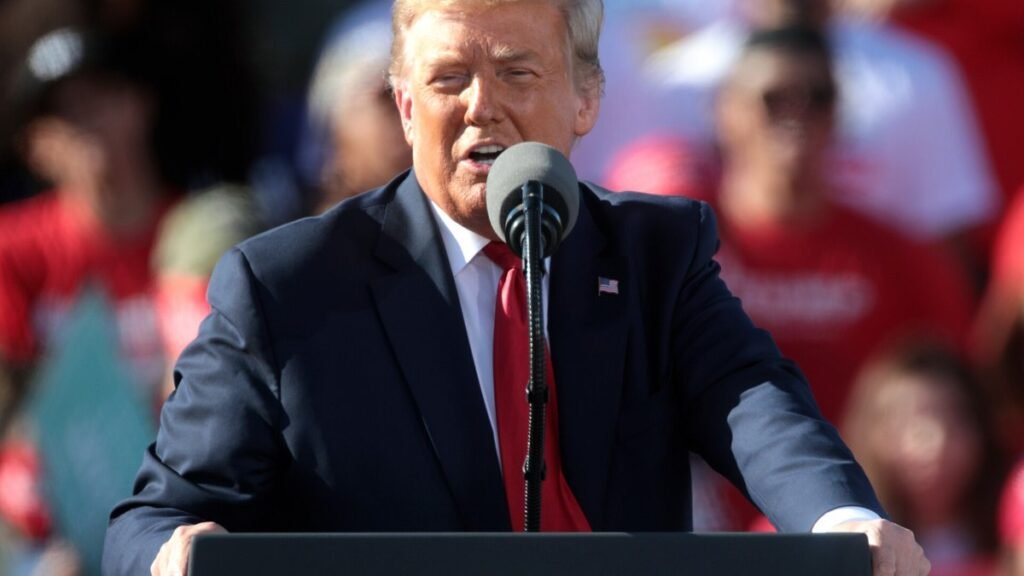
President Donald Trump told a campaign rally in Sioux City, Iowa, on Thursday, Oct. 22, “We’re going to have Iran finished very soon. One way or the other,” CNN reported. His own ambassador to the United Nations, Mike Waltz, has a longer clock in mind: he told the Financial Times the war could last another year, CBS News reported Friday.
The mixed messages came as U.S. Central Command marked 100 days of its reinstated naval blockade of Iranian ports and Iran’s Revolutionary Guard claimed it had stopped all “non-compliant” ships in the Strait of Hormuz. With the U.S. midterms on Nov. 3 and Israel voting on Oct. 27, the question in Washington, Jerusalem and Tehran is less whether fighting resumes than when.
What we know
- Trump’s timeline: At the Iowa rally, Trump said it was “almost insignificant to me which way” the war ends, and promised that “your gasoline prices and your oil is going to come tumbling down,” according to CNN. Before boarding Air Force One at Joint Base Andrews, he told a reporter, “We are not negotiating with” Iran, and added: “Something one way or another will happen, fairly soon. Most people seem to think it’s after the election,” The Times of Israel reported.
- Waltz’s longer view: Waltz told the Financial Times the U.S. Navy “can maintain this blockade for the foreseeable future” and that the administration is still “tightening” economic pressure, according to CBS News. He said he hoped Iran would “come to the table in a meaningful way.”
- Blockade at 100 days: CENTCOM said the blockade, reinstated July 14, has kept at least $25 billion in Iranian crude off the market. “There have been no exports or imports to Iran by sea except for the humanitarian aid U.S. forces have allowed,” the command said, CBS News reported. As of Oct. 17, 138 ships had been redirected.
- Iran’s Hormuz claim: On Friday, Iranian state TV, citing an IRGC Navy source, said movement of “non-compliant” vessels through Hormuz had been “completely halted,” and warned that any resumed U.S. escorts or ship-to-ship transfers would face “much more forceful” action, per CBS News.
- Saudi missile buildup: A Reuters exclusive published Friday said commercial satellite images show Saudi Arabia expanding its al-Duwadimi missile production complex, about 125 miles west of Riyadh.
What we don’t know yet
- Whether Trump has approved new strikes. The New York Times reported that U.S. and Israeli planners have stepped up drills for “a short but intensive operation” after the Nov. 3 midterms, with targets including energy sites, nuclear facilities and missile and drone stocks, according to The Times of Israel’s summary. The report said no final decision had been made, that Trump could still decide against military action and that there was only a small chance of strikes in October.
- Whether Iran’s tanker claims are real. The IRGC said Thursday it hit four vessels conducting ship-to-ship oil transfers and that three more struck mines west of Hormuz. Iranian state TV put the total at seven tankers, which would be the largest single-day toll since the war began Feb. 28. None of the claims has been independently verified. Trump wrote on Truth Social that Iran is “even making up fake hits, mines, and everything else” to drive up oil prices before the midterms, CBS reported.
- Where talks stand. Iranian Foreign Minister Abbas Araghchi said Wednesday that indirect talks through mediators on Iran’s seven-day proposal for Hormuz were continuing. “The negotiating table remains in place,” he said, CBS News reported. Trump has since said there are no negotiations.
- What Saudi Arabia is building. The Saudi embassy and Information Ministry did not respond to Reuters, and the CIA declined to comment.
Mixed signals from Washington
The gap between Trump and Waltz is less of a contradiction than it first looks. Trump has said for weeks that the war will end “one way or the other,” a phrase he used again on Oct. 9 at the White House, The Times of Israel reported. The “other” way is military. Waltz described the pressure track: a blockade the Navy can hold indefinitely and sanctions that keep tightening.
Treasury added to that track Wednesday, sanctioning the Panamanian-Greek law firm Karnakis and Karnakis and shipping agents in Singapore and the UAE over Iran’s shadow fleet. “We know who you are, we know what you’re doing,” Treasury Secretary Scott Bessent said, according to CBS News.
Politics at home shape the timing. A person briefed on U.S. and Israeli war planning told NPR that a possible attack could come in early November, after both elections, and that the U.S. is “amassing forces in the region.” A U.S. official told Al Jazeera on Oct. 2 that the USS Theodore Roosevelt carrier strike group had left San Diego for the Middle East, part of a plan to have three carriers and two amphibious groups around Iran by the end of November, Al Jazeera reported.
Iran’s response: new doctrine, wider target list
Tehran has spent the week raising the cost of a second round. IRGC spokesman Hossein Mohebi announced Wednesday what he called an “offensive and asymmetrical” doctrine. “Now we say that if a country attacks us, we will both respond and launch an offensive,” he said, Al Jazeera reported. He claimed, without giving figures, that Iran’s missile stockpile had grown 1.5 times since the June 2025 war.
The IRGC also warned Thursday that continued U.S. escorts through Hormuz would bring the fight to American bases. “The US military must know that if this trend continues, the conflict will extend to its bases in the region,” it said in a statement carried by AFP, according to The Times of Israel. “This is a serious warning.”
Mohsen Rezaei, secretary of Iran’s Supreme National Security Council, said Wednesday that “any action against Iran comes at a cost,” Al Jazeera reported. He also told state-run Press TV that more than $2 trillion in U.S.-linked data centers, AI facilities and other tech infrastructure in the region could be at risk if Washington attacks again. “We have not yet included these assets among our targets,” he said, according to Al Arabiya.
Iran named a new defense minister on Wednesday, Mehrdad Akhlaghi, a missile-industry veteran under sanctions since 2007.
Israel’s posture ahead of its election
Prime Minister Benjamin Netanyahu said Wednesday he had directed the IDF, the Mossad and Israel’s security services to bring down Iran’s government. “There is only one way to remove this threat once and for all,” he said, CBS News reported. The Financial Times reported that Trump blocked an Israeli multiday operation planned for the weekend of Oct. 10, according to CBS News.
Israel’s top general appears in less of a hurry. IDF Chief of Staff Lt. Gen. Eyal Zamir saw no operational need to strike Iran before the Oct. 27 vote, Israel’s Channel 13 reported, as The Times of Israel noted. The IDF said Friday it will hold a pre-planned drill on Sunday and Monday in northern and central Israel simulating a surprise attack and infiltration by air and land.
Saudi Arabia under fire, and building missiles
The study Reuters described comes from Sam Lair and Michael Duitsman of the Foreign Policy Research Institute, who reviewed Planet Labs imagery from April 2025 to September 2026. They found a new building that appears to hold casting pits for solid-fuel rocket motors, and a second that may store fuel ingredients or finished parts. The imagery “suggests that Saudi Arabia is expanding the infrastructure at the missile production complex,” the study said. Lair said the kingdom may already be producing China’s solid-fuel DF-15 and that the expansion is likely meant for the longer-range DF-21 or a similar missile, Reuters reported.
“Iran has a lead because its missiles and drones can strike Saudi wherever it wants,” Sascha Bruchmann of the International Institute for Strategic Studies told Reuters.
The kingdom is already absorbing Houthi strikes. The State Department on Wednesday ordered non-emergency staff and families to leave Saudi Arabia, and Saudi civil aviation said an attack on King Fahd International Airport in Dammam killed two people and injured eight, CBS News reported. Saudi Aramco CEO Amin Nasser said the East-West pipeline, which bypasses Hormuz, is now moving 7 million barrels a day, up from 2 million.
Istanbul talks and the dates ahead
Foreign ministers from Britain, France and Germany met counterparts from Turkey, Saudi Arabia, Pakistan and Egypt in Istanbul on Friday to discuss Hormuz, Yemen and other crises. Britain said passage through the strait “remains under threat.” French Foreign Minister Jean-Noel Barrot told reporters that “a further escalation between Iran and the United States would leave no winners,” Reuters reported via The Times of Israel.
| Date | Event |
|---|---|
| Feb. 28, 2026 | U.S.-Israeli strikes on Iran begin |
| July 14, 2026 | U.S. naval blockade of Iranian ports reinstated |
| Oct. 22, 2026 | CENTCOM marks 100 days of blockade; Trump says Iran will be “finished very soon” |
| Oct. 23, 2026 | E3 and R4 ministers meet in Istanbul |
| Oct. 27, 2026 | Israeli Knesset election |
| Nov. 3, 2026 | U.S. midterm elections |
Brent crude hit $112 on Thursday, its highest since May 18, according to CBS News. Trump has promised voters that price will fall once the war ends. Waltz’s warning suggests the blockade, and the oil squeeze that comes with it, may outlast the campaign season either way.
Official links
- U.S. Central Command
- U.S. Department of State: Iran
- White House: Addressing Threats to the United States by the Government of Iran (Executive Order 14382)
Photo: Gage Skidmore/Wikimedia Commons, CC BY-SA 2.0.