Call 911 in a growing number of American cities and the first responder to show up might not have a badge. It might have four rotors.
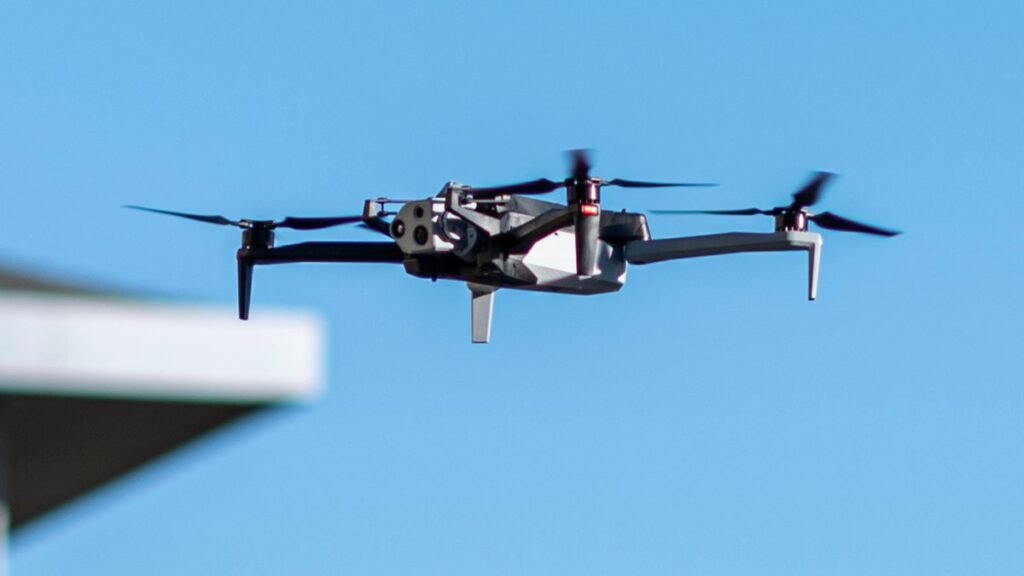
Police departments from California to Missouri to Florida are installing drones on rooftop docks that launch automatically, or close to it, when certain 911 calls come in. The drone flies to the address, streams live video back to a control room and often gets there before the first patrol car. The industry calls it “drone as first responder,” or DFR.
Cops who use it say it saves time and sometimes lives. Civil liberties groups say they get it, but they’d like some rules first, because a fleet of cameras that can be over any address in a city within a couple of minutes is a lot of power. The Federal Aviation Administration‘s new rule for these kinds of flights, meanwhile, is months late.
It started in Chula Vista
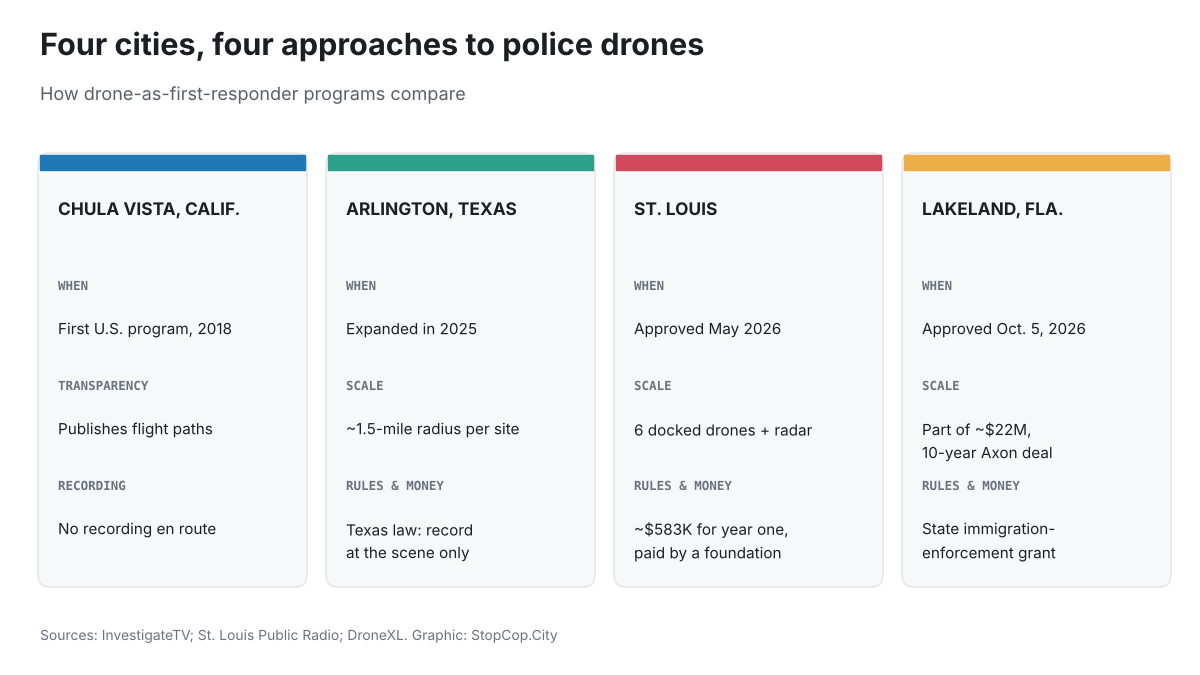
The Chula Vista Police Department, near San Diego, launched the first program of its kind in the U.S. in 2018. Chief Roxana Kennedy is a big believer. “I can’t even imagine policing without the benefit of having drones,” she told InvestigateTV this year.
Her department likes to point to two calls. In one, a drone helped crews find a driver trapped in a burning car whose location was different from what 911 callers had said. In the other, overhead video showed that a man reported to be holding a gun was actually holding a lighter. An officer who knows that before rolling up is a lot less likely to draw.
Chula Vista also publishes its flight paths and says it doesn’t record while a drone is en route to a call. Kennedy’s advice to other chiefs: the worst thing you can do is keep residents in the dark.
That transparency has its limits, though. A newspaper had to win a lawsuit in August 2025 to get video from the program.
Now it’s everywhere
The Electronic Frontier Foundation estimates about 1,500 U.S. police departments run some kind of drone program. DroneXL, a trade publication, counts more than 1,000 public-safety agencies flying under the FAA waivers that DFR programs depend on.
A few recent examples:
- Arlington, Texas, expanded its program in 2025. Each launch site covers roughly a 1.5-mile radius, and the department said it expected several thousand missions that year.
- St. Louis approved six docked drones plus a radar system in May. The St. Louis Police Foundation is covering the first year, about $583,000.
- Lakeland, Florida, voted 7-0 on Oct. 5 for a 10-year, roughly $22 million deal with Axon that bundles drones with body cameras, Tasers and AI report-writing software.
- Smaller cities including Victorville, California; Page, Arizona; Plano, Texas; Manhattan Beach, California; Bridgeton, Missouri; and Lompoc, California, have signed off on programs or pilots in the past year, some over residents’ objections.
St. Louis promised no surveillance. The mayor wasn’t thrilled anyway.
St. Louis officials went out of their way to say what the drones won’t do. “It’s not going to be flying around doing surveillance,” Maj. Joe Morici, who leads the project, said, according to St. Louis Public Radio. The drones launch only on calls for service, get flown by trained pilots from the department’s Real Time Crime Center and start recording only once they reach the scene.
Part of the rush: the department wanted to lock in pricing and be ready well before the 2028 Olympics, when St. Louis is set to host soccer matches.
Mayor Cara Spencer didn’t love the timeline. She said she got the contract the afternoon before the vote. “While you have been looking at this for a year, I’ve been looking at this for 24 hours,” she told the police board. “This is no way to run an over $200 million department.”
The board added a condition before signing off: written policies and community meetings before a single drone takes off.
In Lakeland, the drones came in a bundle
Lakeland’s deal shows where a lot of this is heading. Drones weren’t a standalone purchase. They were one line in a decade-long Axon package that replaces a 2021 contract worth about $9.4 million.
The department’s drone history is bumpy. Florida’s ban on Chinese-made drones grounded its earlier program from 2022 until early 2025, when it restarted with U.S.-built aircraft from Skydio and Brinc. Axon’s drone line runs on Skydio hardware.
Chief Sam Taylor has pitched the deal mostly as a paperwork fix, with the department estimating AI tools could cut report-writing time 30% to 50%.
The money raised eyebrows. Nearly $4 million for the first two years comes from Florida’s State Board of Immigration Enforcement, and the grant application said the equipment would support immigration enforcement, DroneXL reported after digging through city records. Drones weren’t listed in that application, and the itemized vendor quote wasn’t in the public agenda packet.
What the ACLU wants
The ACLU isn’t trying to ban police drones. Jay Stanley, a senior policy analyst there, has said they can help find missing people and get officers to emergencies faster.
What worries him is mission creep. New, controversial tech tends to get used carefully, he argues. Once it’s routine, the pressure to use it more, and keep the video longer, builds. He’s warned about “omniscient eyes in the sky, watching everybody in the community all the time.”
The case civil liberties lawyers bring up most is Baltimore. In 2016, police there flew a privately operated surveillance plane over the city for months without telling anyone. The ACLU sued, a federal appeals court ruled the program violated the Fourth Amendment, and it was shut down.
The ACLU’s asks are pretty concrete: write down when flights are allowed, keep drones away from protests and crowd control, and set clear rules on how video is stored and shared. Beyond FAA safety rules, there’s no federal law on any of this. It’s up to states and cities.
The bigger worry is the combination. A citywide drone network linked up with license plate readers, camera registries and analytics software could add up to something no city council ever voted on as a whole. It’s the same concern behind the backlash over Flock Safety’s plate cameras, which we dug into in our look at Flock’s new rules. Flock sells drone systems to police, too.
The federal rule that’s stuck
FAA rules generally require drones to stay within sight of their operator. Flying a mile across town to a 911 call breaks that rule, so departments operate under waivers granted one at a time.
The FAA’s fix is a proposed rule called Part 108, which would swap the waivers for a standard permit system for flights beyond visual line of sight. A June 2025 executive order gave the agency 240 days to finish it. That deadline passed in February. The final rule went to the White House for review on July 10 and, as of early October, still hadn’t been published, according to the tracking site DroneRanker. An FAA official has said the agency hopes to get it out by the end of the year.
Part 108 is about aviation safety, not privacy. It doesn’t say anything about what a police drone can film. But by making long-range flights easier to approve, it could make big police programs easier to launch.
Before your city signs
If your city council is considering one of these programs, these are the questions worth asking:
- Which 911 calls trigger a launch, and who decides?
- When does recording start and stop, and how long is video kept?
- Are flight logs public, and how quickly?
- Can drones fly over protests or big public events?
- Will drone video be combined with plate readers or facial recognition?
- Who audits the program, and what happens when someone breaks the rules?
- What does it cost after the grant or foundation money runs out?
Price tags vary a lot. St. Louis is spending about $583,000 in year one. St. Charles County, Missouri, approved five systems for about $900,000 over four years. Santa Fe, New Mexico, approved $2.2 million after a long fight. None of those numbers include the full long-term cost of pilots, a control room staffed around the clock, replacement aircraft and video storage.
Where this reporting comes from
- InvestigateTV: Police drone programs expand as first-responder tool
- St. Louis Public Radio: St. Louis police drone program approved
- DroneXL: Lakeland’s $22M Axon deal
- DroneRanker: FAA Part 108 rule status
- Santa Fe New Mexican: Council approves $2.2 million drone program
Featured image: Alexander Kubitza / Wikimedia Commons, public domain (cropped)