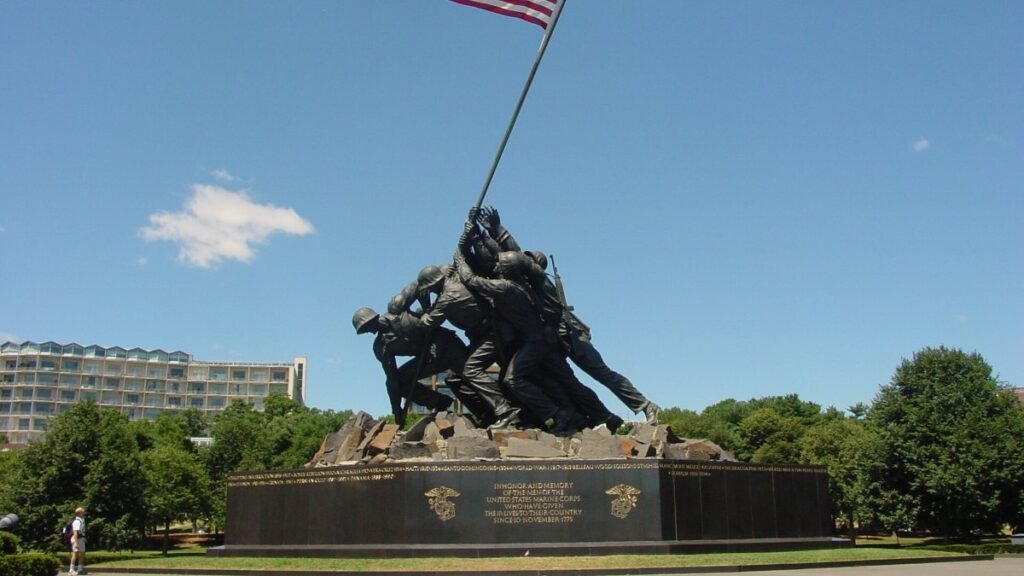
A 27-year-old Stafford County man is being held without bond on three charges, two of them felonies, after Prince William County police say officers caught him taking a sledgehammer to the limestone Iwo Jima flag-raising statue at the main gate of Marine Corps Base Quantico, Virginia, late Wednesday, Oct. 21. Police said he knocked the head off one of the Marines in the sculpture.
Police identified the man as Miguel Alonso Maldonado Soriano. He is charged with felony destruction of property, trespassing with intent to damage property and felony injury to a monument, NBC Washington reported Thursday. Police estimate the damage at hundreds of thousands of dollars, according to Sgt. Erin Noble of Prince William County police, as cited by the Prince William Times. They have not offered a possible motive, and he has not been convicted of anything.
The statue is not the giant bronze memorial outside Arlington National Cemetery. It is the smaller, nine-foot limestone version that sculptor Felix de Weldon carved in 1945, according to the Marine Corps History Division, the same year photographer Joe Rosenthal captured the flag-raising on Mount Suribachi. The Marine Corps has described it as marking the entrance to the base, and its flag is changed by Marines from the base’s Ceremonial Platoon.
What police say happened at the Quantico main gate
Officers were called at about 10:13 p.m. Wednesday to a destruction-of-property report at the statue near Richmond Highway and Fuller Road, according to local reports. According to police, they found a man hitting the statue with a sledgehammer when they arrived. Officers detained him without incident, police said.
Police said the damage includes the head removed from one of the Marine figures, plus other damage to the sculpture. Police did not say which figure was struck. Officials also have not said publicly whether the original head can be reattached or whether part of the statue will have to be recarved.
The location matters for jurisdiction. The Marine Corps has described the statue as standing just outside the main gate, marking the entrance to the base. Prince William County police are handling the case. Police have not said whether federal authorities are involved, and no federal charges had been announced in reporting through Thursday.
Charges and the next step in court
Maldonado Soriano is being held without bond, and a court date was still pending as of Thursday, according to local reports. Police have not said whether he has a lawyer, and none could be identified from public reporting.
Police have not said which sections of the Virginia Code they used. Reports have differed on whether the trespassing count is a felony. Under Virginia law, entering someone else’s property to damage it is ordinarily a Class 1 misdemeanor. Under the state’s property-damage statute, intentionally damaging property, a memorial or a monument is a Class 6 felony when the damage is $1,000 or more, and a court can order restitution after a conviction. Virginia law sets the penalty for a Class 6 felony at one to five years in prison. A judge or jury can instead impose up to 12 months in jail, a fine of up to $2,500, or both.
The damage estimate police released, hundreds of thousands of dollars, is well above that $1,000 threshold. A final repair bill could also matter at sentencing if the case reaches that point. Every charge is still an allegation. Prosecutors will have to prove it in court.
No public word yet on repairs
In reporting through Thursday, neither Marine Corps Base Quantico nor Headquarters Marine Corps had publicly said how or when the statue will be repaired, what it will cost, or whether the damaged figure will be covered or fenced off in the meantime. Patch reported that it had asked the Marine Corps for comment. No veterans organization had made an on-record statement in the coverage reviewed for this story.
The base has handled this statue’s repairs before, and its own records show how it works. On March 30, 2014, Marines of the Ceremonial Platoon found cracks in the limestone while changing the monument’s flag, the base reported that April. John Callaway, then the base’s Public Works operations officer, blamed normal weathering and warned that water in the cracks could freeze and break the stone further. Inspectors found cracks where repairs had been made after a 2012 vandalism, other cracks, some of them original, and a crack in a finger that had been reattached.
In August 2014, the base put a construction fence around the statue for a restoration expected to take six to eight weeks. The job included replacing a broken finger on one of the hands holding the flag, replacing crumbling parts of a rifle barrel, recarving broken pieces and resealing the base. Some of the work was also cleanup from an earlier attack. In December 2012, vandals sprayed bright pink paint about halfway around the statue’s base. The paint was removed, but the porous limestone held a stain.
The base’s facilities chief at the time described the stain work this way in 2014:
“They are going to presoak the stone to draw it out the stain because the limestone absorbed it.” — Elton Rupe, then facilities operations officer at Marine Corps Base Quantico, in an Aug. 28, 2014, Marine Corps news story on that year’s restoration
The damage police describe this time is far worse than a broken finger or a paint stain. Limestone can be patched, pinned and recarved. But a missing head, on a figure carved by hand 81 years ago, puts conservators in a hard spot: they can reattach the original if it survived in pieces, or they can carve a replacement that will never quite match the weathered stone around it.
Other de Weldon flag-raising statues show what such repairs can involve. The one-third-scale monument at Marine Corps Recruit Depot Parris Island, S.C., built of steel-reinforced concrete and dedicated in 1952, went through a 2015-2016 conservation campaign that the National Park Service later documented. Conservators stripped 11 layers of paint, removed the statue’s wet clay core and replaced corroded rebar with fiberglass. That statue was decaying slowly. Quantico’s was struck.
About the statue
On Feb. 23, 1945, Marines raised a second flag on Mount Suribachi during the battle for Iwo Jima, and Joe Rosenthal’s photograph of that moment became one of the best-known images of World War II. Felix Weihs de Weldon was on duty with the Navy when he saw it.
De Weldon was born in Vienna in 1907, came to the United States in 1937 and became a citizen in 1945. According to his Marine Corps History Division biography, he built a scale model of the flag-raising shortly after the photo was released and carved a nine-foot limestone statue of the group before the end of 1945. That stone figure is the one at Quantico. Some early reports this week placed the carving in the late 1940s and early 1950s, but the Marine Corps’ own history office dates it to 1945.
The Marine Corps has described it as one of the scale models de Weldon produced while working toward his best-known piece, the U.S. Marine Corps War Memorial in Arlington. That bronze, cast in 108 pieces, was dedicated by President Dwight D. Eisenhower on Nov. 10, 1954, the Marine Corps’ 179th birthday. Marines, friends of the Corps and members of the naval service paid for it.
De Weldon died in Woodstock, Virginia, in 2003 at age 96 and is buried at Arlington National Cemetery. The stone version he carved in the months after the battle has been repaired at least twice in the past 14 years. Whoever fixes it this time will be working on one of the earliest versions of the scene that de Weldon ever made.
Official links
- Marine Corps Base Quantico
- U.S. Marine Corps
- National Museum of the Marine Corps
- U.S. Marine Corps War Memorial (National Park Service)
- George Washington Memorial Parkway (National Park Service)
- Prince William County Police Department
Photo: Christopher Hollis/Wikimedia Commons (public domain).