Updated Oct. 20, 2026: Added more findings from the VA report, including firearm deaths, age-adjusted gaps and recently separated veterans, along with reaction, VA prevention figures and the Pentagon’s 2024 data on service members.
If you are a veteran in crisis, or worried about one, call 988 and press 1, text 838255, or chat at VeteransCrisisLine.net. You don’t need to be enrolled in VA care.
The number of veterans who died by suicide fell for a second straight year in 2024, to 6,488, according to the Department of Veterans Affairs’ annual suicide prevention report, released Sept. 30.
That is 174 fewer than in 2023 and more than 500 below the 2018 peak of 7,015. It works out to about 17.7 veterans a day, down from 19 a day in 2018.
The rate barely moved, though. Veterans died by suicide at a rate of 36.4 per 100,000 in 2024, compared with 36.6 the year before. For the general U.S. population, the VA’s comparison figure was 16.4. That raw rate is more than double, though the gap narrows once differences in age and sex are taken into account, as the findings below show.
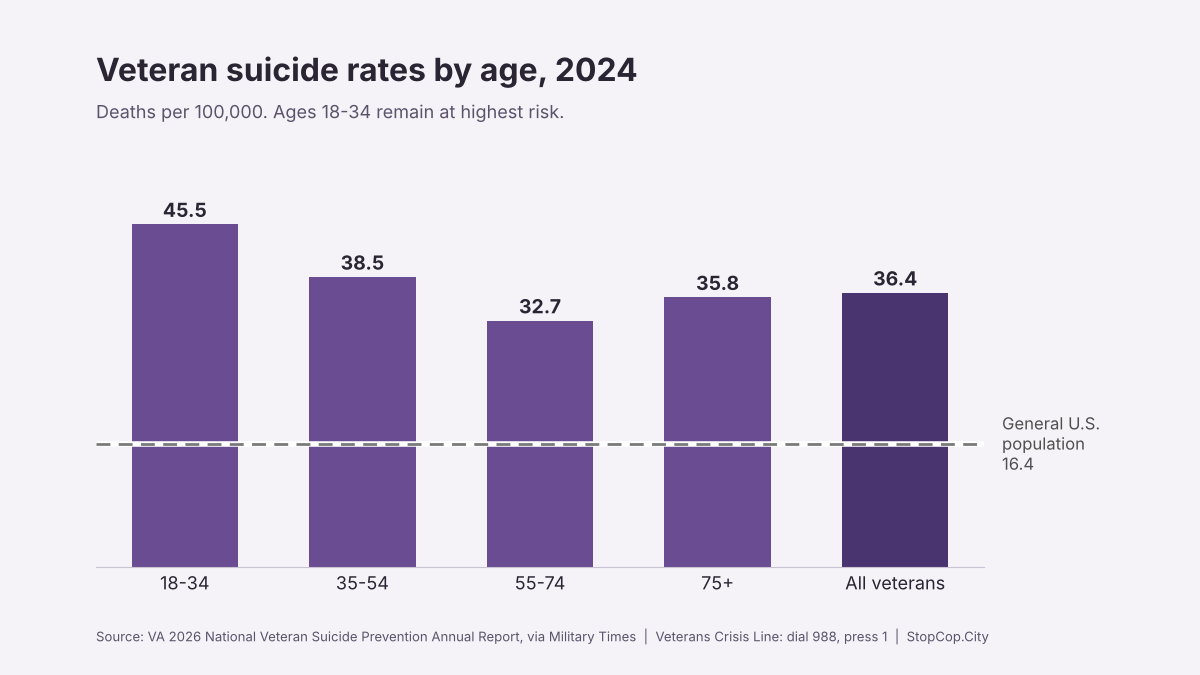
The youngest veterans are at the highest risk. The rate for veterans 18 to 34 was 45.5 per 100,000, the highest of any age group, though it fell 4.7% from 2023. Veterans 35 to 54 were at 38.5, down 2.3%. The rate was 32.7 for those 55 to 74 and 35.8 for those 75 and older, Military Times reported.
The VA’s clearest finding is about who uses its health care. Since 2001, the suicide rate among veterans enrolled in VA care fell 2.2%. Among veterans outside the VA system, it rose 70.8%. In 2024 alone, the rate for enrolled veterans dropped 4.8%.
“VA healthcare saves lives, so we’re making every effort to get more Veterans into the system,” VA Secretary Doug Collins said in a statement.
That is where the department is putting its effort. The VA says an outreach push enrolled more than 280,000 new veterans in 2026. Its Solid Start program, which calls service members in their first year out of uniform, offers a rough measure of what contact is worth: the suicide rate was 30.5 per 100,000 among people it reached and 42.7 among those it tried and failed to reach. That comparison doesn’t prove the calls made the difference, since veterans who pick up the phone may differ from those who don’t, but the VA is citing it as evidence that early contact matters.
The department also pointed to its crisis line, which answered more than 1.3 million calls, chats and texts in fiscal 2026, up more than 7%. Since 2023, nearly 50,000 veterans have used a benefit created by the COMPACT Act that covers emergency suicide care at any hospital at no cost, whether or not they are enrolled in VA health care.
On Oct. 1, $111.9 million in grants became available to 191 community groups under the Staff Sergeant Parker Gordon Fox Suicide Prevention Grant Program, which pays local organizations to reach veterans the VA does not see. About 17,000 veterans, service members and family members got services through the program in 2025.
The full report and state-by-state data are posted on the VA’s suicide prevention data page. Veterans who want to enroll in VA health care can apply online at VA.gov or by calling 877-222-8387.
Other findings in the report
Firearms were involved in 74.3% of veteran suicides in 2024, including 75.4% among men and 51.9% among women, according to the VA report.
Men accounted for 95.3% of veteran suicides. The rate for male veterans was 39.2 per 100,000, and for female veterans 13.9, down from 14.6 the year before. After adjusting for age, the rate for male veterans was 56.5% higher than for non-veteran men, and for female veterans 99.9% higher than for non-veteran women, the report found.
The 2023 count has also been revised. VA’s earlier report put 2023 at 6,398; the new report puts it at 6,662, Task & Purpose reported.
Most veterans who died had not been getting VA health care. Of the 6,488, 62.2% had no Veterans Health Administration care in 2023 or 2024, according to the report.
Among VA patients, homelessness was tied to a 118.5% higher suicide rate and a recent traumatic brain injury to a 111% higher rate, Task & Purpose reported.
Veterans who left the military in 2023 had a suicide rate of 36.1 per 100,000 in the year after separation, down from 51.1 for those who left in 2019 and the lowest since 2016, according to the report and Military Times.
Reaction
Sen. Richard Blumenthal of Connecticut, the top Democrat on the Senate Veterans’ Affairs Committee, called the rate “distressing” and urged more support for the Veterans Crisis Line and more VA mental health hiring, according to a statement from his office.
Former VA Secretary David Shulkin wrote on social media that “the progress has been frustratingly slow,” Stars and Stripes reported.
What VA says it is doing
According to VA’s announcement of the report:
- The Veterans Crisis Line answered more than 1.3 million calls, chats and texts in fiscal 2026.
- Almost 50,000 veterans have used free emergency suicide crisis care since 2023 under the Veterans Comprehensive Prevention, Access to Care, and Treatment Act of 2020.
- VA completed more than 5.5 million suicide risk screenings through August 2026.
- A data-sharing effort helped VA identify and contact 140,000 at-risk veterans, 40% of whom had not recently been to VA.
VA also awarded $111.9 million in suicide prevention grants to 191 community organizations on Sept. 29, according to a separate announcement. “Community organizations are critical to reaching Veterans who may not otherwise connect with VA care,” Collins said.
Service members
The Pentagon’s most recent annual report, covering 2024, counted 471 service member suicides, down from 531 in 2023: 302 active duty, 64 reserve and 105 National Guard. The active-duty rate fell to 23.8 per 100,000 from 28.2, according to the Defense Suicide Prevention Office. The 2025 report has not been released.
Where these numbers come from
- U.S. Department of Veterans Affairs: Suicide prevention data and 2026 annual report
- Military Times: Veteran suicides declined in 2024 for second straight year
- FOX 5 Atlanta: VA releases annual veteran suicide prevention report
- VA: REACH suicide prevention resources
Featured image: Airman 1st Class Lauren Jacoby / U.S. Air Force via Wikimedia Commons, public domain (cropped)