Eight hundred fifty. That is the minimum number of F-35 fighters the Pentagon says it will buy for the U.S. military over the next decade under a framework agreement with Lockheed Martin announced Oct. 22. The deal would cover production Lots 21 through 30, with the Fort Worth, Texas, line holding at 156 jets a year for American and foreign customers, plus initial spare parts and 10 years of modification kits and fleet sustainment, according to Lockheed’s announcement.
Neither the Pentagon nor Lockheed put a price on it. Neither said how much money it is supposed to save. And nothing in the agreement binds anyone yet: it only becomes a contract if Congress grants multiyear procurement authority and then funds fiscal 2027, a budget lawmakers have not passed.
What the F-35 framework is — and isn’t
Here is what the two sides have actually said.
- It is a 10-year plan covering at least 850 U.S. aircraft out of about 1,560 to be built over the decade, Air & Space Forces Magazine reported.
- It is a package deal. Jets, spares, modification kits and sustainment of the global fleet would sit under one structure instead of separate annual contracts.
- It is backed by a Lockheed promise to self-fund at least $7 billion in F-35 program initiatives, the Pentagon said.
- It isn’t a contract. The F-35 Joint Program Office and Lockheed would still have to negotiate pricing, terms and schedules for a formal award.
- It isn’t priced. No total value or per-jet cost was released, Military Times noted.
- It isn’t a production increase. Unlike other recent Pentagon frameworks, it keeps the fighter’s rate at 156 a year, Breaking Defense reported.
- It isn’t broken down by service. The split among the Air Force’s F-35A, the Marine Corps’ F-35B and the Navy’s F-35C has not been disclosed.
The math gives a hint of the plan. Spread evenly, 850 jets over 10 years works out to 85 a year, which is exactly what the Pentagon requested for fiscal 2027. Congress funded 47 F-35s in fiscal 2026, Military Times reported.
Michael Duffey, the under secretary of defense for acquisition and sustainment, framed it as proof of a new approach to buying weapons. His statement, as quoted by Stars and Stripes and Breaking Defense:
“We have fundamentally changed how we stabilize the American defense industrial base to produce at speed and scale. This agreement with Lockheed Martin proves it.”
Duffey said tying the contractor’s money to how the jets actually perform would make sure troops get the combat capability they need, according to Stars and Stripes.
Lockheed Chairman and CEO Jim Taiclet said in the company’s release that “this multiyear framework strengthens the way we can plan and invest in the F-35 enterprise.”
How it differs from the annual F-35 lot buys
The government has mostly bought F-35s a few lots at a time, after long negotiations. The Lots 15-17 deal, worth about $30 billion for up to 398 jets, was announced Dec. 30, 2022. The next one, covering Lots 18 and 19, was not finalized until late September 2025: 296 aircraft, 148 per lot, for about $24.3 billion, Breaking Defense reported at the time.
Prices went up in that second deal. In early September the Joint Program Office gave Air & Space Forces Magazine average flyaway costs for Lots 18 and 19, in current-year dollars and including engines and radars. The magazine compared them with Lots 15-17 prices.
| Lots | Jets (U.S. and foreign) | F-35A | F-35B | F-35C |
|---|---|---|---|---|
| 15-17 (announced Dec. 2022) | Up to 398 | $82.5M | $109M | $102.1M |
| 18-19 (finalized Sept. 2025) | 296 | $92M | $121.4M | $110.8M |
| 21-30 (framework, Oct. 2026) | About 1,560, at least 850 U.S. | Not released | Not released | Not released |
That is an 11.5% jump for the Air Force’s F-35A. When that deal was finalized, Lockheed said the per-jet increase in Lots 18 and 19 was smaller than the rate of inflation.
Under the framework, suppliers would sign long-term contracts for bulk materials and critical parts instead of year-to-year deals, which Lockheed says have strained its supply base. Taiclet said at least 60% of an F-35’s content comes from suppliers such as Northrop Grumman and BAE Systems. The deal would be fixed-price with an escalator, Air & Space Forces Magazine reported.
TR-3 and Block 4 still hang over the program
The F-35’s biggest upgrade is still unfinished. Technology Refresh 3, a $1.9 billion package of new hardware and software, is the foundation for the jet’s Block 4 modernization.
In a September 2025 report, the Government Accountability Office said Lockheed expected to start delivering combat-capable TR-3 jets in 2026, about three years late. Since July 2024 the program has accepted TR-3 jets that are not combat capable and has withheld about $5 million on each one, releasing portions when Lockheed meets certain criteria. GAO put Block 4’s cost at $16.5 billion and said the reduced version is expected to finish in 2031, roughly five years behind the original plan.
The Pentagon’s top weapons tester was blunter. The fiscal 2025 annual report from the Director, Operational Test and Evaluation, concluded that “no new combat capability was fielded in FY25.” As of January, Breaking Defense reported, the program office still limited TR-3 jets to training.
Sustainment is the bigger F-35 bill
Buying the jets is the smaller part of the F-35’s cost. In June, GAO reported that the share of time U.S. F-35s could fly at least one assigned mission fell from 67% in fiscal 2021 to 44% in fiscal 2025, while the full mission capable rate dropped from 38% to 25%. GAO pegged lifetime U.S. sustainment at $1.6 trillion as of 2024 and said the program office’s new readiness plan needs $13.7 billion more than planned through fiscal 2031.
GAO also found that hundreds of millions of dollars in contractor incentives paid since 2020 had not improved readiness. An earlier five-year performance-based logistics contract stalled after officials could not show it would cut costs or improve readiness, according to Breaking Defense. Lockheed argues steady, long-term orders will push the mission capable rate up.
The Air Force fighter math
The Air Force told Congress it needs 1,509 combat-ready fighters by 2035 to operate at “moderate risk,” and 1,723 for low risk, Breaking Defense reported Oct. 21. The service does not currently meet the floor of 1,145 primary mission aircraft that Congress set. F-35As would make up about 40% of that 2035 force, Military Times reported.
The fiscal 2027 base request would fund 24 F-35s and 24 F-15EXs for the Air Force, and 14 more F-35s depend on a reconciliation bill whose future is now in doubt. “Without the TOA [total obligation authority], the money available, we’re not going to be able to do this,” Lt. Gen. David Tabor, the Air Force’s deputy chief of staff for plans and programs, said, according to Breaking Defense.
What Congress has to do
Lawmakers must grant multiyear authority in the fiscal 2027 National Defense Authorization Act, then appropriate the money.
The NDAA language
The House passed its NDAA in July with multiyear F-35 authority. The Senate Armed Services Committee’s bill also allows it. The House version adds conditions: the defense secretary must certify that the contract includes a full set of initial spares and alternate mission equipment for each jet, and the Pentagon must show savings of at least 5%. Neither bill explicitly authorizes a multiyear sustainment deal, Breaking Defense reported. Senate Democrats blocked their chamber’s bill from the floor, and leaders have pushed it past the November midterms, Military Times reported.
The money
The government is running on a stopgap law through Dec. 11 that holds spending at last year’s levels and generally bars new programs and multiyear buys. Until a full-year appropriation passes, the framework is unfunded.
What it means for international F-35 buyers
Foreign orders are built into the 156-a-year rate. Lockheed says 13 nations now operate F-35s on home soil, and more than 1,375 of the jets are fielded at 42 bases worldwide. A Lockheed spokesperson told Breaking Defense the agreement “will not change the process for production slot allocation,” and said the Joint Program Office will keep ownership of the production order for every customer. Lockheed says volume pricing could save foreign buyers money later but has offered no figures.
F-35 framework FAQ
How much will the 850 F-35s cost?
No one has said. For scale, the 296-jet Lots 18-19 deal cost about $24.3 billion.
When could it become a binding contract?
Only after Congress passes an NDAA with multiyear F-35 authority and a full-year fiscal 2027 appropriation. The Senate bill has been pushed past the November midterms, and the current stopgap runs only through Dec. 11.
Does the deal build F-35s faster?
No. Production stays at 156 jets a year.
Official links
- F-35 Lightning II Joint Program Office
- Lockheed Martin F-35 Lightning II
- GAO-26-108113: F-35 Sustainment report
- GAO-25-107632: F-35 late deliveries and future development
- DOT&E fiscal 2025 annual report
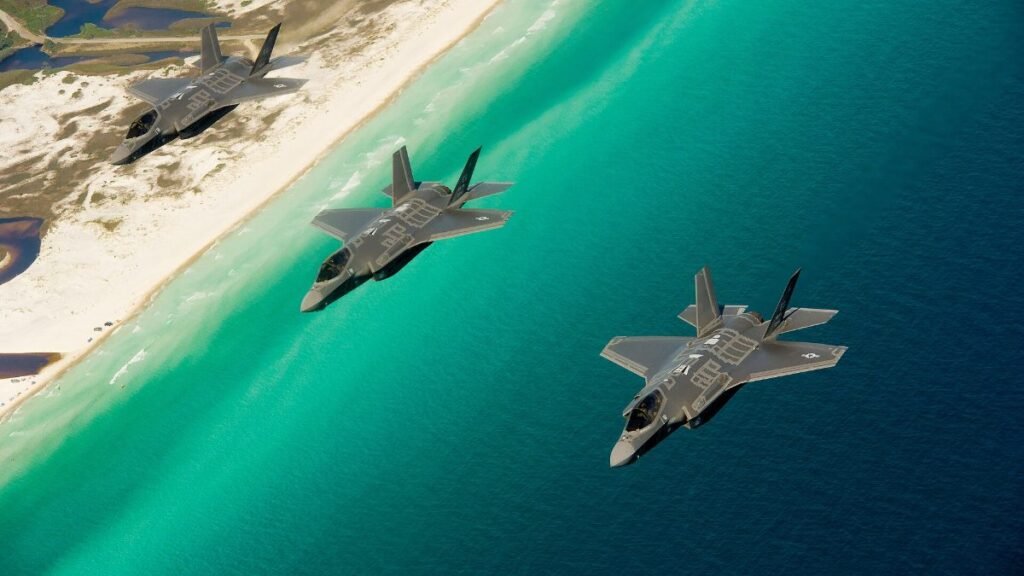
Photo: Master Sgt. John Nimmo Sr./U.S. Air Force.