NEW DELHI — India’s Defense Ministry on Oct. 15 signed two contracts worth about 4,106 crore rupees, or 41 billion rupees, for a dedicated military communications satellite for the Indian Air Force and a new batch of Varunastra heavyweight torpedoes for the navy.
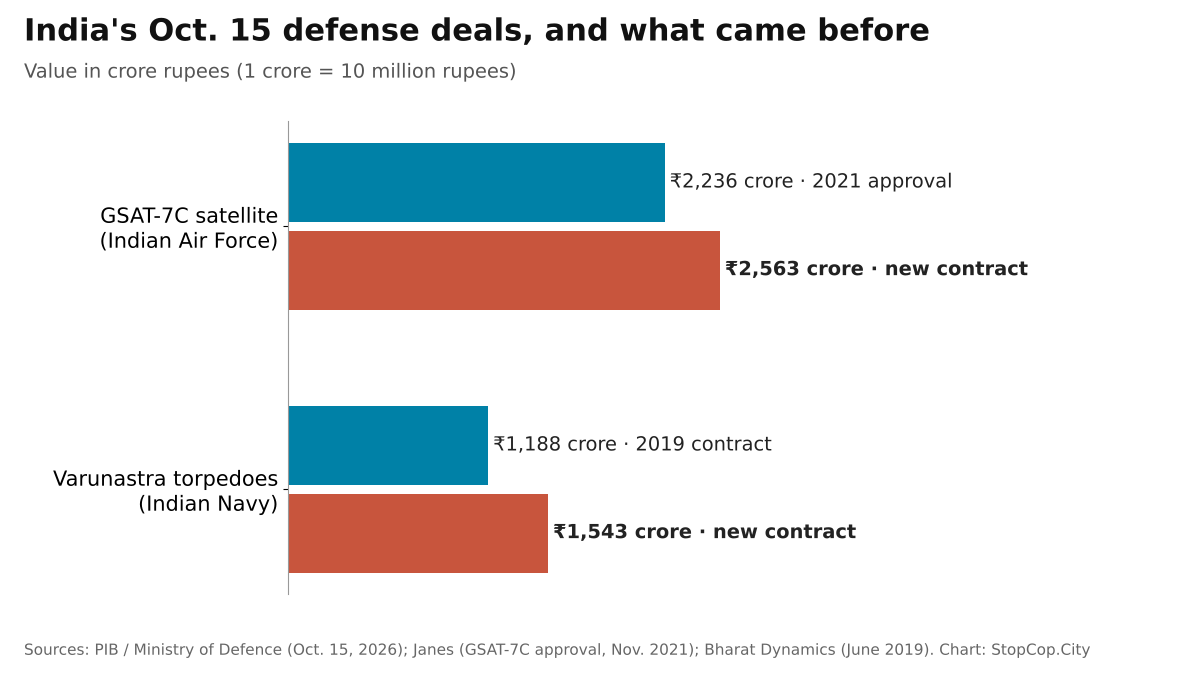
The larger deal, worth 2,563 crore rupees, went to NewSpace India Limited, the commercial arm of India’s Department of Space, for the GSAT-7C satellite. The second, worth 1,543 crore rupees, went to state-owned Bharat Dynamics Limited in Hyderabad for the torpedoes, according to a Ministry of Defence release.
Both were signed in New Delhi in the presence of A. Anbarasu, additional secretary and director general of acquisition at the Department of Defence.
The ministry said the satellite “will enhance the secure, resilient and seamless communication capabilities for the assets of the Indian Air Force,” The Week reported. It called the pair of contracts “a significant step towards advancing the development of domestic defence manufacturing,” in line with the government’s Atmanirbhar Bharat self-reliance policy.
The ministry did not give a launch date for the satellite, a delivery schedule for the torpedoes or how many torpedoes the contract covers.
A satellite of the Air Force’s own
GSAT-7C is meant to give the Air Force beyond-line-of-sight links between its aircraft, ground stations and the software-defined radios now entering service, so pilots and controllers can talk and share data in real time even when out of radio range.
India’s Defence Acquisition Council, chaired by Defense Minister Rajnath Singh, first approved the program on Nov. 23, 2021, through an acceptance of necessity, the first formal step in India’s defense procurement process, at an estimated 2,236 crore rupees for the satellite and its ground hubs, Janes reported at the time. The contract signed this week is about 327 crore rupees higher than that estimate.
When it approved the program, the ministry said the satellite would “enhance the ability of our Armed Forces to communicate beyond the Line of Sight among one another in all circumstances in a secure mode.” It was classed as a Make in India project, with design, development and launch all to take place in India, and Janes reported that the Indian Space Research Organisation would develop it with support from local industry, including state-owned Bharat Electronics.
Nearly five years passed between that approval and this week’s contract. The ministry has not said when the satellite will fly or which rocket will carry it.
The satellite joins India’s GSAT-7 series of military communications satellites. GSAT-7, launched in 2013, serves the navy. GSAT-7A, launched on a GSLV rocket in December 2018, serves the Air Force. GSAT-7C is designed, developed and built in India, the ministry said, and NSIL is a government-owned company under the Department of Space that sells and manages Indian Space Research Organisation satellites and launches.
The navy has already replaced its first satellite. Its newer GSAT-7R, also called CMS-03, went up on Nov. 2, 2025, aboard India’s LVM3 rocket. At about 4,400 kilograms, it was the heaviest communications satellite launched to geostationary transfer orbit from Indian soil, Space.com reported, and it replaces the original GSAT-7.
Varunastra: India’s own heavyweight torpedo
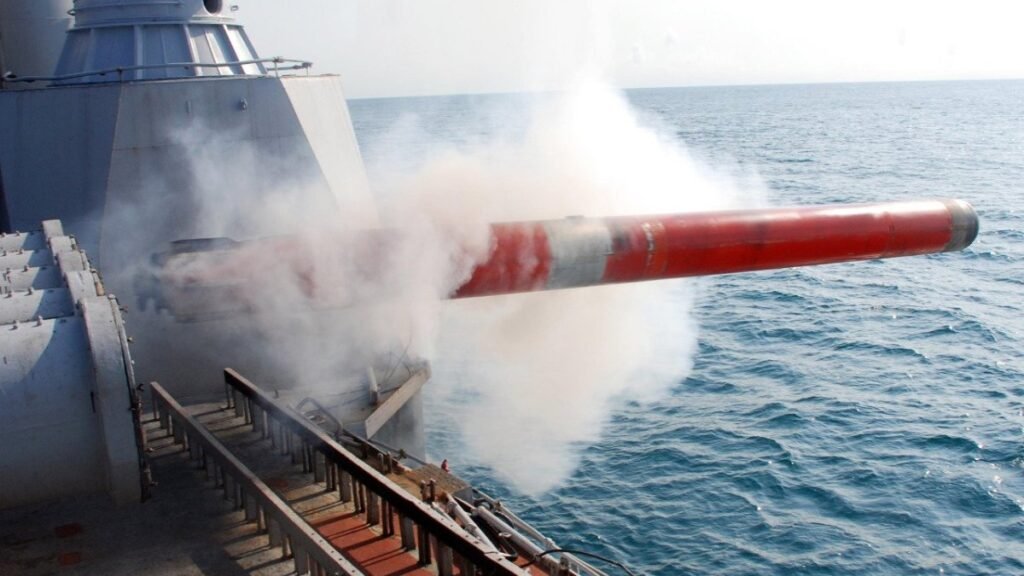
Varunastra is a ship-launched, electrically powered anti-submarine torpedo developed by the Naval Science and Technological Laboratory in Visakhapatnam, part of India’s Defence Research and Development Organisation. It is built to hunt submarines in both shallow and deep water.
Bharat Dynamics lists these figures for the weapon:
| Specification | Varunastra |
|---|---|
| Length | 7.78 meters |
| Diameter | 533.4 millimeters |
| Speed settings | 27 and 40 knots |
| Operating depth | 8 to 600 meters |
| Weight | About 1,605 kg (exercise) / 1,850 kg (combat) |
| Propulsion | Electric, contra-rotating propellers |
| Guidance | Acoustic homing with wide look angle, counter-countermeasures, multiple-target tracking |
Development at the laboratory took more than a decade. The navy formally received the torpedo at a ceremony in New Delhi on June 29, 2016, where then-Defense Minister Manohar Parrikar formally handed it over to the navy chief, Adm. Sunil Lanba.
Production followed. In June 2019, Bharat Dynamics signed a 1,187.82 crore rupee contract to make Varunastra at its Visakhapatnam unit, to be delivered over 42 months, according to a company release. In March 2025, the Defence Acquisition Council cleared buying more of the combat version as part of approvals worth more than 54,000 crore rupees, according to a government release.
The torpedo was first fired with a live warhead from a Kamorta-class anti-submarine corvette in June 2023, and a submarine-launched trial hit its target the following day, Janes reported.
Where the money comes from
Both contracts draw on a capital budget that India raised sharply this year. The Ministry of Defence’s 2026-27 budget totals about 7.85 lakh crore rupees, up 15.2% from the year before, and its modernization budget for new weapons is 1.85 lakh crore rupees, up 24.6%, according to an analysis by the Manohar Parrikar Institute for Defence Studies and Analyses, a government-funded think tank in New Delhi. (One lakh crore is one trillion rupees.)
Seventy-five percent of that modernization money, about 1.39 lakh crore rupees, is set aside for buying from Indian companies, the institute said. Both of this week’s suppliers, NSIL and Bharat Dynamics, are state-owned Indian firms, and both products were designed in India.
The budget line for aircraft and aero engines, which mostly serves the Air Force, rose 31.1% to about 63,734 crore rupees. The navy’s main fleet modernization line is about 25,024 crore rupees.
Bharat Dynamics also won an 811 crore rupee defense ministry order in late September, and the ministry separately signed a 661 crore rupee contract for BrahMos fire control systems and launchers for navy ships in early October, Business Today reported.
Documents and reporting
- Press Information Bureau: Ministry of Defence signs contracts worth about Rs 4,106 crore (Oct. 15, 2026)
- The Week: How India’s Rs 4,106 crore defence deals will boost IAF, Navy
- Business Today: Defence Ministry signs Rs 4,106 crore deals for IAF, Navy
- MP-IDSA: Ministry of Defence 2026-27 Budget Estimates, an analysis
- Janes: India clears Air Force procurement of GSAT-7C satellite (2021)
- Bharat Dynamics: Varunastra contract release (June 2019)
Photo: Indian Navy via Wikimedia Commons (Government of India). Chart: StopCop.City.