Ukraine’s navy fired Neptune cruise missiles at a Russian air base in the Voronezh region overnight Oct. 14-15, hitting six Su-34 fighter-bombers parked at the Borisoglebsk airfield, Ukrainian officials said. Satellite imagery verified by Reuters shows destruction at the airfield.
Ukraine’s navy said the six Su-34Ms were struck along with equipment that supports flight operations, and that the attack set off secondary explosions and a fire, Ukraine’s state news agency Ukrinform reported.
“On the night of Oct. 14-15, the Ukrainian Armed Forces’ navy struck the Borisoglebsk military airfield,” the navy said, according to the Kyiv Post. Its first statement did not say whether all six jets were destroyed or only damaged, and said the results were still being clarified. The navy said the strike would weaken Russia’s aviation and reduce its ability to carry out tactical air operations in the sectors those jets supported.
Later on Thursday, Ukraine’s General Staff said on Telegram that it had “confirmed damage of varying degrees to all six aircraft,” Reuters reported. Satellite imagery taken that day and verified by Reuters shows evidence of destruction at the airfield.
President Volodymyr Zelenskyy gave a more precise count. “Four Su-34 aircraft were destroyed and two more Su-34s were hit,” he wrote on X, adding that a “Long Neptune” missile was used, The Moscow Times reported.
“These aircraft were ready for new strikes on Ukraine and were equipped with aerial bombs,” Zelenskyy wrote, according to the Kyiv Independent. “The Russians used them to terrorize our people.”
The base lies about 370 kilometers from the front line, according to the Kyiv Independent.
Russia did not acknowledge a strike on the base. Voronezh Gov. Alexander Gusev said air defenses intercepted 33 drones and several jet-powered targets over the region that night, and that falling debris damaged outbuildings and a car in the city of Voronezh. Residents of Borisoglebsk reported explosions and a large fire, The Moscow Times reported.
Why the Su-34 matters
The Su-34 is a two-seat fighter-bomber and, in the Kyiv Post’s words, “one of Russia’s principal platforms for launching guided aerial bombs against Ukrainian defensive positions.” The Su-34M can carry multiple guided and unguided aerial bombs as well as missiles, the Kyiv Post noted. Reuters describes it as a large jet that costs tens of millions of dollars and is often used to drop glide bombs on Ukrainian cities near the front.
The upgraded Su-34M carries improved avionics and electronic warfare equipment, including the Khibiny countermeasures system, and sensor pods tied to Russia’s growing use of glide bombs fitted with guidance kits, the Kyiv Post reported this month. Russian videos have shown the jets carrying 500-kilogram steerable glide bombs and 3,000-kilogram FAB-3000 bombs.
Russia has been racing to replace them. The aircraft is built at the Chkalov Aviation Plant in Novosibirsk. Russia’s United Aircraft Corp. delivered 18 Su-34s in seven batches in 2025, and handed over its second batch of 2026 on Oct. 7, a week before the strike, the Kyiv Post reported. The size of that batch was not disclosed; analyst Guy Plopsky said it could be as many as four jets. Open-source estimates put Su-34 output at roughly 30 aircraft in 2026, nearly double the rate before the full-scale invasion, the Kyiv Post reported.
The jets still depend on imported parts. A July 2025 investigation by the International Partnership for Human Rights identified 221 foreign electronic components in Su-34 wreckage recovered in Ukraine, made by 59 companies in eight countries, most of them in the United States, followed by Japan, the European Union, Switzerland, Taiwan and South Korea, according to the Kyiv Post.
“These aircraft are the basic strike power of our frontline aviation,” UAC chief executive Vadim Badekha said at the handover, according to the Kyiv Post. “We are maintaining a high pace of production of combat aircraft.”
Ukraine has been chipping away at the fleet all year. Ukraine’s SBU security service said drones destroyed a Su-34 and a Su-35 at Khanskaya airfield in southern Russia on Oct. 4, and another Su-34 was shot down over the battlefield in late March, the Kyiv Post reported. In July 2025, a Ukrainian operation reportedly put four Su-34s out of action at an airfield in the Volgograd region.
A familiar target
Borisoglebsk is a key base for Russian fighter jets and bombers, including Su-34, Su-35S and Su-30SM warplanes, the Kyiv Post has reported.
Ukraine has struck it before, with drones, in August 2024, October 2024 and July 2025. The October 2024 attack by the SBU and the July 2025 strike both targeted glide-bomb storage, according to the Kyiv Post.
The missile
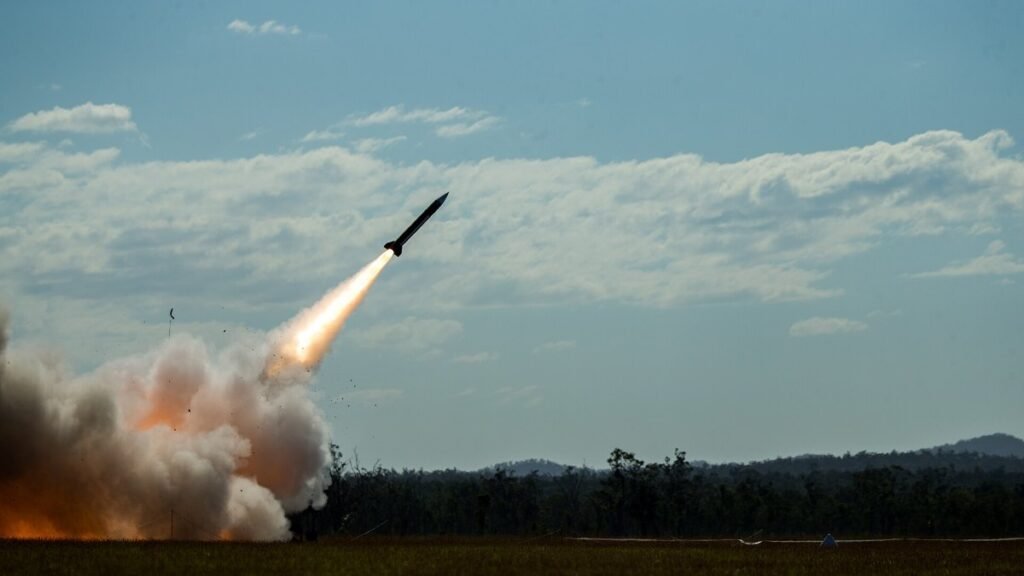
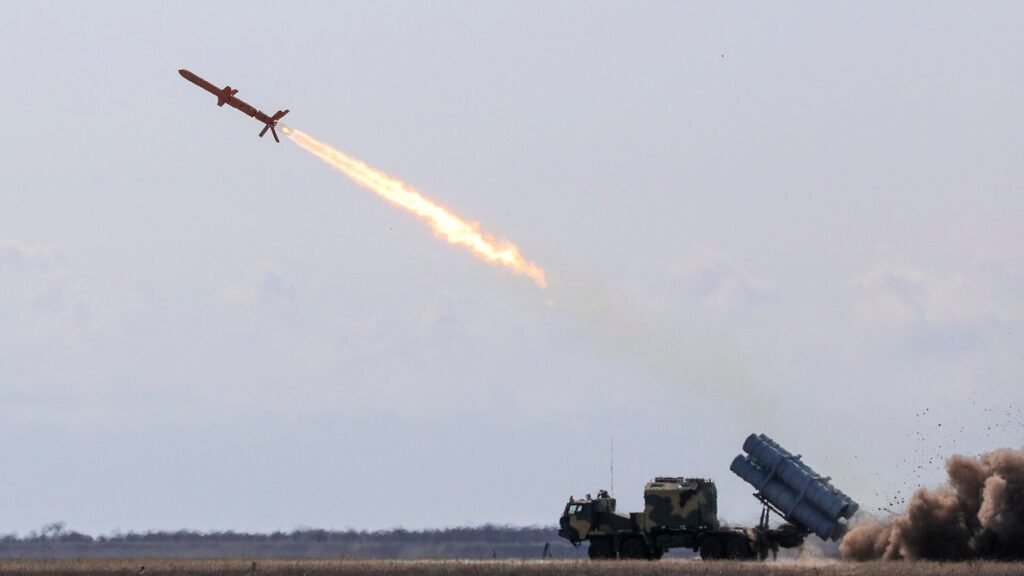
The R-360 Neptune is a domestically produced, ground-launched cruise missile first designed to hit ships. It became famous in April 2022, when Ukraine used it to sink the Russian Black Sea Fleet flagship Moskva. Since then, Ukraine has developed a longer-range land-attack version. The upgraded Long Neptune unveiled in 2025 has shown a range of 1,000 kilometers, the Kyiv Independent reported.
Ukraine’s navy and Ukrinform described the weapon simply as Neptune. Zelenskyy specified the Long Neptune.
The same night, Ukrainian forces also hit a site in Russia’s Oryol region used to store and launch attack drones and a target in the Black Sea, Zelenskyy said, The Moscow Times reported. Ukraine has also struck Shagol airfield in Chelyabinsk, about 1,700 kilometers from the border, hitting Su-57 and Su-34 jets, and in September it hit a MiG-29 near Millerovo and a Ka-27 helicopter near Yeysk, the outlet reported.
“Russia is dragging out the war, so our long-range operations will continue,” Zelenskyy wrote.
Sources
- Reuters: Ukraine says it damaged six Russian military jets in missile strike on airfield
- Ukrinform: Ukraine destroys six Su-34M bombers at airfield in Russia’s Voronezh region
- Kyiv Independent: Ukraine hits 6 Russian Su-34 bomber jets with Neptune missile
- The Moscow Times: Ukraine says missile strike destroyed Russian warplanes at Voronezh airfield
- Kyiv Post: Navy strikes Borisoglebsk airfield
- Kyiv Post: Russia steps up production of improved Su-34 fighter-bombers
Photo: Office of the President of Ukraine via Wikimedia Commons (CC BY 4.0). The image shows a 2019 Neptune test launch.