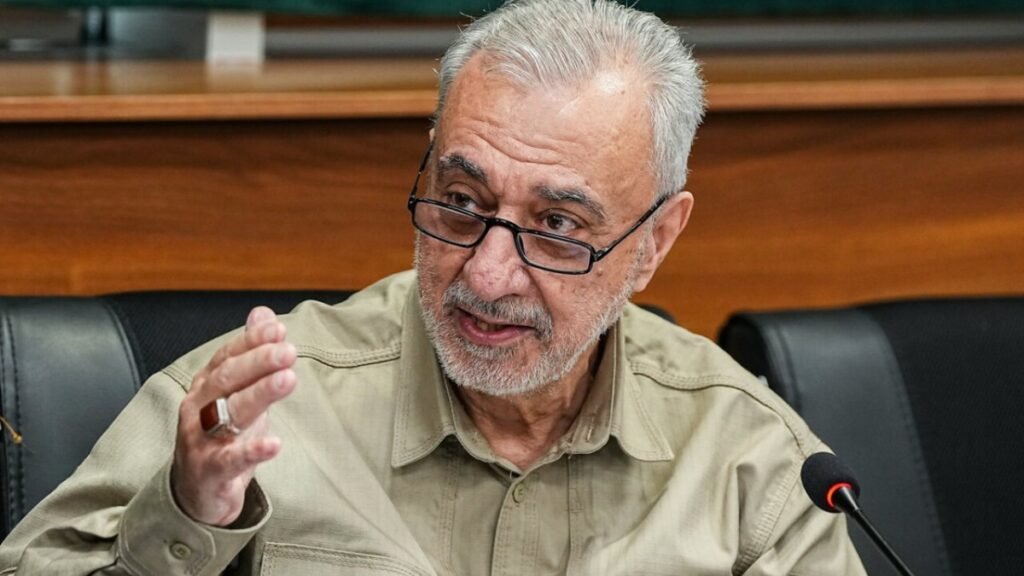
When Vice President JD Vance wanted to reach Iran’s leadership last month, he did not write to the president or the foreign minister. He wrote to Mohsen Rezaei.
That choice says a lot about where power sits in wartime Tehran. Rezaei, the secretary of the Supreme National Security Council, is a 72-year-old veteran of the Revolutionary Guards whose career stretches from the battlefields of the 1980s to an Interpol wanted list. He is now the official Washington and the mediators most need to persuade, and the one who keeps saying no in public.
Rezaei at a glance
- Born: 1954, Masjed Soleyman, Khuzestan province
- Revolutionary Guards commander: 1981 to 1997
- Expediency Council secretary: 1997 to 2021
- Presidential runs: 2009, 2013 and 2021; withdrew in 2005
- Vice president for economic affairs: 2021 to 2023
- Military adviser to the supreme leader: appointed March 2026
- Current post: secretary of the Supreme National Security Council
Biographical details are drawn from his public record.
The war commander
Rezaei was only in his twenties when he took command of the Islamic Revolutionary Guard Corps in 1981, a year into Iraq’s invasion of Iran. He led the force for 16 years, through the entire eight-year war.
He was known as a hawk. He pushed to keep fighting even after Iraqi forces had been driven out of Iranian territory, and clashed with commanders of the regular army. By 1988, as losses mounted, he wrote to Ayatollah Ruhollah Khomeini that the war could not be won. That summer, Khomeini accepted a UN-brokered ceasefire, famously comparing the decision to drinking from a poisoned chalice.
That history is relevant now. Rezaei is one of the few senior figures in Iran who has both led a long war and watched one end in a stalemate that the leadership had to sell as survival.
The politician who kept losing
After leaving the Guards, Rezaei spent nearly a quarter century as secretary of the Expediency Discernment Council, a body that arbitrates disputes between Iran’s parliament and its clerical overseers. He ran for president repeatedly, finishing third in 2009, fourth in 2013 and second to Ebrahim Raisi in 2021. Raisi then made him vice president for economic affairs.
Wanted by Interpol, sanctioned by Washington
Rezaei carries heavy baggage abroad. In 2006, an Argentine judge issued an arrest warrant for him and other Iranian officials over the 1994 bombing of the AMIA Jewish community center in Buenos Aires, which killed 85 people. He has been subject to an Interpol red notice since 2007. He denies involvement.
The U.S. Treasury also sanctioned him in January 2020, as part of a set of designations aimed at Iranian officials.
That background is one reason a face-to-face meeting with Vance would be politically awkward for both sides.
Why he matters in this war
After Supreme Leader Ali Khamenei was killed in the first U.S.-Israeli strikes on Feb. 28, his son Mojtaba Khamenei succeeded him and, in March, named Rezaei a military adviser. Rezaei now leads the council that coordinates Iran’s security and foreign policy decisions.
Vance’s letter, sent through Qatar in late October, was addressed to him and proposed direct talks, Al Jazeera reported. Iran confirmed receiving it but did not publicly answer.
Rezaei has also been the most visible hardliner in public. After the U.S. midterms, he said Iran had handed President Donald Trump a strategic defeat on the battlefield and a political defeat in Washington, The National reported. An Abu Dhabi-based outlet, Erem News, reported that he rejected a Qatari proposal to open a direct channel with Washington in Doha, even as Iran’s president, parliament speaker and foreign minister pushed to move ahead, according to The Times of Israel. That report has not been confirmed by Iranian officials.
The meeting that may or may not happen
On Nov. 9, Turkey’s intelligence chief, Ibrahim Kalin, said Vance and Rezaei were scheduled to meet in Qatar the following week, Iran International reported. Kalin said regional mediators were working on a seven-point proposal covering sanctions relief, frozen Iranian assets, nuclear commitments and reopening the Strait of Hormuz, and that the main dispute was over which side moves first.
Tehran shot it down within hours. Foreign Minister Abbas Araghchi said there were no plans for such a meeting, and an Iranian security official told the Tasnim news agency the same. Rezaei went further on X, writing: “STOP manufacturing FAKE NEWS about imaginary talks.” He demanded that Washington accept Iran’s seven conditions.
Secretary of State Marco Rubio, for his part, said before a G7 meeting in Paris that the sides were not on the verge of a breakthrough, Al-Monitor reported.
Hardliner or dealmaker?
Both readings exist. His public posts are combative, and his background makes him a natural voice for the security establishment that wants to drag the war out. But his 1988 letter to Khomeini shows he has argued for ending a war before when he judged it could not be won.
Iran’s mixed signals reflect that tension. President Masoud Pezeshkian said on Nov. 9 that Supreme Leader Mojtaba Khamenei had told the country’s leadership to end the state of no war, no peace with the United States, The Times of Israel reported. As security council secretary, Rezaei sits at the center of whatever that instruction turns into. Whether that means a deal or a final confrontation may depend in part on Rezaei.
What to watch
- Any confirmed contact between Rezaei and Vance, in Doha or elsewhere.
- Whether Iran publishes its seven conditions.
- Signs of a split between Rezaei and Iran’s civilian leaders.
Sources and official links
- The Times of Israel: Live updates, Nov. 9
- Iran International: Araghchi denies plans for meeting between Rezaei and Vance
- Tasnim: No plans for Doha meeting between SNSC chief and US VP
- The National: Iran sees opening after Trump midterms setback
- The Times of Israel: Live updates, Nov. 3
- Al Jazeera: What we know of Vance’s letter to Rezaei
- Al-Monitor: Trump meets Qatar PM as mediators push Iran deal
- Wikipedia: Mohsen Rezaei
- Interpol: About red notices
Photo: Julia Maudlin, CC BY 2.0, file photo.