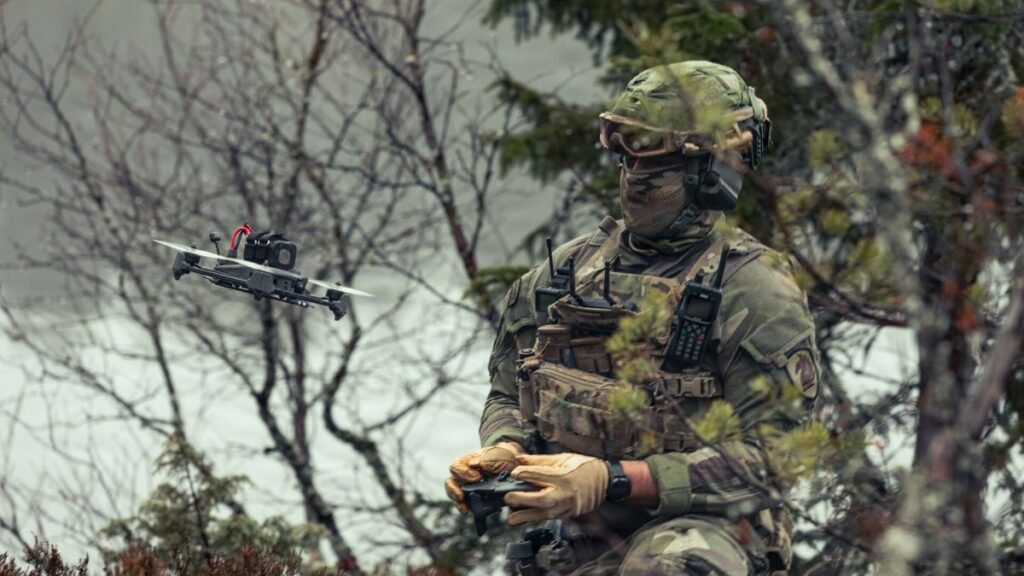
Ten warrant officers at Fort Bragg, North Carolina, just became the first soldiers in an Army job that didn’t exist a month ago. Their title is 390A robotics technician, and their final exam was to design, 3D-print and code a working robotic system in the field.
The Army activated the specialty on Oct. 1 at the John F. Kennedy Special Warfare Center and School and inducted the first class the next day, according to an Army release. On the same day, the acting Army secretary ordered positions for 390A technicians and for 15X tactical drone specialists in every unit that needs them, Task & Purpose reported.
“We are scaling this across the Army,” Vice Chief of Staff Gen. Christopher LaNeve said.
At a glance
| Job | 390A Robotics Technician (warrant officer) |
|---|---|
| Branch | Special Forces branch, serving across U.S. Army Special Operations Command |
| Course | 390A Warrant Officer Basic Course, 19 weeks |
| Where | Fort Bragg, Camp Mackall, Fort McClellan and Clark Range, Alabama |
| Assignment | Technical adviser to brigade, group and task force commanders |
| First class | 10 warrant officers, inducted Oct. 2, 2026 |
What the job is
A 390A is the person a commander calls when the drones stop working. The technicians build, program, repair and integrate robotic and autonomous systems, and advise commanders on how to use them. Maj. Gen. Jason Slider, who commands the special warfare school, described the role as “that architect,” a warrant officer who can turn robotics and autonomy into combat power.
The Army decided it needed a dedicated specialist rather than handing the work to whoever on a team was good with electronics. “It cannot be an additional task or an additional hat for someone on the ODA,” said Chief Warrant Officer 5 Jerry Brown, the top warrant officer at 1st Special Forces Command, referring to the 12-man Special Forces A-team. Technicians are not assigned to those teams and don’t have to pass Special Forces selection.
Training is heavy on engineering. Fourteen of the course’s 19 weeks cover computer networks, AI at the edge, computer-aided design, additive manufacturing and radio frequency systems. Students build drones from scratch that can navigate without GPS or radio signals, which matters on battlefields where both are routinely jammed, as they are in Ukraine. The course ends with two weeks of mission planning, a three-week field exercise and a “prototype capstone.”
Who could apply for the first class
When the Army opened recruiting for the first cohort in 2025, it was limited to soldiers already serving in special operations units, and Special Forces qualification was not required, Soldier Systems Daily reported. The requirements were:
- enlisted soldiers in any MOS and grade
- warrant officers who had finished candidate school and their basic course, and were CW2s with at least a year in grade or CW3s with no more than a year in grade
- officers from any branch, if branch qualified
- a Secret clearance and Army fitness and height and weight standards
- no derogatory information, referred evaluations or pending adverse action
- the ability to serve a three-year tour after the basic course
Those rules could change as the Army expands the job beyond special operations, which LaNeve’s comments suggest it will. The current prerequisites and packet instructions are posted on the U.S. Army Recruiting Command warrant officer feeder list, under 390A. Soldiers interested in the enlisted drone track can ask their career counselor about 15X.
The Army has not said how many 390A slots it will fund or when the next class starts.
Sources
- U.S. Army: Architects of autonomy: Army activates 390A robotics technician MOS
- Defense News: US Army creates robotics technician job to focus on drone warfare
- Task & Purpose: Hundreds of soldiers transfer to newly created jobs in robotics and space
- Soldier Systems Daily: US Army opens recruiting for robotics warrant MOS
Featured image: Staff Sgt. Reece Heck / U.S. Army via Wikimedia Commons, public domain (cropped)