Australia’s Ghost Shark robot submarine is getting weapons. Defense officials and Anduril Australia on Monday unveiled a set of plug-in payloads that will let the extra-large uncrewed undersea vehicle lay sea mines, launch aerial drones by the dozen and drop off supply caches, with some of the hardware headed straight into an AUKUS exercise near San Diego.
“The Ghost Shark now has teeth and will have the ability to inflict damage on any potential adversary,” Defense Industry Minister Pat Conroy said at the unveiling, Breaking Defense reported.
The modular payloads are being built for three Australian sea drones: Anduril’s Ghost Shark, C2 Robotics’ Speartooth uncrewed underwater vehicle and Ocius’ Bluebottle uncrewed surface vessel. The Australian government’s Oct. 19 release said the work supports undersea warfare, seabed operations, sea denial and protection of critical undersea infrastructure.
What Australia unveiled for Ghost Shark, Speartooth and Bluebottle
The government release itself stayed general, listing remote delivery of supply caches, sea mines and uncrewed aerial vehicles as examples. The specifics came from Conroy and from reporting on the event at Anduril Australia’s facility in Sydney. Conroy said the minelaying module can deploy 12 mines, and the drone module carries Anduril’s Altius strike and reconnaissance aircraft, according to Breaking Defense. USNI News reported that “Australia’s Ghost Shark variant can carry up to 12 undersea mines and at least 24 Altius-600 aerial drones.”
| Payload | What it does | Vessel |
|---|---|---|
| Minelaying module | Deploys up to 12 sea mines | Ghost Shark |
| Altius drone launcher module | Launches at least 24 Altius-600 drones, configurable for reconnaissance or one-way attack | Ghost Shark |
| Supply cache | Delivers and leaves logistics supplies remotely | Ghost Shark |
| Thin-line towed array sonar | Listens for submarines in anti-submarine warfare | Bluebottle |
| Payloads under development | Not publicly detailed | Speartooth |
The Altius-600 is an Anduril drone. USNI News noted it can be configured to scout or to dive into a target as a one-way attack weapon.
Vice Adm. Matt Buckley, chief of the Royal Australian Navy, called the payload program “an important investment in autonomous and uncrewed maritime systems,” Breaking Defense reported. He argued that, “given the vastness of our maritime geography,” rapidly delivering uncrewed systems “adds numbers to our fleets” and complements the navy’s crews, ships and submarines.
How the Ghost Shark extra-large autonomous undersea vehicle works
Ghost Shark is what Australia calls an extra-large autonomous undersea vehicle, or XL-AUV. USNI News described Canberra’s investment as going to Anduril’s Dive-XL extra-large UUV. Anduril has released few hard performance numbers, and none of the reporting reviewed for this story gives the vehicle’s length, depth rating, speed or range.
What is on the record is the architecture. The vehicle uses an all-electric powertrain built for long-range, long-duration missions without surfacing, can be run from shore or from another ship, and can be flown in aircraft such as the C-17, Breaking Defense reported when the production contract was announced in September 2025. One was flown to Hawaii on a C-17 for the Rim of the Pacific exercise.
The key design choice is modularity. Ghost Shark “has been engineered to carry multiple distinct mission payloads,” Anduril said, Defense News reported. The new mine, drone and cache modules are the first public look at what fills those sections. David Goodrich, executive chairman and CEO of Anduril Australia, previewed this in 2025, saying Ghost Shark “will continue to evolve, as it must, with new payloads, new weapons.”
The A$1.7 billion contract
Australia announced on Sept. 10, 2025, that it would spend A$1.7 billion, about $1.12 billion, over five years to build, sustain and further develop Ghost Shark in Australia, according to the government and Defense News. Canberra had spent A$145 million on the program since April 2022, and Anduril delivered three prototypes ahead of schedule.
An exact fleet size has not been released. Conroy said at Monday’s event that the contract covers “dozens and dozens” of Ghost Sharks, USNI News reported. In the government release, he called the vehicle “a flagship Australian success story that showcases the ingenuity of our defence industry.” The Ghost Shark buy sits inside a larger plan: up to A$5.8 billion over the decade for autonomous and uncrewed undersea warfare under the 2026 National Defence Strategy and Integrated Investment Program.
Why mines and drones from the seabed matter in the Indo-Pacific
An uncrewed vehicle that can slip into a contested strait, seed a minefield and leave, or wait quietly before launching two dozen drones, gives a mid-size navy a way to threaten an adversary without risking crewed ships or one of its few submarines. That is the “sea denial” mission the government release names.
Australia’s motivation is not abstract. USNI News noted that Chinese intelligence collection ships, surface action groups and amphibious assault ships have sailed near Australia, and that Chinese forces have shone lasers and conducted live-fire drills within Australia’s exclusive economic zone.
The most visible episode came in February 2025, when three Chinese navy ships, a frigate, a cruiser and a supply tanker, held drills in the Tasman Sea between Australia and New Zealand with little warning, forcing commercial flights to divert midair, CBS News reported. Defense Minister Richard Marles said Australian warships typically give 12 to 24 hours’ notice. “That notice was not provided here,” he said.
Undersea drones are also meant to watch the sea floor itself. The government framed the payloads partly as protection for critical undersea infrastructure, the cables and pipelines that carry data and energy across the region.
The AUKUS Pillar II angle and the US role
The payloads are tied to Pillar II of AUKUS, the Australia-U.K.-U.S. pact on advanced military technology that runs alongside the better-known nuclear submarine effort. On May 30, defense ministers from the three countries launched the first Pillar II “signature project,” focused on payloads and enabling systems that can be used across all three nations’ uncrewed undersea vehicles, the Australian Department of Defence said. Delivery begins in 2027.
The listed missions go well beyond mines: protecting seabed infrastructure, surveillance, reconnaissance and strike, logistics, anti-submarine and anti-surface warfare, mine countermeasures, electronic warfare and contested littoral maneuver.
Testing at Maritime Big Play Pacific in San Diego
Some of the new payloads are being fielded at Maritime Big Play Pacific, an AUKUS Pillar II exercise near San Diego hosted by Naval Information Warfare Center Pacific, U.S. Pacific Fleet and the U.S. Marine Corps. The Australian release said the event builds on three years of testing payloads and enabling systems with AUKUS partners at earlier iterations of the exercise. The exercise runs Oct. 5-25.
Where the US Navy stands
Anduril is an American company, and it has pitched Ghost Shark to the U.S. Navy. The company opened a production facility at Quonset Point, Rhode Island, in 2025, and built a U.S. payload module from American steel and software that was being tested off California, USNI News reported. “I am highly confident that in the very near future there will be a contractual path,” Chris Brose, Anduril’s president and chief strategy officer, said at the time.
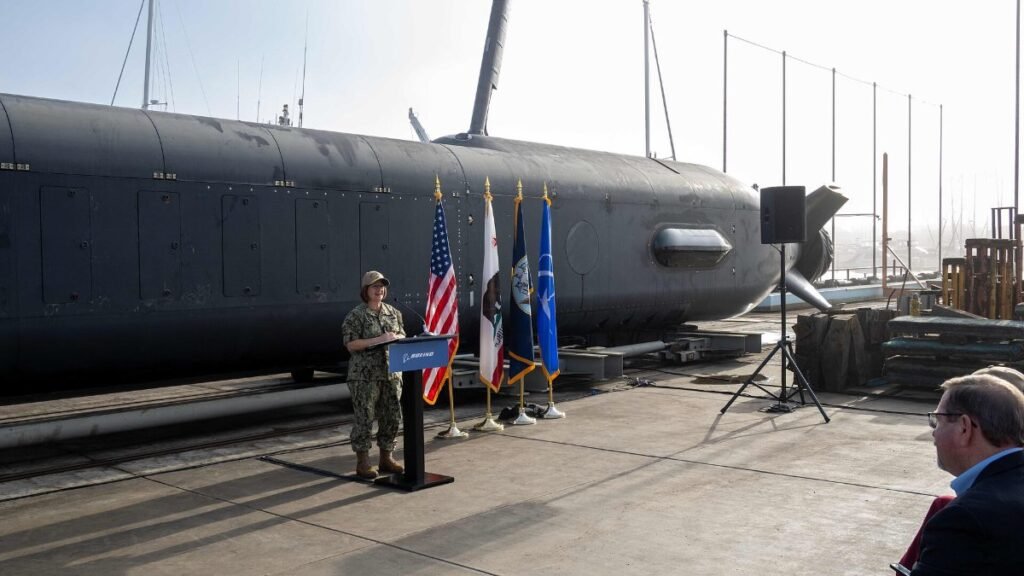
The Navy’s own extra-large UUV effort has moved slowly. Boeing has been building Orca XLUUV prototypes, and a June 2025 Government Accountability Office report said it was “unclear whether the Navy will transition the XLUUV to a program of record,” USNI News reported.
What’s next for Ghost Shark and AUKUS undersea payloads
- Payload trials at Maritime Big Play Pacific near San Diego, which runs through Oct. 25.
- Continued Ghost Shark deliveries to the Royal Australian Navy from Anduril’s Sydney factory, which Conroy said is producing the vehicles at an increasing rate.
- Integration of payloads on C2 Robotics’ Speartooth and a thin-line towed array sonar on Ocius’ Bluebottle for submarine hunting.
- Delivery of the first AUKUS Pillar II signature project payloads, usable on all three nations’ undersea drones, beginning in 2027.
- A possible U.S. Navy decision on whether to buy Ghost Shark or carry its own XLUUV work into a program of record.
Marles, in the government release, framed the payloads as part of a push for “practical outcomes” in “an increasingly complex strategic environment.”
Official links
- Australian Minister for Defence: Australia advances undersea warfare capabilities (Oct. 19, 2026)
- Australian Minister for Defence: Ghost Shark production contract (Sept. 10, 2025)
- Australian Department of Defence: AUKUS partners launch Pillar II project
- Australian Department of Defence: AUKUS advanced capabilities
- Australian Department of Defence: Ghost Shark program announcement (2022)
Photo: Chief Mass Communication Specialist William Spears/U.S. Navy.