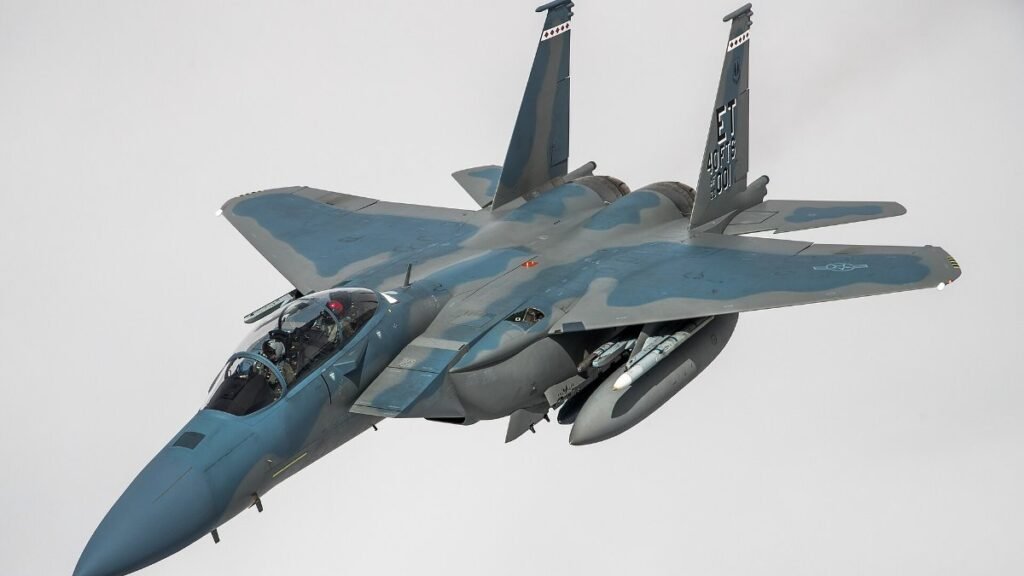
The Air Force says it needs 1,509 combat-coded fighters by 2035 to fight at what planners call moderate risk. It does not have them. The service’s own count in May was 1,098 fighters under the measure Congress uses, 47 short of the 1,145 minimum written into federal law.
The new number comes from a force structure report the service sent to Congress on Oct. 16. Lt. Gen. David Tabor, the Air Force’s deputy chief of staff for plans and programs, walked reporters through it at the Pentagon on Oct. 20, Air & Space Forces Magazine reported.
The two figures use different yardsticks, since the 1,509 target also counts backup and reserve jets, so the gap is not simple subtraction. Either way, closing it depends on money the service does not yet have. Tabor’s summary, as Breaking Defense quoted it: “The baseline premise is we need it all.”
What the 2035 fighter force structure report says
The unclassified report, dated August 2026, updates a study the Air Force issued in October 2025. It sets two targets for 2035. A moderate-risk force needs 1,509 combat-ready fighters. A low-risk force needs 1,723, up from the 1,558 figure in last year’s report, Breaking Defense reported.
Tabor told reporters that planners “generally don’t plan to low risk” and instead aim for “a moderate level of risk.” Under the military’s scale, risk runs from low to medium, significant and high. At medium risk, forces would likely meet their objectives but could be strained in long operations, Defense News reported.
Last year’s report set an objective of 1,369 fighters for 2030. The new goal adds about 140 more, a mix of F-35s, F-15EXs and F-47s, Air & Space Forces Magazine reported. Tabor called the earlier data “pretty old.”
The 1,509 count leaves out Collaborative Combat Aircraft, the drone wingmen the service wants 500 of by 2032. Tabor said they could shrink future requirements but are not changing the math yet.
The 2035 fighter mix by type
Tabor gave the mix as approximate shares of the fleet rather than aircraft counts. A-10s are not in the 2035 plan and are excluded from these figures.
| Aircraft | Share of fleet today | Share by 2035 | What’s known |
|---|---|---|---|
| F-35A | About 30% | About 40% | FY27 request: 38 jets, 14 of them tied to reconciliation |
| F-22 / F-47 | About 10% (F-22) | About 20% combined | 185 F-22s as of August 2026, per CRS; F-47 to replace them in roughly equal numbers |
| F-15 (E and EX) | About 15% | About 40% combined, split roughly evenly | 212 F-15Es in the fleet; FY27 request: 24 F-15EXs |
| F-16 | About 45% | Older jets reach end of service life in mid-2030s; new-build “F-16G” undecided |
How the Air Force got here: retirements, aging jets and Iran war losses
The Congressional Research Service put the fleet’s average age at 27.4 years in a September report and said the inventory may keep falling until 2030 before it grows again, Military Times reported.
The legal floor sits in 10 U.S.C. 9062: at least 1,145 combat-coded fighters in the primary mission aircraft inventory, a requirement CRS said runs through Oct. 1, 2026. CRS said the Air Force secretary notified Congress on May 5 that the fleet stood at 1,098.
Congress has also barred F-22 retirements below 184 jets through Sept. 30, 2027, and capped F-15E retirements at 51 total. The A-10’s full divestment was shelved in the FY27 request, with 36 jets extended through 2030, according to the CRS report.
Losses in Operation Epic Fury
The war with Iran, which began Feb. 28, cut into an already thin fleet. A CRS insight updated Oct. 5 counts 81 U.S. military aircraft lost or damaged, up from 42 in May. Most are drones: at least 45 MQ-9 Reapers.
The fighters on the list:
- 12 F-15E Strike Eagles. Three were lost in a friendly-fire incident over Kuwait, one was shot down over Iran during an April rescue mission, and eight took light damage in a September attack on Muwaffaq Salti Air Base in Jordan and returned to service.
- Two A-10s. One crashed after enemy fire during the rescue mission; the other lost a wing in the Jordan attack.
- One F-35A, damaged by ground fire over Iran on March 19. It landed safely.
CRS cautioned that the list is not a count of destroyed jets. “Some damaged aircraft may have been returned to active service,” the report said. The Congressional Budget Office put equipment losses through Aug. 1 at $1.9 billion to $3.3 billion.
Tabor said the 1,509 analysis was not driven by the war. The work predated it, he said, and was “just a refresh of the numbers and the combatant command requirements.” The report itself, however, cites the war’s “sustainment challenges and losses” in arguing for a new way to count fighters.
The money: FY27 fighter buys and reconciliation risk
The Air Force’s FY27 request seeks 62 fighters: 38 F-35s and 24 F-15EXs, according to the service’s budget rollout brief. That compares with 24 F-35s and 21 F-15EXs in FY26. The brief puts F-15EX procurement at $3 billion and F-47 research and development at $5 billion, up $1.5 billion.
The catch is in the F-35 line. Only 24 of the 38 jets are in the base discretionary budget. The other 14, worth $2.34 billion, depend on a reconciliation bill that can pass the Senate with a simple majority, but which is now in doubt.
If that bill fails, Tabor said, the service could move money from other programs or push the purchases to 2028. “We just lose 14 times [an] F-35’s worth of other capabilities that we were planning on,” he said, according to Air & Space Forces Magazine.
Even the full 62 falls short of the 72 fighters a year Air Force leaders have long said the service needs just to keep the fleet from shrinking. The last year the Air Force bought more than 72 fighters was 1998, Defense News reported in April.
Production is the second constraint. The report cites F-35 modernization setbacks and Boeing’s F-15EX production struggles. Multiyear deals for both jets are pending before Congress. “The question is, can industry produce at those levels?” Tabor said, according to Air & Space Forces Magazine. He said companies have assured the service they can, but the Air Force still needs “to see it manifest.”
What Congress and analysts say about the fighter shortfall
The sharpest fight may be over how jets are counted. The Air Force wants Congress to move from primary mission aircraft inventory to combat-coded total aircraft inventory, which adds backup and attrition reserve jets. The service calls the new metric “fundamentally more accurate.” The 1,509 target uses it. Critics argue it can shortchange the service because backup and reserve jets are funded at different rates, Breaking Defense reported, citing Air & Space Forces Magazine.
Tabor said it “won’t be a flip of the switch.” CRS has flagged related questions: whether to extend or revise the statutory floor through 2035, and whether drone wingmen should count toward it. Both chambers’ NDAA versions exclude them.
Pressure for bigger buys is also coming from the states. In an April 1 letter, 22 adjutants general with fighter units asked appropriators for multiyear deals and up to 108 new fighters a year. “Funding below 72 aircraft per year means the Air Force is not even sustaining current fighter capacity,” Brig. Gen. Shannon Smith, commander of the Idaho Air National Guard, told Defense News. “It’s actively shrinking.”
Retired Lt. Gen. David Deptula of the Mitchell Institute for Aerospace Studies called the 38-jet F-35A request “budget triage,” Defense News reported, arguing the service needs to buy more.
What to watch next
- Reconciliation. Whether the bill carrying 14 F-35As moves at all, or the Air Force has to cut elsewhere or slip the buy to 2028.
- Multiyear contracts. Congressional approval for F-35 and F-15EX multiyear procurement would be the first real test of whether higher production rates are achievable.
- The counting rule. Any NDAA language that changes, extends or replaces the 1,145 floor, or adopts the Air Force’s preferred metric.
- The F-16 decision. Tabor said a new-build F-16 is not “urgent” and likely won’t be settled in the FY28 budget, but older F-16s age out in the mid-2030s.
- Iran war replacements. Whether Congress funds replacement aircraft; the White House’s $87.6 billion emergency request from June has not been approved.
FAQ
How many fighters does the Air Force say it needs by 2035?
It says 1,509 combat-coded fighters for moderate risk and 1,723 for low risk.
What is the legal minimum, and does the Air Force meet it?
Federal law sets a floor of 1,145 combat-coded fighters in the primary mission inventory. The Air Force reported 1,098 in May, 47 below that line.
How many fighters does the FY27 budget buy?
The request covers 24 F-15EXs and 38 F-35s, but 14 of the F-35s depend on a reconciliation bill that has not passed.
Official links
- CRS: Air Force Fighter Force Structure: Background and Issues for Congress (R49338)
- CRS: U.S. Aircraft Combat Losses in Operation Epic Fury: Considerations for Congress (IN12692)
- Department of the Air Force FY27 budget rollout brief
- U.S. Air Force
Photo: Ethan Wagner/U.S. Air Force.