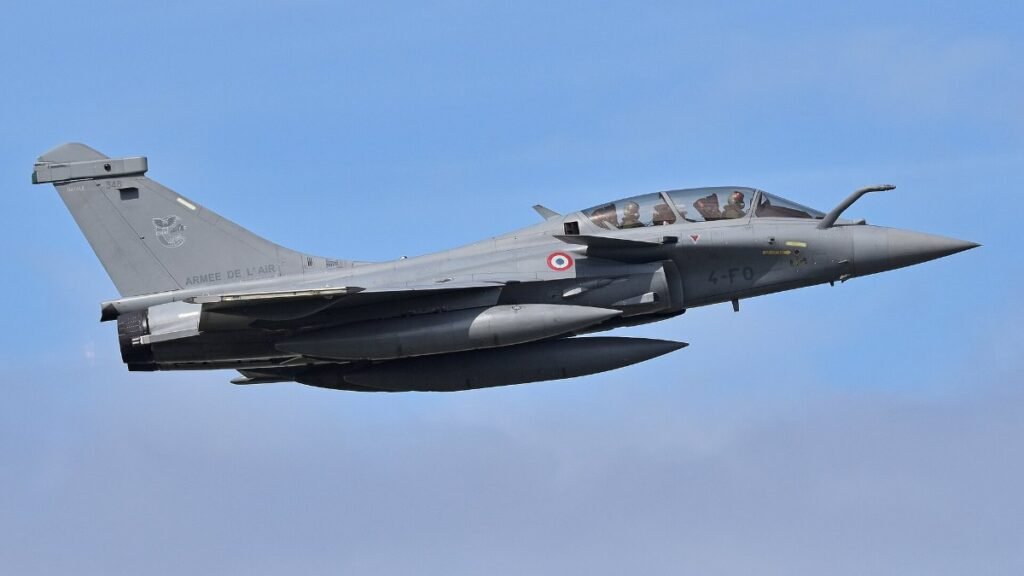
British fighter jets have flown inside a French nuclear-strike rehearsal for the first time. France’s Armed Forces Ministry said Friday, Oct. 23, that Royal Air Force Eurofighter Typhoons escorted French Rafale jets on a simulated nuclear-strike mission over the Mediterranean on Oct. 20-21, in an exercise code-named Rummy. Airbus A330 MRTT tankers kept the formation fueled. No nuclear weapons were carried, Defense News reported.
The French and British crews took off from Saint-Dizier air base in northeastern France. It was the first joint drill involving France’s airborne nuclear capability, Reuters reported, and it comes 15 months after Paris and London agreed to coordinate their nuclear forces.
What happened during Exercise Rummy
French Armed Forces Minister Catherine Vautrin said the British jets joined the mission on the evening of Tuesday, Oct. 20. “Having independent nuclear forces does not preclude coordination,” she said, according to Reuters. “Our nuclear cooperation with the United Kingdom continues to deepen: on Tuesday evening, British Typhoons took part for the very first time in a French nuclear exercise alongside Rafales,” she added.
Gen. Fabien Mandon, chief of staff of the French armed forces, posted on X that the drill showed a “very high level of interoperability.” His post included a picture of three taxiing Eurofighters and another of a Eurofighter under a hardened shelter bearing the markings of the RAF’s 29 Squadron, Defense News reported.
The ministry said the exercise was run under strict safety and security procedures and was meant to build coordination and mutual understanding between French and British personnel. It did not say how many aircraft took part in total.
Etienne Marcuz, a senior analyst at the Paris-based Fondation pour la Recherche Strategique, told Defense News the drill was a “revolution” for the Strategic Air Forces, which have operated in complete autonomy since their creation in the 1960s. He described the presence of at least three British Eurofighters as “quite significant.”
The British statement
British Defence Secretary Wes Streeting, who took the job in July, framed the drill as a message to Moscow and anyone else watching. In remarks quoted by Reuters, he said:
“In an increasingly dangerous world, our adversaries should be in no doubt: the United Kingdom and France stand together in their commitment to European security and to maintaining the deterrence that has helped preserve peace for generations.”
What an airborne nuclear-strike rehearsal involves
France keeps two nuclear legs: ballistic-missile submarines and an airborne force. According to the French Armed Forces Ministry, the Strategic Air Forces have run the airborne component since 1964. Their job is to be able to carry out a presidential order to launch a nuclear missile in any circumstances.
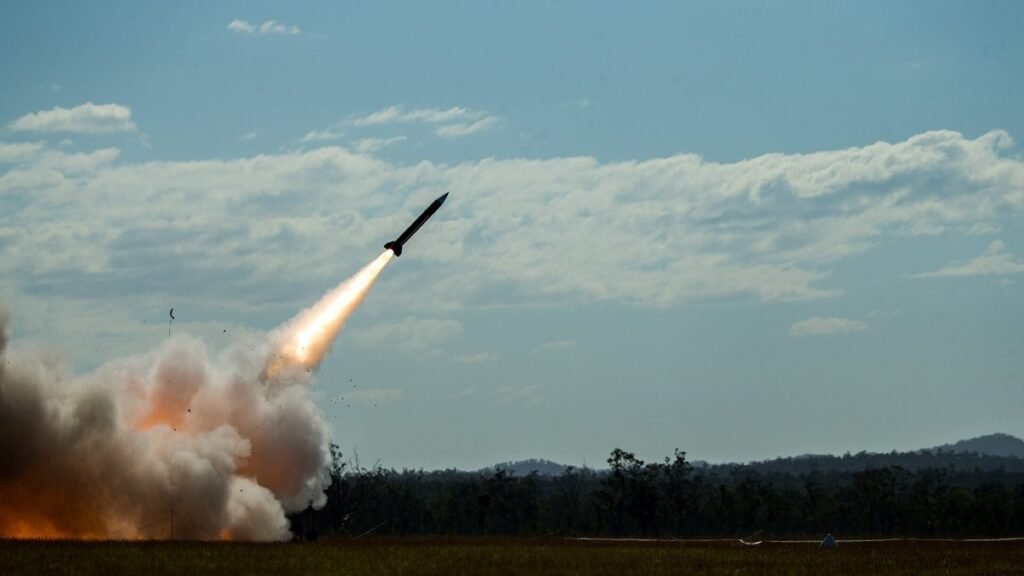
The Rafales carry the ASMPA-R, a renovated version of France’s nuclear-tipped air-to-ground cruise missile. Rehearsing its use is mostly about everything that happens before a launch: long-range flight, aerial refueling, escort fighters and getting through defended airspace on time.
The ministry described one such rehearsal in detail in 2024. In a May 22, 2024, statement, it said a Rafale B from the Strategic Air Forces fired an ASMPA-R without a warhead after a flight that simulated a nuclear raid over French territory. That raid used A330 Phenix tankers and Rafale B jets, while other French fighters and ground-based air defenses played the opposing side.
The French air force also holds regular simulated strike exercises called Poker, Defense News reported. Rummy followed the same basic pattern, with one change: British fighters were part of the strike package for the first time. French officials gave no further details on the profile of the flight.
The missile is due for replacement. France’s defense procurement agency, the DGA, notified MBDA on June 2, 2026, of a framework contract to develop the ASN4G, a fourth-generation hypersonic nuclear air-to-ground missile meant to arm the Rafale F5 around 2035.
Why the UK has no airborne nuclear leg of its own
Britain’s deterrent rests entirely on submarine-launched Trident missiles. The last British air-dropped nuclear bombs were retired in 1998, and U.S. nuclear bombs have not been stationed in the UK since 2008, according to Defense News.
That is starting to change, but through NATO rather than France. At the NATO summit in The Hague in June 2025, the UK said it would buy 12 F-35A jets able to carry U.S. nuclear bombs and join the alliance’s nuclear-sharing air mission. Downing Street called the move the “biggest strengthening of the UK’s nuclear posture in a generation,” Al Jazeera reported. Under that arrangement, the U.S. keeps final control over the bombs. The Associated Press reported at the time that any British use under the mission would need approval from NATO’s Nuclear Planning Group, the U.S. president and the British prime minister.
Rummy is a separate track. The Typhoons played no role in carrying a weapon. They escorted French aircraft whose nuclear mission answers only to the French president. Defense News noted that both countries keep independent forces and do not share decisions on using them.
Milestones in UK-France nuclear cooperation
- Oct. 30, 1995: At a London press conference with French President Jacques Chirac, then-Prime Minister John Major said the two countries agreed that “the vital interests of one could not be threatened without the vital interests of the other equally being at risk,” according to the John Major archive.
- Nov. 2, 2010: As part of the Lancaster House agreements, the two governments signed a treaty to build and run shared nuclear-weapons research facilities: EPURE at Valduc in France and a technology development center at Aldermaston in England, under a program called Teutates.
- July 10, 2025: President Emmanuel Macron and then-Prime Minister Keir Starmer issued the Northwood Declaration, stating that “there is no extreme threat to Europe that would not prompt a response by our two nations” and creating a UK-France Nuclear Steering Group.
- March 2, 2026: Macron ordered an increase in France’s warhead count and said eight European countries, Britain among them, had agreed to take part in a plan that could see them temporarily host French nuclear-capable aircraft, Al Jazeera reported.
- Oct. 20-21, 2026: RAF Typhoons fly in a French simulated nuclear strike for the first time during Exercise Rummy.
The Northwood Declaration and Macron’s European offer
The Northwood statement, issued during Macron’s state visit to Britain, said: “Our nuclear forces are independent, but can be coordinated.” The steering group it created is led by the French presidency and the UK Cabinet Office and is meant to coordinate nuclear policy, capabilities and operations. The French ministry called Rummy a sign of growing cooperation under that agreement.
France has since gone further with its continental partners. In his March 2 speech at the Ile Longue submarine base, Macron said “an upgrade of our arsenal is essential” and said France would stop publishing figures on the size of its stockpile. He called the new approach “advanced deterrence” and said it was “distinct from but complementary to” NATO’s nuclear arrangements, according to Al Jazeera.
Germany has moved fastest. On July 17, 2026, Chancellor Friedrich Merz confirmed that German conventional forces would take part in upcoming French nuclear exercises, and Macron said a French nuclear-capable Rafale had been temporarily hosted at Germany’s Norvenich air base for the first time, Defense News reported. “We are charting a new, shared course in deterrence,” Merz said. Defense News reported in July that nine countries had joined France’s initiative. Paris keeps sole authority over its weapons and any decision to use them.
Russia, NATO and the numbers
France spends roughly 5.6 billion euros ($6.04 billion) a year to maintain its stockpile of 290 submarine- and air-launched weapons, the world’s fourth-largest arsenal, and Britain has 225 nuclear warheads, Reuters reported. Russia and the United States each hold more than 5,000.
Moscow had not publicly responded to Rummy as of Friday. It did react to France’s last nuclear signal. On Oct. 6, the submarine Le Vigilant fired an M51.3 ballistic missile off Finistere in western France as Macron watched from the frigate Auvergne, the French Armed Forces Ministry said. A day later, Kremlin spokesman Dmitry Peskov said Europe was building its defense identity “on the basis of confrontation,” called that “a dead end path” and said problems should be settled “not through demonstrative missile launches, but through dialogue,” Reuters reported.
Rummy also followed closely on NATO’s own nuclear exercise. Steadfast Noon, the alliance’s annual nuclear deterrence drill, began in Italy on Oct. 13 with 17 nations and no live weapons, NATO said. On its nuclear policy page, the alliance says the “independent strategic nuclear forces of the United Kingdom and France” have a deterrent role of their own and “contribute significantly to the overall security of the Alliance.”
Frequently asked questions
Were real nuclear weapons used in Exercise Rummy?
No. The French Armed Forces Ministry said the exercise did not involve nuclear weapons. The strike was simulated over the Mediterranean.
Does Britain now share control of French nuclear weapons?
No. Both countries keep independent nuclear forces, and decisions on their use are not shared. The RAF Typhoons acted as escorts for the French Rafales.
What is the Northwood Declaration?
It is a joint UK-France nuclear statement issued on July 10, 2025. It says the two deterrents stay under national control but can be coordinated, and it set up a Nuclear Steering Group to direct that work.
Official links
- French Armed Forces Ministry: La dissuasion nucleaire francaise
- GOV.UK: Northwood Declaration, 10 July 2025 (UK-France joint nuclear statement)
- NATO: Nuclear deterrence policy and forces
Photo: Alan Wilson/Wikimedia Commons, CC BY-SA 2.0.