Key figures
- The Pentagon puts the U.S. cost of the war at $47.1 billion, most of it for munitions.
- 23 U.S. service members have died since the war began, 11 of them from enemy fire.
- Shipping through the Strait of Hormuz is running about 70% below prewar levels.
Americans vote in the midterm elections today with the war against Iran in its ninth month and President Donald Trump weighing whether to resume strikes once the polls close. Here is where the conflict stands, in numbers, based on official figures and reporting from major news organizations.
What the war has cost
| Measure | Figure | Source |
|---|---|---|
| Total U.S. cost, latest Pentagon estimate | $47.1 billion | AP |
| Cost to replace munitions | More than $29 billion | Reuters |
| Replacement equipment and platform losses | More than $6 billion | Reuters |
| July estimate by Defense Secretary Pete Hegseth | $37.5 billion | Reuters |
| Share of U.S. missile interceptors used up (CBO, September) | About two-thirds | Military Times |
The October estimate is more than 25% higher than the July figure, and it does not clearly include the cost of repairing U.S. bases damaged by Iranian missiles and drones, Reuters reported. A congressional report in early October found the number of U.S. aircraft lost or damaged had nearly doubled from an earlier count. We broke down where the $47 billion went.
The human toll for US forces
The Pentagon’s Defense Casualty Analysis System lists 23 U.S. service members who have died since the war began. Eleven were killed by enemy fire and 12 died in what the military classifies as nonhostile circumstances, including accidents and illness, CBS News reported.
Two airmen were added to the count last week, both in nonhostile categories. One died of an illness and the other’s cause of death remains under investigation.
The blockade and the strait
- About $25 billion in Iranian crude kept off the market by the U.S. naval blockade, according to U.S. Central Command, as of its 100th day in late October (CBS News).
- 155 inbound and 122 outbound transits through the Strait of Hormuz in the week ending Oct. 28, about 70% below prewar levels, according to the British military’s UKMTO center (Al Jazeera).
- At least six tankers damaged by mines in recent days, Iranian state television claimed. Iran says the ships used unauthorized routes; Western monitors have confirmed some of the attacks but not Iran’s full count.
At the pump
U.S. diesel averaged $6.35 a gallon on Oct. 26, just under the record $6.53 set in September, according to federal data cited by Defense News. Before the war began on Feb. 28, diesel had stayed below $3.90 for months; it jumped nearly 25% in the first week of fighting.
In Europe, German Chancellor Friedrich Merz has said the war has cost the continent more than 100 billion euros over eight months, Al Jazeera reported.
The wider war
The fighting has spread well beyond Iran. Yemen’s Houthis, Iran’s allies, have attacked civilian airports and other critical infrastructure in Saudi Arabia, causing civilian casualties and severe travel disruption, according to the U.S. Mission to Saudi Arabia. The State Department ordered non-emergency U.S. government staff and their families to leave the kingdom, effective Oct. 23, and U.S. government employees there now need special permission to use any Saudi airport.
Diplomacy has widened too. Saudi and Qatari diplomats, along with officials from Pakistan and Turkey, held talks with Iranian officials in Tehran on Oct. 26, Al Jazeera reported. Iran says the strait will stay closed until the United States lifts its blockade, eases oil sanctions and releases frozen assets, among other conditions.
Key dates
| Date | Event |
|---|---|
| Feb. 28 | U.S. and Israeli strikes on Iran begin; Supreme Leader Ali Khamenei is killed |
| March | Mojtaba Khamenei succeeds his father as supreme leader |
| April | A ceasefire pauses the fighting |
| June | A U.S.-Iran memorandum briefly reopens Hormuz |
| July | The deal collapses; the U.S. reinstates its naval blockade |
| Sept. 1 | Last confirmed U.S. strikes on Iran (CNBC) |
| Oct. 23 | U.S. orders non-emergency staff and families out of Saudi Arabia amid Houthi attacks (U.S. Embassy) |
| Oct. 28 | U.S. tells allies to prepare for possible strikes after the midterms (AP) |
| Oct. 31 | Mojtaba Khamenei orders forces to be ready for a response without geographic limits |
The forces in place
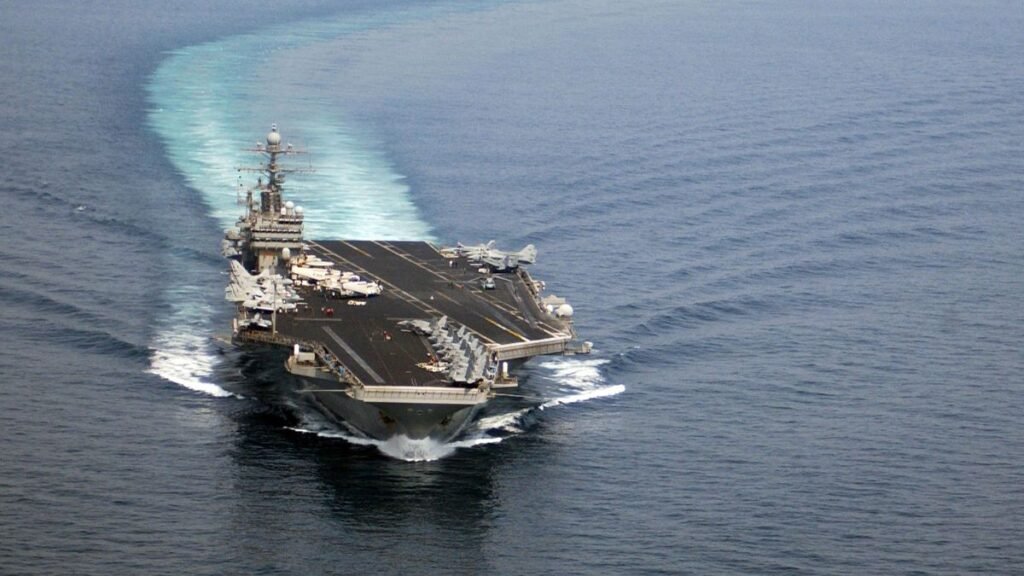
The aircraft carrier USS Theodore Roosevelt and a group of amphibious ships carrying Marines, about 9,000 troops in all, were sent from San Diego to the region late last month, the AP reported. A U.S. official said the deployment could bring the number of sailors and Marines in the region above 20,000, a level reached only a handful of times in two decades.
What happens after today
Trump has said he will not attack Iran before the election and has framed his choice as between a deal and finishing the war militarily. Vice President JD Vance has sent a letter to Iran’s security chief proposing direct talks, and Qatari mediators were in Tehran over the weekend. Iran has confirmed receiving the letter but had not publicly answered it as of Saturday.
Our explainer covers what a post-election strike could target and how Tehran says it would respond.
Sources
- The Associated Press: US warns allies to prepare for possible Iran strikes after elections
- Reuters via Military Times: US costs of Iran war rise to over $47 billion
- Military Times: CBO says Iran war depleted two-thirds of US missile interceptors
- Military Times: US aircraft lost or damaged in Iran war nearly doubles
- CBS News: Iran war updates, Oct. 30
- CBS News: Iran war live updates, Oct. 23
- Al Jazeera: Iran warns of unfettered retaliation if attacked
- CNBC: Trump says he’ll soon decide whether to make a deal with Iran
- Defense News: Trump’s Russian diesel deal benefits Moscow more than US consumers
- Al Jazeera: What we know of Vance’s letter to Rezaei
- U.S. Mission to Saudi Arabia: Security alert, Oct. 30, 2026
Photo: U.S. Navy (public domain), file photo.