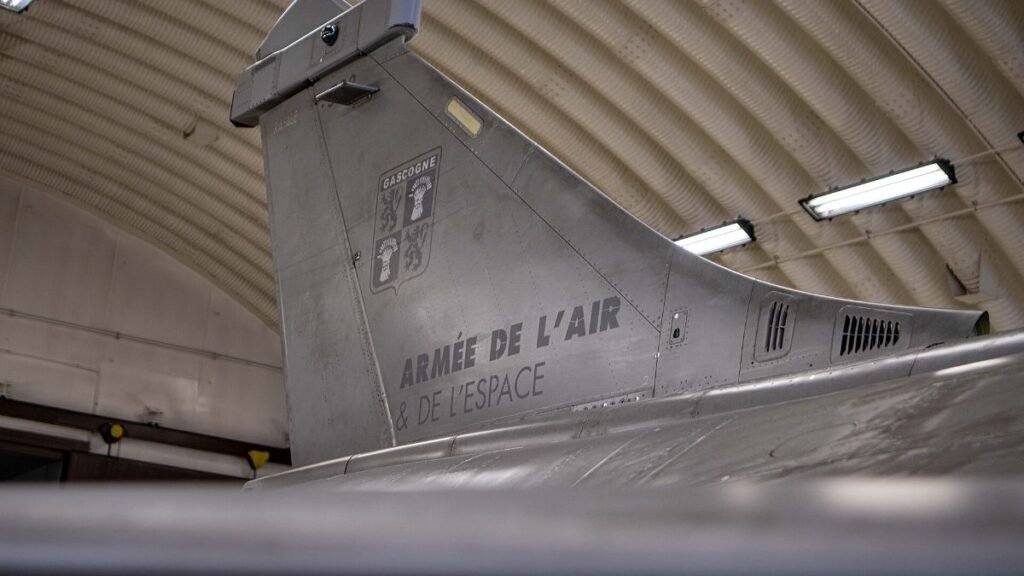
Ten European countries are now working with France on a plan that could see nuclear-capable French Rafale fighters deployed on allied soil, a sharp expansion of the only nuclear arsenal in the European Union. The three Baltic states, the NATO members most exposed to Russia, are not among them.
The project, which President Emmanuel Macron calls “forward deterrence,” also includes new links for secure communications, early warning and intelligence sharing between Paris and its partners, The Wall Street Journal reported on Oct. 26.
The 10 partners
The countries taking part, with different levels of involvement, are:
- United Kingdom
- Germany
- Poland
- Netherlands
- Belgium
- Greece
- Finland
- Norway
- Sweden
- Denmark
Italy declined to join, according to the Journal. Estonia, Latvia and Lithuania are not included.
The list has grown since March. When Macron announced the policy at the Ile Longue nuclear submarine base in Brittany, he said eight countries had agreed to take part, including Germany, Poland, Sweden and Britain.
What France is offering, and what it is not
Paris is not handing over any control. Every decision on nuclear use stays with the French president, and France still sits outside NATO’s Nuclear Planning Group, as it has since Charles de Gaulle built an independent force in the 1960s.
What partners get is a seat closer to the table. France has set up 10 separate steering groups, one with each partner, and holds talks one country at a time rather than as a club. Senior defense officials told the Journal that this hub-and-spoke setup has partner capitals calling each other to compare what Paris has told them.
Finland’s president, Alexander Stubb, said his country has no plans to host nuclear weapons in peacetime but wants to help create a strategic dilemma for Russia, and he expects the effort to take a decade or more. Norway’s foreign minister, Espen Barth Eide, described the French offer as a supplement to the U.S. nuclear umbrella, not a replacement.
In March, Macron also said France would resume producing nuclear warheads for the first time in decades and would stop disclosing the size of its stockpile. France is believed to hold about 290 operational warheads, a small fraction of the U.S. and Russian arsenals.
Where France draws its red line
French doctrine allows nuclear use only when the country’s “vital interests” are threatened, and Paris has never said exactly where those interests end. In his March speech, Macron said they have a European dimension and do not stop at France’s borders. He asked whether France could treat a threat to the survival of its closest partners as having nothing to do with its own vital interests.
That vagueness is on purpose. France has offered no explicit guarantee to any ally, the Journal noted, but the list of countries brought into the plan offers clues about where Paris sees its stake.
The debate is an old one. In 1961, de Gaulle asked President John F. Kennedy whether he would sacrifice New York to save Paris, and he received no answer. That silence became one of the main reasons France built a deterrent it alone controls.
Britain sits in a different place. Europe’s other nuclear power relies on American-made platforms for its deterrent and places it under NATO command, while France keeps its forces fully sovereign.
Why Rafales matter more than old bombs
Much of the case for the French plan rests on the weapon itself. The U.S. nuclear-sharing program in Europe is built around B61 gravity bombs that would be dropped from allied aircraft, with any use requiring approval from both Washington and the host country. France’s jets carry a nuclear cruise missile instead.
| U.S. nuclear sharing in NATO | French forward deterrence | |
|---|---|---|
| Weapon | B61 gravity bomb | ASMP-A air-launched cruise missile |
| Who decides on use | U.S. and the host nation together | French president alone |
| Aircraft | Allied fighters certified to carry the bomb | French Rafales, possibly based in partner countries |
| Part of NATO nuclear planning | Yes | No |
Military officials and analysts told the Journal that the ASMP-A is designed to reach major Russian cities and has a high chance of getting through, while the B61, first designed in the 1960s to stop Soviet tank columns, faces modern Russian air defenses. NATO itself says on its nuclear deterrence page that the independent forces of Britain and France contribute to the alliance’s overall security.
Paris has started putting the idea into practice. On Oct. 20-21, Royal Air Force Typhoons flew escort for French Rafales on a simulated nuclear-strike mission over the Mediterranean, the first time British jets took part in a French nuclear rehearsal. We reported on that exercise, code-named Rummy, last week.
The Le Pen question
The plan’s biggest risk may be French politics. Marine Le Pen’s far-right National Rally leads polls for next spring’s presidential election, and keeping nuclear control fully in French hands was partly meant to make forward deterrence acceptable to her party, according to the Journal. The National Rally has implicitly endorsed it.
Not everyone is convinced that would hold. Bruno Tertrais, deputy director of the Foundation for Strategic Research in Paris, told the Journal that a National Rally president would weaken both the deterrent message to Moscow and the reassurance to allies. A senior defense official from one partner country said the partnership would face fresh scrutiny if Le Pen won.
France has its own domestic strains. The government deployed 70,000 police for last weekend’s protests after some of the worst street violence in years.
How Washington and Moscow see it
Doubts about U.S. guarantees are not new in Europe, but they have grown as President Donald Trump has struck energy deals with Russia and pressed Ukraine, the Journal reported. Vipin Narang, an MIT professor who oversaw nuclear policy at the Pentagon under President Joe Biden, called the French plan better than nothing but not a substitute for U.S. extended deterrence.
The United States deliberately keeps its response to an attack on Europe vague, the Journal noted. Many European capitals have read that ambiguity as a sign that America’s big strategic forces exist mainly to protect the U.S. homeland, leaving the aging bombs in the NATO sharing program as Europe’s practical umbrella.
Nicole Grajewski, a Russia and nuclear affairs expert at Sciences Po in Paris, said it is unclear whether Moscow believes France would risk Paris to defend Warsaw, but that Russian officials are paying close attention. As she put it to the Journal: “The French nuclear arsenal, by contrast, can reach Russia.”
Sources
- The Wall Street Journal (via To Vima): France’s nuclear forces bring in neighbors to keep Russia in check
- South China Morning Post: Europe reacts to Macron’s offer to deploy atomic weapons to France’s allies
- NATO: Nuclear deterrence
Photo: Airman 1st Class Albert Morel/U.S. Air Force (public domain), file photo.