Iran’s floating stockpile of crude in Asian waters is gone. Analysts at ship-tracking firm Kpler told The Wall Street Journal that the reserves were fully depleted by mid-October, with the U.S. naval blockade keeping Iran from replacing the oil it sells to Chinese refineries. Accounts of the Journal’s report put the remaining volume below 1 million barrels by Oct. 5, down from nearly 90 million barrels as recently as this summer.
The Journal’s report, published late Oct. 21, describes the end of a cushion that let Tehran keep selling oil to China for months after the U.S. Navy shut Iran’s ports. For most of the war, dozens of tankers loaded with Iranian crude waited off Malaysia and Singapore, outside the reach of the blockade, and fed Chinese refineries. With no new barrels able to leave Iran to replace them, the floating reserve drained away.
“There’s no more oil to discharge to China anymore,” Homayoun Falakshahi, Kpler’s head of crude oil analysis, told the Journal.
What the tanker-tracking data shows
Tracking Iranian oil has always been imprecise. Shadow-fleet tankers often switch off their transponders, swap cargoes at sea and sail under shifting names and flags. The two major tracking firms cited by the Journal don’t fully agree on the final number, but they agree on the direction.
The figures below are as reported in coverage of the Journal’s story. Tracking firms’ estimates of Iran’s floating storage vary, and some outlets have reported different interim numbers.
| Date | Iranian crude in floating storage | Source cited by WSJ |
|---|---|---|
| Late February 2026 (war begins) | About 135 million barrels stored overseas | Estimate cited by WSJ |
| Mid-June to mid-July 2026 (blockade paused) | Rebuilt to nearly 90 million barrels in Asian waters | Kpler |
| Oct. 5, 2026 | Below 1 million barrels | Kpler |
| Oct. 9, 2026 | About 6 million barrels near Singapore | Vortexa |
| Mid-October 2026 | Fully depleted | Kpler |
The gap between Kpler’s figure and Vortexa’s roughly 6 million barrels near Singapore shows how hard it is to count oil that is built to be hidden. Even the higher number, though, is a sliver of what Iran had parked at sea when the fighting started.
Why the stockpile held out so long
The floating reserve explains why Iranian oil kept reaching Chinese buyers well after the blockade began. Tankers already east of the Strait of Hormuz were never inside the zone the Navy was patrolling. They could keep discharging cargoes to refiners in China while the ships waiting at Iran’s own terminals sat idle.
Kpler’s data, as described by the Journal, shows two phases of drawdown. Sales out of storage continued through the first blockade in the spring. When the blockade was suspended in June during negotiations, Iran shipped fresh crude out and refilled its Asian reserve. Once the blockade returned in mid-July, nothing could replace what was sold, and the stock fell steadily until it ran out.
How the U.S. blockade works
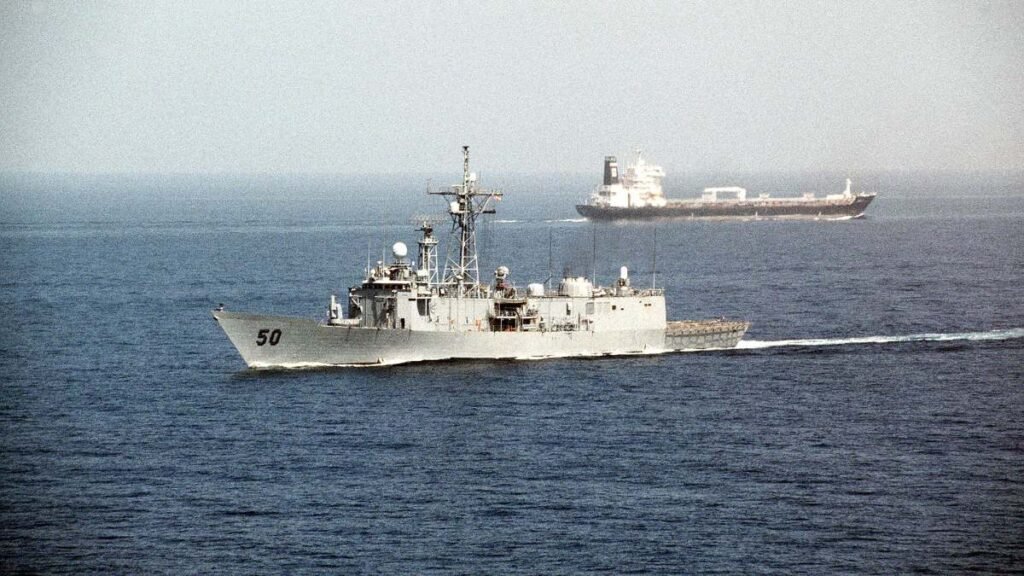
U.S. Central Command announced the blockade on April 12, saying it would start at 10 a.m. Eastern time the next day and cover all shipping into and out of Iranian ports on both the Persian Gulf and the Gulf of Oman. In its public release, CENTCOM said the operation “will be enforced impartially against vessels of all nations” and “will not impede freedom of navigation for vessels transiting the Strait of Hormuz” to and from other countries’ ports.
That distinction matters. The blockade is aimed at Iran’s ports, not at the strait itself, which Iran effectively closed to most traffic after the U.S. and Israel struck the country on Feb. 28. U.S. warships have been escorting merchant ships through Hormuz while stopping anything bound to or from an Iranian terminal.
The blockade has not run continuously. It was suspended in June while the two sides negotiated and reimposed in mid-July after that track collapsed. On July 8, CBS News reported, President Donald Trump told reporters, “We may put down the blockade, we may put it back, the blockade, and it’ll only be a blockade for Iran.” CBS also reported that the White House and the military counted more than 140 ships interdicted before the blockade was lifted in mid-June.
CENTCOM puts the cost to Iran at $25 billion
Adm. Brad Cooper, the CENTCOM commander, said in a video released Oct. 16 that the blockade has kept Iran from exporting about $25 billion worth of oil, The Times of Israel reported. Cooper also said the U.S. had helped freeze $350 million in Iranian cryptocurrency, that U.S. forces had helped 400 merchant vessels through Hormuz in the previous week and that more than 1 billion barrels of oil had been moved out of the region since the war began.
“The Strait of Hormuz is controlled by the United States and our regional partners, not Iran,” Cooper said, according to the Times of Israel’s live coverage. The $25 billion figure is CENTCOM’s own estimate and has not been independently verified.
Treasury keeps sanctioning the shadow fleet
The Navy stops the ships. The Treasury Department goes after the companies, lawyers and agents behind them.
On Oct. 21, Treasury’s Office of Foreign Assets Control sanctioned four entities, five individuals and nine vessels it tied to Iran’s shadow fleet. The biggest target was Karnakis and Karnakis, a law firm with offices in Panama and Greece, along with five people linked to it. Treasury also designated Roxette Maritime Shipping and Trading S.A., which it said manages seven cargo ships, as well as Singapore-based shipping agent Amigoz Singapore Pte. Ltd. and Dubai-based Whales Shipping Line LLC, whose two small support vessels were identified as blocked property.
The State Department said the law firm helped “set up shell companies to hide the true owners of vessels carrying Iranian oil,” and said proceeds from those sales benefited the Islamic Revolutionary Guard Corps-Qods Force and the Houthis.
Treasury Secretary Scott Bessent warned that “if you are supporting the Iranian regime, we will find you and sanction you.” He added: “Iran’s facilitators must make a choice: Either you are with us or against us.”
The Oct. 21 action followed an Oct. 8 round that targeted 17 shadow-fleet vessels and 17 companies. Treasury titled that release “Operation Economic Outcast Neutralizes Iranian Regime’s Remaining Shadow Fleet Network.” In it, Bessent said, “Treasury is starving the tyrannical regime in Tehran of the money it uses to wage war in the region.”
Both actions fall under Operation Economic Outcast, the Treasury-led campaign Bessent announced Aug. 24 at Trump’s direction. The White House said it targets Iran’s digital-asset dealings, technology, precious metals, air travel and maritime transport. “Our objective is to sever every economic lifeline that sustains this tyrannical regime until Tehran stands alone,” Bessent said at the time.
What it means for Iran’s budget and its China trade
Chinese refineries have been the main customers for the oil Iran stored at sea, with cargoes often moved ship to ship in waters off Malaysia and Singapore before delivery, according to the Journal. With that supply gone, the paper reported, independent Chinese refiners are turning to crude from Brazil and West Africa.
The financial hit lands on a government that depends on oil. Kpler’s Falakshahi told the Journal that oil revenue makes up roughly 30% to 40% of the Iranian government’s budget. The Journal also reported that the rial has lost about a third of its value against the dollar since early July.
Tehran disputes the picture of collapse. Central bank Governor Abdolnaser Hemmati rejected claims last week that the economy is near breaking point and said it had shown resilience, according to the Journal.
No fresh cargoes leaving Iran’s terminals
The floating stockpile ran down because nothing new could get out. Bloomberg reported Oct. 19 that no tankers had berthed to load crude at the main terminals on Kharg Island, Iran’s primary export hub, since late August, and that no loadings had been seen at the Jask terminal on the Gulf of Oman, according to the Journal’s account of that reporting.
Gulf attacks keep oil prices high
Iran’s shrinking exports haven’t brought relief at the pump, because the wider war keeps squeezing supply. Brent crude briefly topped $111 a barrel on Oct. 20 for the first time since May before easing to $110.30, ABC News reported. U.S. benchmark West Texas Intermediate stood at $105.75, and AAA put the national average for gasoline at $4.27 a gallon, nearly $1.30 above where it was in late February.
Shipping through the strait remains dangerous. In the same Oct. 16 video, Cooper said more than 20 civilian mariners have been killed in Iranian attacks on commercial shipping since February, The Times of Israel reported. He also pointed to reports that Iran-aligned militias across the region are withholding pay from their fighters to send money back to the IRGC, which he cited as a sign the regime is short of cash.
The Treasury actions this month go after the next layer of that trade: the agents, ship managers and lawyers who keep sanctioned tankers registered and moving. Bessent’s message to them in the Oct. 21 release was blunt. “We know who you are, we know what you’re doing, and we will continue to take action,” he said.
Official links
- U.S. Treasury: Operation Economic Outcast targets Iran’s shadow fleet networks (Oct. 21, 2026)
- U.S. Treasury: Sanctions on Iran’s remaining shadow fleet network (Oct. 8, 2026)
- OFAC press releases
- U.S. Central Command: U.S. to blockade ships entering or exiting Iranian ports
- U.S. State Department: Service providers facilitating Iran’s shadow fleet
- The White House: Operation Economic Outcast
- U.S. Energy Information Administration: Iran country analysis
Photo: U.S. Department of Defense.